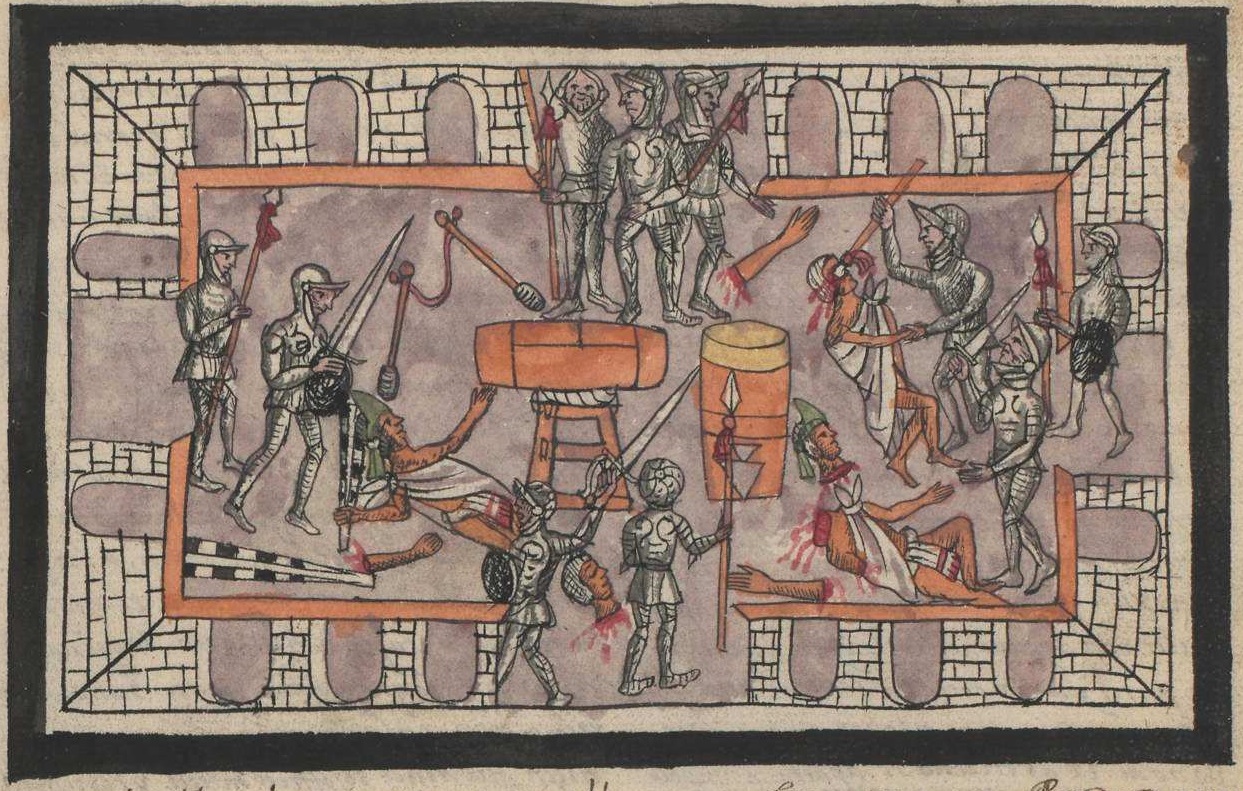
Massacre in the Great Temple of Tenochtitlan
They were dancing when the killing started. On May 22, 1520, hundreds of Mexica nobles, warriors, and priests had gathered in the sacred courtyard of the Great Temple of Tenochtitlan to celebrate Toxcatl, the annual feast honoring Tezcatlipoca. They had asked permission from the Spanish commander Pedro de Alvarado, and he had granted it on the condition that no one carry weapons and no sacrifices take place. The celebrants came adorned in precious stones, pearls, gold and silver jewelry, and elaborate feathered headdresses. They were unarmed. What happened next became one of the defining atrocities of the Spanish conquest.
The Feast of Toxcatl
Hernan Cortes had left Tenochtitlan weeks earlier to confront Panfilo de Narvaez, a rival Spanish commander sent by the Governor of Cuba to arrest him. In his absence, Cortes entrusted the city to Pedro de Alvarado with eighty soldiers. The Mexica festival of Toxcatl honored the god Tezcatlipoca at the onset of the dry season, a prayer for rain to fall on crops and water to fill streambeds. More than 600 nobles and lords gathered in the temple courtyard - some accounts say more than a thousand. Spanish historian Francisco Lopez de Gomara recorded that they played drums, shells, and bugles, performing the sacred dance called mazeualiztli. The songs were devotional, praising their god and asking for water, grain, healthy children, and victory. The celebrants danced in circles, holding hands, responding in song to the musicians. It was the most important religious gathering of the Mexica calendar.
The Gates Close
Alvarado stationed ten to twelve soldiers at each of the courtyard's exits: the Gate of the Eagle, the Gate of the Canestalk, the Gate of the Snake of Mirrors. Then he entered with more than fifty armed Spaniards. The Mexica account, preserved in the Florentine Codex and later published in Visión de los Vencidos (The Broken Spears), describes what followed in harrowing detail. The soldiers surrounded the dancers and rushed the drummers first, cutting off the arms and then the head of the man playing the drum. Then they turned on everyone else - stabbing, spearing, slashing. People fell with their entrails spilling onto the stones. Some tried to flee but found every gate blocked. Others climbed the walls. Others hid among the dead, lying still until they were discovered and killed. The blood, the Mexica account says, ran like water across the courtyard, forming widening pools. The smell of blood and death fouled the air.
Two Accounts, One Atrocity
The Spanish and Mexica sources agree on the basic facts but diverge on motive. Gomara's account acknowledges multiple theories: that Alvarado feared a planned rebellion, that the Spaniards wanted the gold the dancers were wearing, that the attack was meant to prevent an uprising. Gomara himself wrote that the Spaniards acted "without remorse and lacking any Christian piety." The Mexica account, compiled by Friar Bernardino de Sahagun in the Florentine Codex, offers no such ambiguity - the Spaniards came to kill people who were celebrating a festival. What both accounts make clear is that the victims were unarmed, had received permission to gather, and were engaged in worship when they were attacked. Whether Alvarado acted out of paranoia, greed, or preemptive military calculation, the result was the same: the slaughter of hundreds of people in a sacred space during a religious ceremony.
The Aftermath That Changed Everything
When word of the massacre reached the streets outside, the cry went up: "Captains, Mexicas, come here quickly! Our captains have been murdered! Our warriors have been slain!" The Mexica counterattack was immediate and ferocious, driving the Spanish back into the Palace of Axayacatl. Cortes returned to the city in late June 1520 and ordered the captive Moctezuma to plead for peace. Moctezuma was killed shortly after - historians remain uncertain whether the Spanish strangled him or his own people stoned him for cooperating with the invaders. His brother Cuitlahuac became emperor and led the revolt. The Spanish attempted to sneak out of Tenochtitlan during a rainstorm, but the Mexica caught them on the causeways. Over 800 Spanish soldiers and 2,000 Tlaxcalan allies died, many drowning in Lake Texcoco weighed down by stolen gold. This night became known as La Noche Triste - the Night of Sorrows. The massacre in the Great Temple had transformed an uneasy occupation into open war, setting the stage for the siege and destruction of Tenochtitlan the following year.
From the Air
Located at 19.435°N, 99.131°W - the site of the Great Temple (Templo Mayor) is in the historic center of Mexico City, just northeast of the Metropolitan Cathedral on the Zocalo. The excavated ruins of the Templo Mayor are visible from low altitude as an open archaeological site amid dense urban blocks. The courtyard where the massacre occurred would have been within this temple complex. Nearest major airport is Mexico City International (MMMX/MEX). From altitude, the Zocalo - one of the largest public squares in the world - provides a clear landmark, with the cathedral and excavation site on its north side.