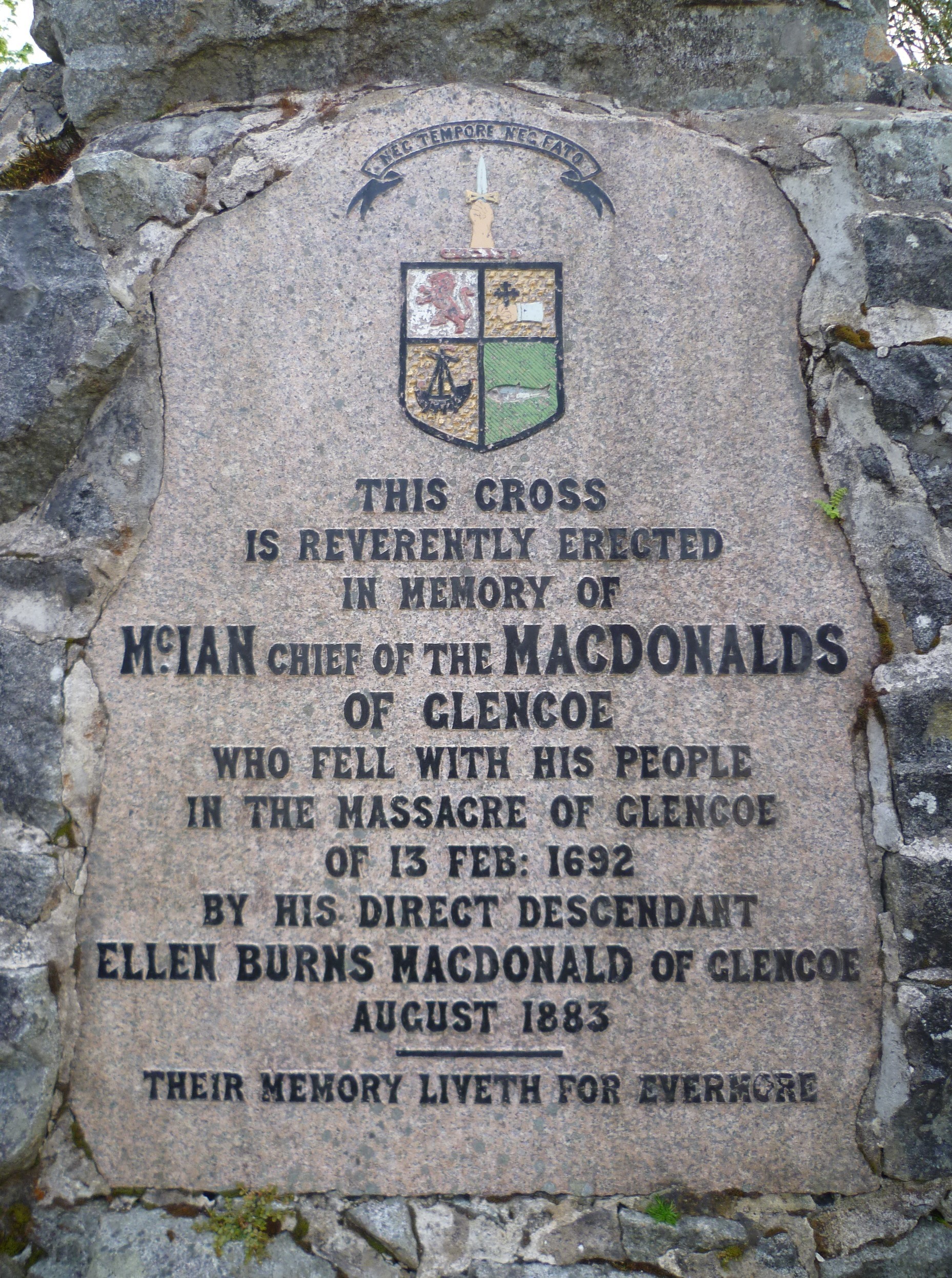
Massacre of Glencoe Monument
Every year, on or near 13 February, people gather at the foot of an eighteen-foot granite Celtic cross in Upper Carnoch to lay wreaths for the dead. The ceremony has the quiet formality of a church service and the weight of 330 years of memory. The monument they encircle was sculpted by Alexander Macdonald and Co. of Aberdeen in 1883 -- nearly two centuries after the event it commemorates -- yet it feels less like a historical marker than an open wound kept deliberately visible.
Stone Raised by a Name That Remembered
The cross was commissioned by a Macdonald -- the surname itself a statement of intent. By 1883, the Highlands had endured clearances, famine, and a systematic dismantling of clan culture, yet the memory of what happened on 13 February 1692 had not dimmed. Thirty-eight men of Clan MacDonald of Glencoe were killed that morning by government soldiers who had been their guests for two weeks; an unknown further number died of exposure fleeing into the mountains. The monument's design draws on the elaborate Gosforth Cross, a tenth-century Viking-age monument in Cumbria, giving the memorial a visual lineage that reaches back through centuries of stone-carving tradition. It rises from a rugged cairn above the river, tapering skyward from a base of rough-hewn rock. The choice of dark granite was deliberate: it weathers the Highland rain without losing its edges, a material as stubborn as the memory it carries.
The Wreath and the Glen
The annual wreath-laying ceremony is not a grand state occasion. It is a local observance, attended by descendants and sympathizers, conducted in the shadow of mountains that have not changed since the morning the soldiers turned on their hosts. The glen itself serves as the monument's context: the U-shaped glacial valley, less than 700 meters wide, the same river, the same flanking peaks. Upper Carnoch, where the cross stands, was part of the settlement where the MacDonalds lived. The proximity of memorial to massacre site gives the monument a quality that more distant memorials lack -- the dead did not fall in some faraway campaign. They fell here, within sight of where the granite now stands. The cross is Category C listed, a heritage designation that protects it from alteration, and it remains in the care of those who believe that some things should not be allowed to fade from view, no matter how many centuries intervene.
From the Air
Massacre of Glencoe Monument at 56.6824N, 5.0951W stands as a tall Celtic cross in Upper Carnoch, Glencoe village. It is small and may not be individually visible from altitude, but is located near the river in the lower glen. The village of Glencoe and the A82 road provide orientation. Best viewed at 1,500-2,500 ft. Nearest airport: Oban (EGEO) approximately 25 nm southwest.