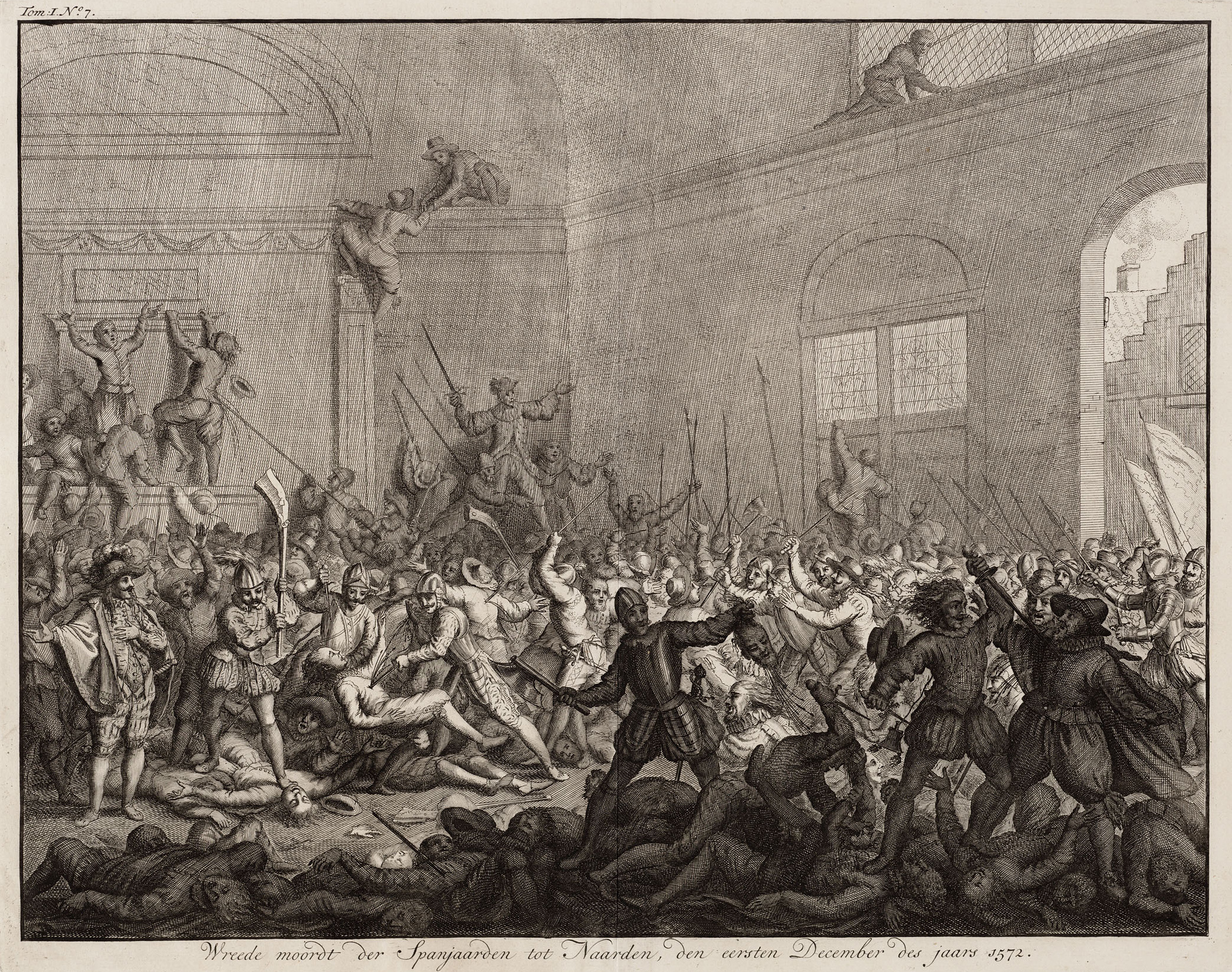
Massacre of Naarden
Naarden was a small Dutch fortified town of perhaps three thousand people — fishermen and merchants, weavers and brewers, a community small enough that everyone knew whose children went to which school. By the morning of 2 December 1572 — the day after the massacre — only about sixty of them were still alive. The killing took less than a day. What survived was a story so terrible that the Spanish themselves carried it across the Low Countries, expecting it to terrify the Dutch into submission. It had the opposite effect. The destruction of Naarden became one of the founding wounds of a new nation.
An Army That Lived on Loot
The Eighty Years' War had begun six years earlier — a long, ugly war of religion, taxation, and Habsburg overreach in the Low Countries. By 1572 the war was being fought with terrifying methods on the Spanish side. The Duke of Alba, the elder Fadrique Álvarez de Toledo's father, sent his son's army into the rebel provinces with an order that has chilled historians ever since: capture a list of Dutch towns, and make examples of them. The soldiers were poorly and irregularly paid. The army was meant to feed itself on the looting of the very towns it was supposedly disciplining. On 2 October 1572 the Spanish sacked Mechelen, looting for three days and killing hundreds of townspeople; women and girls were raped in front of their families, men tortured and murdered. *Not a nail was left in the wall*, Don Fadrique reported to Madrid. On 14 November the same fate fell on Zutphen. The news travelled. Naarden heard it.
A Surrender That Was a Trap
The town was not built for siege warfare. A delegation of Naarden's leading citizens went out and met the Spanish commander Julián Romero, hoping to spare their families through honourable surrender. They agreed terms that should have been merciful: a small Spanish garrison would be admitted, supplies would be handed over, every citizen would swear a new oath of loyalty to King Philip. On 22 November the army marched in — not the small garrison promised, but the entire force. The townspeople were told to assemble. They were herded into the town's church and into the guildhall — the two largest interior spaces Naarden possessed, the buildings where, in normal times, the community gathered for worship and for civic business. The doors were closed. The Spanish set fire to the buildings. They began at the same time to sack the town.
The Names We Do Not Have
Several hundred people burned to death in the church and guildhall. Several hundred more were killed in the square outside or in their own kitchens and bedrooms as the soldiers worked through the streets. Of more than three thousand inhabitants, only about sixty survived. Don Fadrique wrote later to King Philip a single sentence that has become infamous: *Not a man born escaped*. We do not have the names of most of the dead — the parish registers burned with the parishioners. The historical record gives us the cold arithmetic: roughly 750 killed, a town of three thousand annihilated. But every one of those numbers was a person who had been planning Christmas, owed money to a neighbour, was teaching a child to read. Several days later, Spanish soldiers conscripted peasants from nearby Gooiland and forced them to demolish the buildings that had not already been burned. The wells were poisoned. Naarden was meant to be erased.
The Spark That Lit a War
Don Fadrique's strategy was based on a simple calculation: terror produces obedience. He was wrong. The story of Naarden spread across the Netherlands faster than any Spanish edict could chase it — often, ironically, carried by the boasting Spanish soldiers themselves. The destruction of the small fortress town became a rallying symbol of Dutch resistance. *Remember Naarden* became the answer when anyone counselled compromise. The Eighty Years' War continued for another seventy-six years; Philip would not live to see its end, nor would Don Fadrique, nor would the children of any survivor. Naarden itself was rebuilt slowly through the late sixteenth and seventeenth centuries, and in time it became one of the most spectacularly fortified small towns in Europe — a star fortress whose green ramparts you can still walk today, laid out as much as a memorial as a defence. The dead never had headstones. The town became their headstone. The country they had not lived to see called itself, in part, into existence to honour them.
From the Air
Naarden sits at 52.30°N, 5.16°E, on the south shore of what was once the Zuiderzee and is now the IJmeer. From altitude the town reads as one of the clearest preserved star-fortress patterns in Europe — a near-perfect twelve-pointed bastion-and-moat geometry surrounding the medieval core, built after the massacre to ensure no army could ever take Naarden by surprise again. Amsterdam lies 15 km west across the IJmeer; nearest airfield is Hilversum (EHHV) just south, with Schiphol (EHAM) to the southwest.