Massacre of Thessalonica
The chariots would have been ready when the soldiers came. Thousands of citizens of Thessalonica, families with children, traders and farmers from the surrounding country, slaves seated in the upper tiers, had gathered in the hippodrome on a spring afternoon in 390. They had come for the races. According to one description preserved in The Cambridge Ancient History, the slaughter took roughly three hours, and seven thousand men, women, and children were killed when Emperor Theodosius I's Gothic troops were let loose inside the stadium. The contemporaneous accounts that might have told us exactly what happened do not survive. What survives are the angry letters of Bishop Ambrose of Milan, the disputed numbers from later church historians, and the stones of the hippodrome itself, buried now beneath a square in modern Thessaloniki.
What We Cannot Quite Know
Modern historians have struggled to reconstruct what happened. There are no contemporaneous accounts of the massacre. The earliest surviving descriptions come from fifth-century church historians, Sozomen, Theodoret, and Cassiodorus, writing decades later, and they contradict one another in important ways. Pagan historians of the period do not mention the massacre at all. Most scholars accept that something terrible happened, that the people of Thessalonica were assembled in the hippodrome and were attacked by imperial troops, and that the death toll was substantial. The figure of seven thousand comes from a single source. The exact date, the precise sequence, the level of imperial responsibility, all remain debated. What is clear is that this was an act of state violence against an unarmed population gathered for entertainment.
Butheric and the Charioteer
The trigger was a riot earlier the same year. Butheric, a Roman general of Gothic origin who served as magister militum in command of the Illyrican forces stationed at Thessalonica, had detained a popular charioteer. According to Sozomen (the only source for this detail), Butheric had the charioteer arrested for the alleged sexual abuse of a young man and refused popular demands for his release. A crowd at the circus turned, and Butheric was killed by the mob. He held a senior military command, and his death was a direct insult to imperial authority. What followed was not, most modern historians now think, a fit of imperial rage. The historian Mark Hebblewhite argues that at least three months elapsed between Butheric's death and the massacre. The emperor would have consulted his ministers, weighed responses, made a calculated decision.
The Day in the Hippodrome
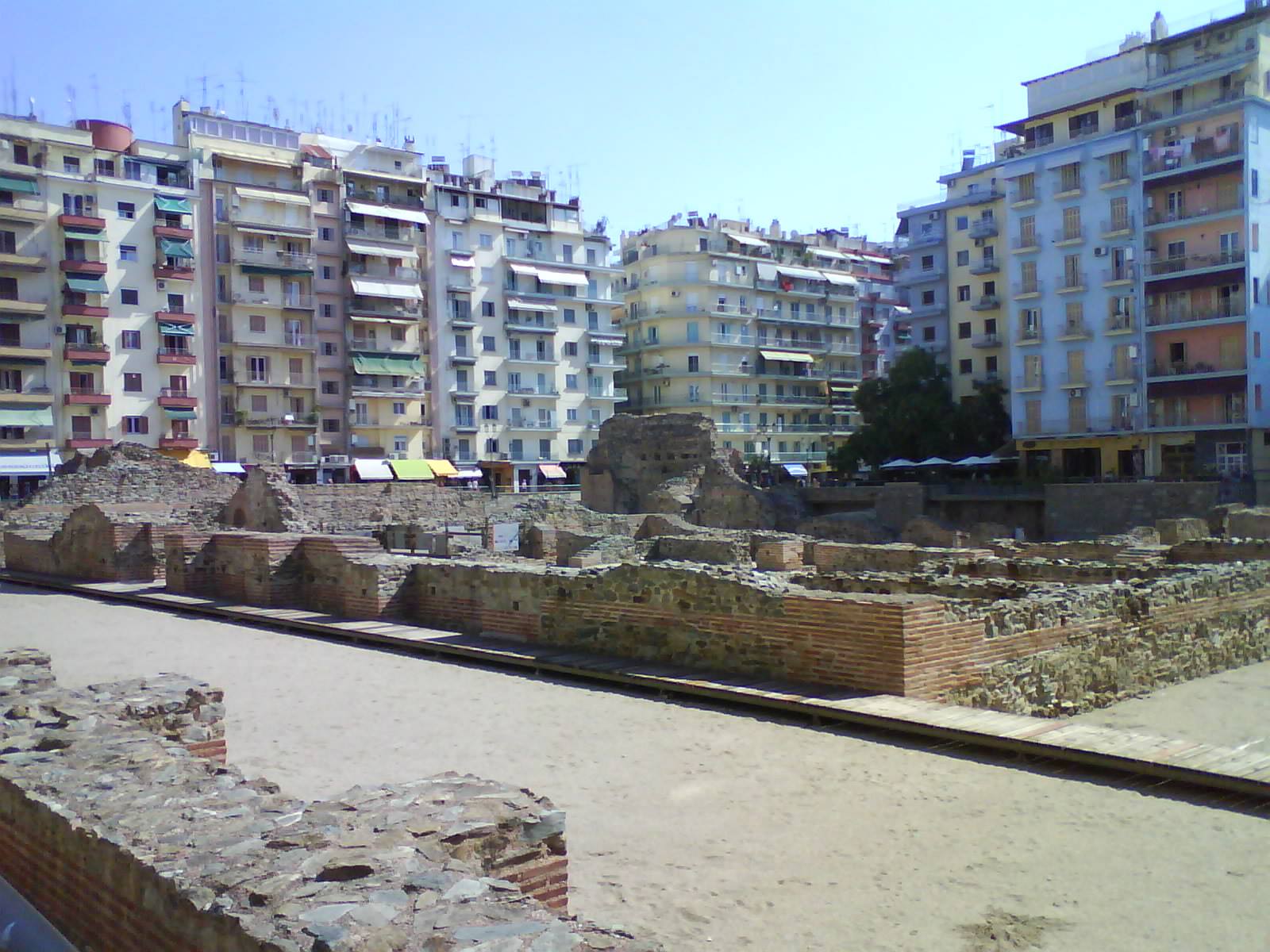
The horror of what happened lies in its setting. People had gathered in the hippodrome for the races, the public entertainment that anchored civic life in late Roman cities. They were not soldiers. They had not taken up arms. Many of them likely had no involvement in the riot that killed Butheric, since Roman cities were large and the rioters were a particular crowd of partisans. The imperial troops, mostly Gothic foederati under Theodosius's command, were ordered to attack. The killing was indiscriminate: men, women, children, slaves and free, gathered for an afternoon at the races. Three hours of slaughter inside walls designed to hold spectators. The Palace of Galerius, whose ruins still stand in Navarinou Square in modern Thessaloniki, was nearby. The hippodrome itself lay just beside it. Today office buildings cover the site. People walk over the ground where this happened without knowing they do.
Ambrose Writes a Letter
When word reached Milan, Bishop Ambrose was not at court. He had to learn of the events through informants. He was one of many advisors to the emperor, not a member of Theodosius's closest council. He had no formal authority to discipline an emperor. What he had was a pastoral office and the willingness to use it. He wrote Theodosius a letter, his Epistola 51, telling the emperor that he must demonstrate repentance and that he would be forbidden from receiving the Eucharist until he did so. According to the traditional account, Theodosius accepted the discipline, performed eight months of public penance, and was readmitted to communion on Christmas Day, 390. The story has been retold for sixteen hundred years as a defining moment of the church standing up to the state, and as the model for centuries of later church-state argument. Some recent scholars are more cautious. The historian Neil McLynn called the famous encounter at the church door 'a pious fiction.' The historian Alan Cameron has argued there is no evidence Ambrose held special influence over Theodosius. What is documented is the letter, the eight months, and the reconciliation.
What Was Lost, What Remained
Whatever the precise number, thousands of people died in three hours in a stadium where they had come to watch horses run. They were Thessalonians: the city had a population of over 100,000 in the late Roman period, drawn from the surrounding region of Macedonia, with Greek, Roman, Jewish, and other communities living in close proximity. The names of the victims are lost. The hippodrome itself eventually fell out of use; later construction covered it over, and it now lies beneath the urban fabric of modern Thessaloniki, with portions visible in Navarinou Square near the surviving columns of Galerius's palace. Ambrose became a saint and a doctor of the church. Theodosius was the last emperor to rule both halves of the Roman Empire, and his statue still stands in obelisks across the former empire. The 7,000, who came for the races, are remembered by their absence.
From the Air
Located at 40.6333 degrees N, 22.95 degrees E in modern Thessaloniki, the second-largest city of Greece. From above, look for Navarinou Square in the city center, near the surviving columns of the Palace of Galerius and the Rotunda. Thessaloniki Macedonia International Airport (LGTS) lies about 8nm southeast of the city center, on the Thermaic Gulf. The hippodrome itself is no longer visible above ground.