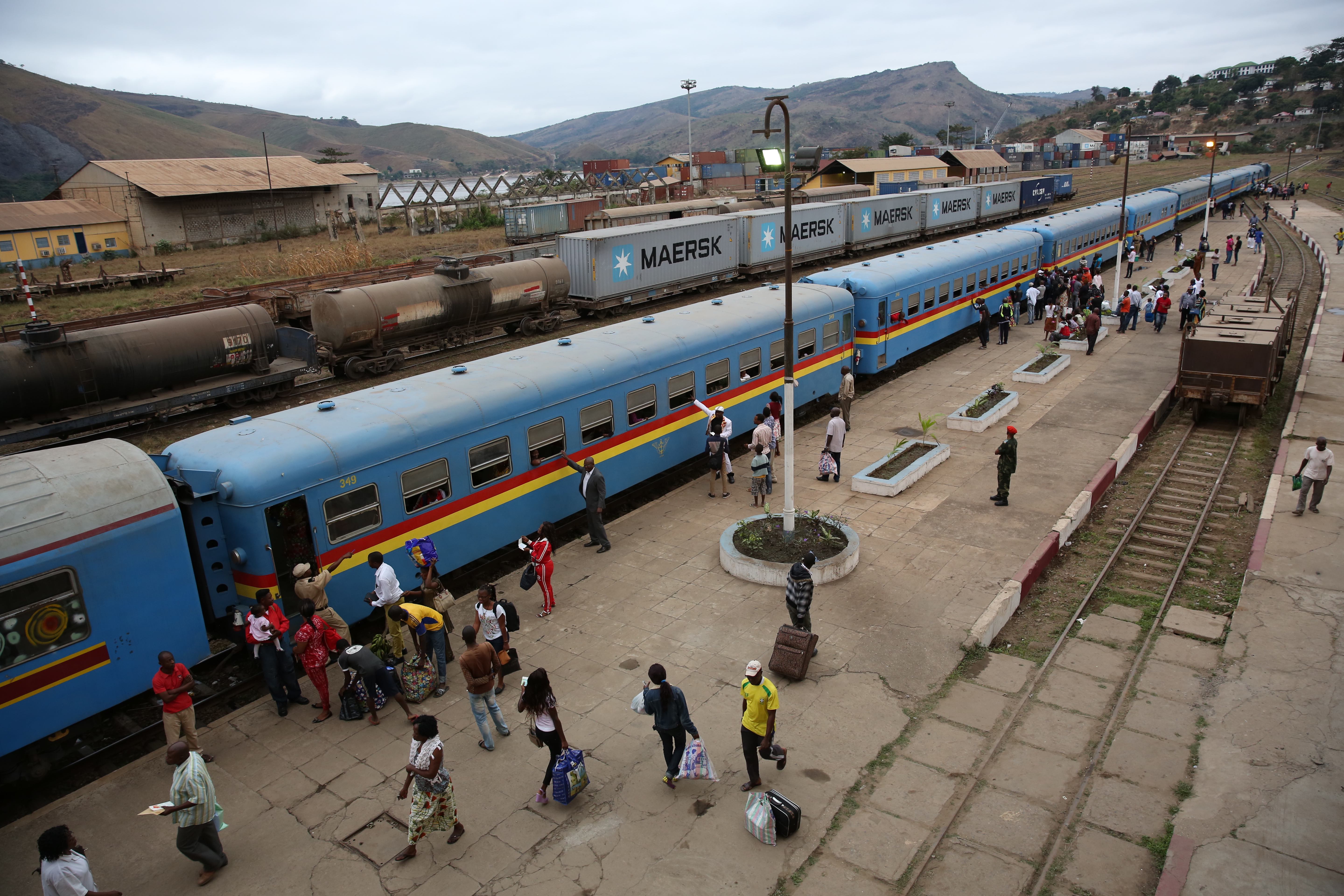
Matadi-Kinshasa Railway
Joseph Conrad saw the railway being built. He was working as a steamboat captain on the Congo River in 1890 when construction had just begun, and the horrors he witnessed along the route -- the forced laborers, the chain gangs, the bodies -- found their way into Heart of Darkness. The Matadi-Kinshasa Railway, a 366-kilometer line connecting the Congo's principal Atlantic port to its capital, was designed to solve a geographical problem: the Livingstone Falls, a series of rapids and cataracts that made the Congo River unnavigable for 300 kilometers between those two cities. The solution was an engineering achievement. Its human cost was staggering.
Three Hundred Kilometers of Impassable Water
The problem was brutally simple. The Congo River was the highway into central Africa's vast interior, but between Matadi on the coast and Leopoldville -- now Kinshasa -- inland, the river dropped through the Livingstone Falls in an unbroken chain of rapids stretching 300 kilometers. Before the railway, all goods moving between the coast and the interior had to be carried by human porters along jungle paths. The portage was slow, expensive, and frequently fatal. For Leopold II's Congo Free State, which depended on exporting ivory and rubber, this bottleneck was intolerable. In 1887, the Compagnie du Congo pour le Commerce et l'Industrie was incorporated, and on the same day its subsidiary, the Compagnie du Chemin de Fer du Congo, was created to build the railway. Albert Thys, the Belgian officer who directed the work, would eventually give his name to one of the stations -- Thysville, now Mbanza-Ngungu.
The Workers Who Paid the Price
The official death toll for the railway's construction was 1,932 people -- 1,800 Africans and 132 Europeans. The real number was almost certainly far higher. At its peak, up to 60,000 laborers worked on the project. In 1892, about two thousand people worked the line at any given time, and an average of 150 died each month from smallpox, dysentery, beriberi, and sheer exhaustion. By the end of that year, 7,000 workers had been recruited; 3,500 had either died or fled into the surrounding forests. The terrible conditions made recruitment nearly impossible. Thys brought in workers from Barbados and from China. The Barbadians refused to disembark at Matadi -- they had to be forced off the ships at gunpoint, and seven people died in that action alone. Decades later, when the line was rebuilt to a wider gauge between 1923 and 1931, the pattern repeated. Tens of thousands of convicts and forced laborers were put to work on the renovation. Seven thousand more lost their lives.
Gorges, Canyons, and the Monts de Cristal
The terrain itself was a formidable adversary. The route had to climb from Matadi at sea level to Mbanza-Ngungu at 604 meters elevation, threading through the gorges of the Congo River, the canyon of the M'pozo River, and a passage along the Monts de Cristal. Medical and sanitary facilities were grossly insufficient for the scale of the operation. The railway was originally built to a narrow gauge, but because local labor struggled with the technical requirement of widening gauge on curves, the entire line was constructed slightly narrower than planned. It operated a fleet of small tank locomotives and eventually 32 Garratt articulated engines before turning to larger 2-8-2 locomotives. Despite everything, the line was completed in 1898 and proved immediately profitable -- primarily from transporting the ivory and rubber that Leopold's forced-labor system extracted from the interior.
Collapse and Revival
The railway and the port of Matadi remained the capital's primary connection to the outside world for over a century. But by the early 2000s, rolling stock had deteriorated to the point of danger. A 2003 derailment killed eleven people, and the line fell into complete disuse for over a decade. It reopened in September 2015, offering one passenger trip per week. Services between Kasangulu and Kinshasa resumed in 2019, only for traffic to be suspended again in 2020. The line restarted on September 5, 2025, and in a poignant twist, the trains now running on weekends are Kiha 183 series diesel cars transferred from JR Hokkaido in Japan -- modern rolling stock operating on a route whose construction claimed thousands of lives. Angola has proposed linking its own rail network to the Matadi-Kinshasa line via the Matadi Bridge, which could eventually connect Kinshasa to the Cabinda enclave and beyond.
Conrad's Ghost on the Line
The railway can be classified as a portage railway -- a line built specifically to bypass an unnavigable stretch of waterway. In that narrow technical sense, it succeeded. Goods that once required weeks of portering through lethal jungle could be moved in hours. But what the railway carried, and what it cost, places it among the darkest chapters of colonial infrastructure. The ivory and rubber that filled its freight cars were the products of a system that reduced entire populations to servitude. The workers who laid its tracks were recruited under duress, transported against their will, and worked until they sickened and died. Conrad's Heart of Darkness remains the most famous artistic response to what he saw here, but the railway itself is the more enduring testimony -- 366 kilometers of steel and gravel that still trace a path through the gorges where so many Congolese, Barbadian, and Chinese laborers perished.
From the Air
The Matadi-Kinshasa Railway runs 366 km through Kongo Central Province in the DRC, approximately following the course of the Congo River between Matadi (5.82S, 13.49E) at the coast and Kinshasa (4.32S, 15.31E) inland. From altitude, the route is visible as it threads through the rugged terrain of the Crystal Mountains and along the gorges of the Congo and M'pozo Rivers. The Livingstone Falls -- the rapids the railway was built to bypass -- are visible as white water along the Congo River. Key stations include Matadi (1 m elevation), Mbanza-Ngungu (604 m), and Kinshasa (177 m). Nearest major airport: N'Djili International Airport, Kinshasa (FZAA). Matadi Bridge is visible near the western terminus.