Mateus Palace
Millions of people have seen Mateus Palace without ever setting foot in Portugal. Since the mid-20th century, its distinctive baroque facade has graced the label of Mateus rose, one of the best-selling wines on the planet. But the palace itself, tucked into the countryside near Vila Real in northern Portugal's Douro region, is far more than a marketing image. Built in the first half of the 18th century with the involvement of Italian-born architect Nicolau Nasoni, the Casa de Mateus stands as one of the finest examples of baroque civil architecture in the country, a place where symmetry, stone, water, and garden conspire to produce something genuinely theatrical.
Nasoni's Grand Stage
The palace was constructed between approximately 1739 and 1743, commissioned by Antonio Jose Botelho Mourao, the 3rd Morgado of Mateus, who replaced an earlier family house that had stood on the same site since the early 1600s. Nicolau Nasoni, the Tuscan-born architect who also designed Porto's iconic Clerigos Tower, brought his flair for dramatic baroque composition to the project. The result is a facade that operates like a piece of theater: a double stairway with balustrade leads the eye upward to the family coat of arms, flanked by two allegorical statues. The palace follows a rectangular plan open to the west, with wings that embrace a U-shaped courtyard closed off by a balustrade. Between the entrance and the courtyard, an ornamental pond surrounded by trees serves as a mirror, doubling the facade in still water.
Chestnut, Canvas, and Cedar
Step inside and the baroque ambition continues. The interior features intricately carved chestnut wood ceilings that required the skill of woodworkers who understood the grain of northern Portuguese timber. Furniture from several periods fills the rooms, alongside 17th- and 18th-century paintings that trace shifting tastes across two hundred years of aristocratic collecting. The palace library holds a remarkable collection of books, including a notable edition of Os Lusiadas, the epic poem by Luis de Camoes that is to Portugal what the Iliad is to Greece. The winery buildings, which date from the 16th century and were modified in the 1800s, remind visitors that this was always a working estate as much as a showpiece.
Gardens as Architecture
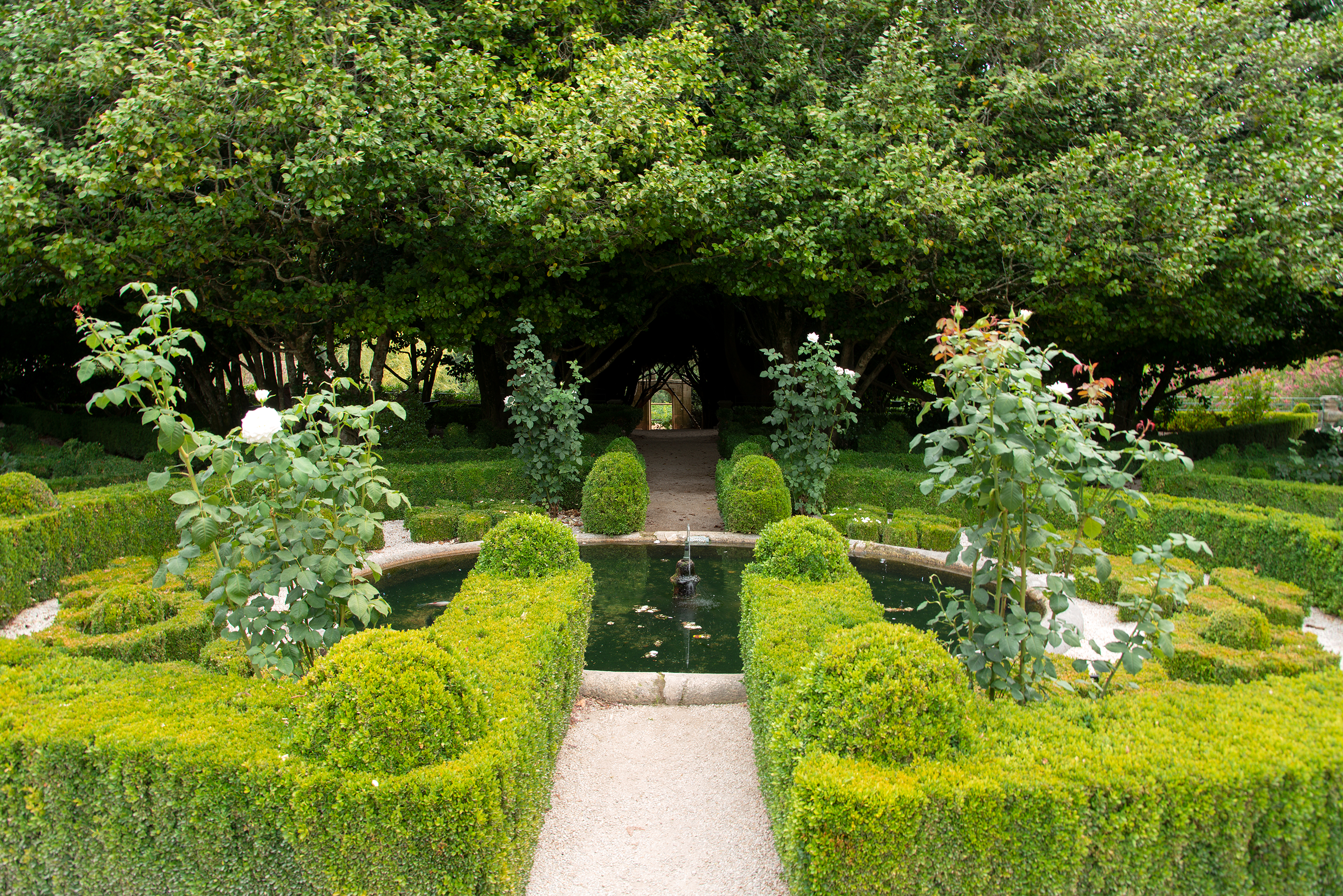
The gardens at Mateus deserve attention on their own terms. Parts were first planted in the 1700s, then reworked in 1870 and expanded in 1930. The most dramatic transformation came in the 1950s and 1960s, when the garden area was extensively redesigned and a lake was added to serve as a reflecting pool for the manor house. The symmetrical garden sections, with their sculpted box hedges and towering cedar tunnel, create a sense of ordered calm that contrasts with the exuberant decoration of the facade. Walking through them is an exercise in controlled perspective, every sightline composed, every turn revealing a new framed view of palace or landscape. The Mateus Foundation, which now owns the property, maintains the gardens and opens them to visitors year-round.
A Label That Conquered the World
The palace was classified as a National Monument in 1910, but its global fame arrived through a different channel entirely. When the Mateus rose brand launched with the palace on its label, the building's silhouette became arguably the most widely reproduced piece of Portuguese architecture in history. The wine itself, a slightly sparkling rose, became a phenomenon in the mid-20th century, introducing millions of drinkers worldwide to Portuguese wine. The irony is that the wine has no direct connection to the palace's own winery; the name and image were licensed. Yet the association stuck, and today visitors arrive in Vila Real carrying an image of the palace in their memory before they ever see the real thing reflected in its ornamental pond.
From the Air
Located at 41.30N, 7.71W near Vila Real in northern Portugal's Tras-os-Montes region. The palace and its formal gardens are visible from low altitude as a symmetrical complex amid vineyard-covered hills. Nearest airport is LPVR (Vila Real) for light aircraft. LPPR (Porto) is approximately 100 km west. The Douro River valley lies to the south, providing a dramatic landscape corridor. Best viewed from 2,000-3,000 ft AGL.