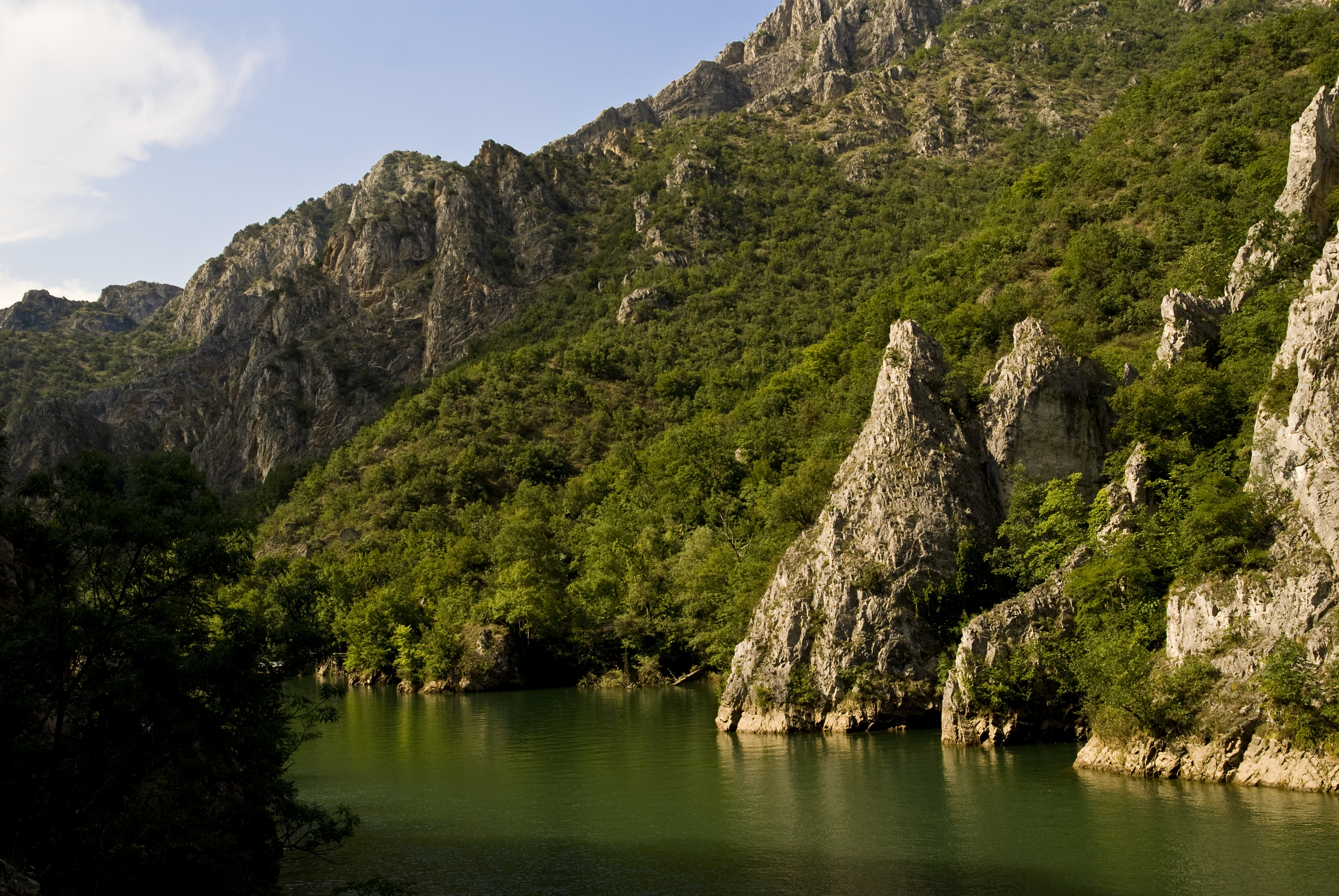
Matka Canyon
Fifteen kilometers west of Skopje's city center, the Treska River cuts through limestone walls that rise vertically from the water. Matka Canyon covers roughly 5,000 hectares, and it feels like another country -- or another century. Medieval monasteries perch on ledges above the gorge, their frescoes darkened by age but still legible. Below the waterline, Vrelo Cave descends to depths that divers have not yet fully mapped, leading some researchers to suggest it may be among the deepest underwater caves in Europe. The canyon's artificial lake, created by a dam built in 1938, is the oldest of its kind in North Macedonia, and it has transformed the lower gorge into a corridor of still, green water reflecting cliffs on both sides.
Into the Depths of Vrelo
Vrelo Cave opens from the canyon wall at the waterline, accessible only by boat. Inside, stalactites crowd the ceiling, including a large formation known locally as the Pine Cone for its layered, resinous shape. The cave holds two underground lakes: the smaller one stretches 8 meters in length and reaches 14.92 meters deep; the larger extends 35 meters with a depth of 18 meters. Beyond the lakes, the cave continues downward into passages that remain unexplored. The exact depth is unknown, but the measurements taken so far have been sufficient for some speleologists to rank Vrelo among the deepest underwater caves on the continent. The uncertainty is part of the appeal. Each diving expedition pushes the known boundary a little further, and the cave keeps going.
A Biodiversity Hotspot at the Capital's Edge
The canyon's isolation within steep limestone walls has created conditions for remarkable biological diversity. Roughly 20 percent of the plant species found at Matka are endemic -- they grow here and nowhere else. Seventy-seven indigenous species of butterfly inhabit the canyon, a startling number for such a compact area. The horned viper, the most venomous snake in southern Europe, lives among the rocks, and the canyon's caves shelter large colonies of bats. Above the waterline, the cliffs support specialized plant communities adapted to the thin soil and intense sun of exposed limestone. Ten caves punctuate the canyon walls, ranging from 20 meters to 176 meters in length, with two vertical pits dropping roughly 35 meters each. For a place so close to a capital city of half a million people, Matka harbors a wildness that feels genuinely remote.
Monasteries on the Ledge
The canyon's cliffs proved irresistible to medieval monks seeking isolation. St. Andrew's Monastery sits on the left bank of the Treska, its history traceable through an inscription recording that a woman named Milica found the church roofless and in poor condition in 1497. She replaced the roof, commissioned new frescoes, built a portico, and planted a vineyard -- a practical act of restoration that kept the building alive for centuries. Higher up, St. Nicholas Shishevski Monastery occupies a cliff ledge above St. Andrew's, offering views straight down into the gorge. Its iconostasis was painted in 1645, and the western wall was frescoed in 1630, during Ottoman rule. The monastery was deserted in the 18th century, briefly revived by an archmonk who found it roofless in 1816, and abandoned again by 1897. Its remoteness, which once attracted monks, eventually defeated them. Today the restored monastery draws hikers who climb the steep trail for the view as much as for the frescoes.
A Canyon for the Weekend
Matka's proximity to Skopje makes it one of North Macedonia's most visited outdoor destinations. Kayakers paddle the Treska below the dam, the river current manageable enough for beginners but the canyon walls dramatic enough to feel like an expedition. Rock climbers work the limestone faces from Easter through November, when the routes dry out and the friction improves. Boat tours depart regularly for Vrelo Cave, the short ride across the lake offering eye-level views of the geology that is harder to appreciate from the rim above. Fishermen cast from the shore and from boats, and on summer weekends the trails along the canyon lip fill with families from the city. The juxtaposition is striking: a canyon harboring endemic species and unplumbed cave systems, yet reachable by city bus from a national capital. Matka manages to be both a genuine wilderness and a neighborhood park, and that dual identity is exactly what makes it worth the visit.
From the Air
Located at 41.94°N, 21.30°E, approximately 15 km west of Skopje, North Macedonia. The canyon is carved by the Treska River through limestone terrain and is visible from altitude as a narrow, winding gorge with a green reservoir. Skopje Alexander the Great Airport (LWSK) is roughly 30 km to the east-southeast. The dam and lake at the canyon entrance are the most recognizable features from the air. Best viewed at 3,000-5,000 ft AGL to appreciate the canyon depth and monastery locations on the cliff walls.