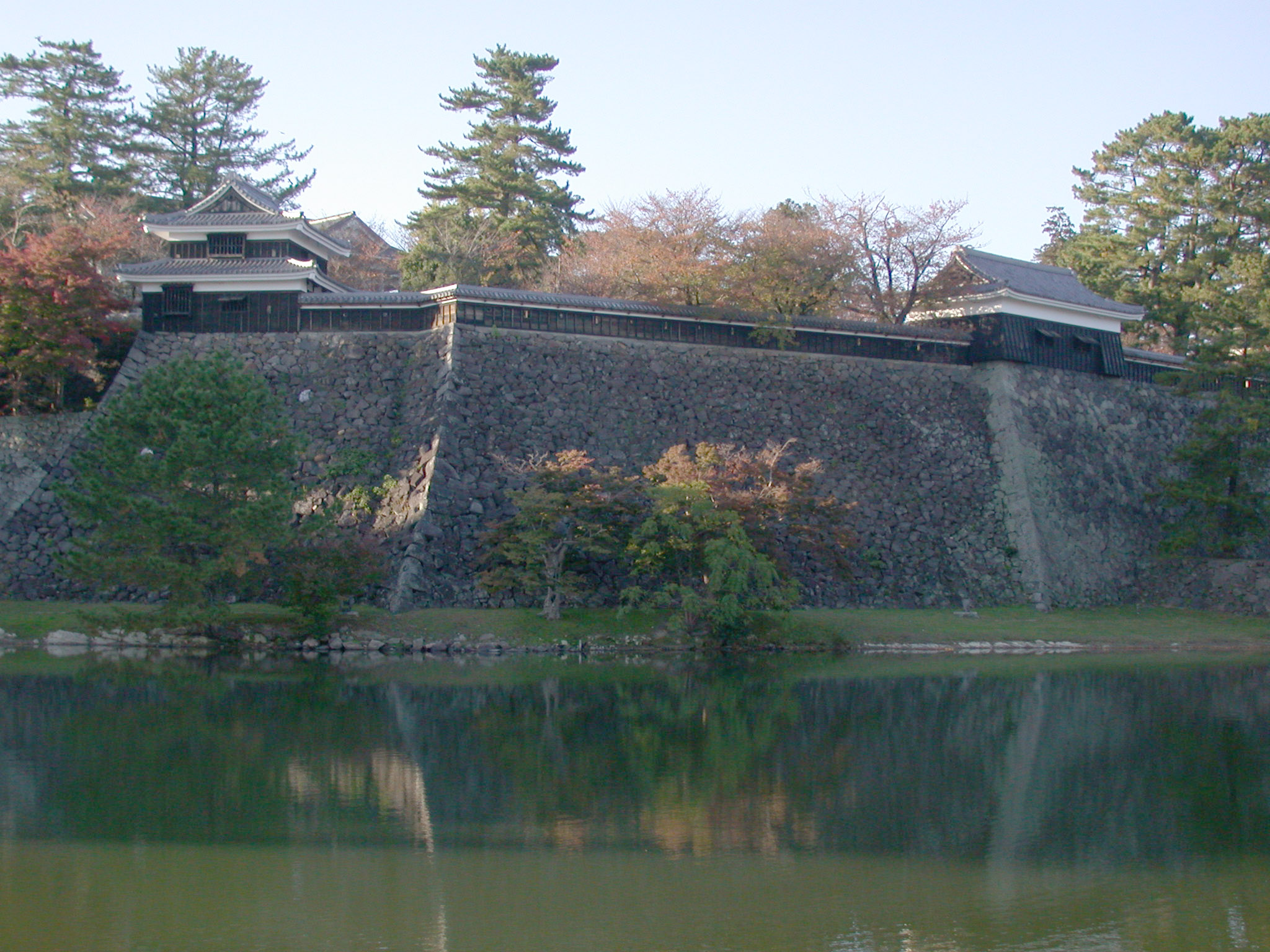
Matsue Castle
Count the floors from outside and you get five. Step inside and climb to the top and you discover there are six. Matsue Castle was designed to deceive, a watchtower-style keep where a hidden level gave defenders an unexpected advantage. Built between 1607 and 1611, during the early years of a peace that would last over two centuries, the castle was engineered for a war that never came to its walls. The irony may explain why it survived when so many others did not.
Black Walls on the Lake
Matsue Castle rises from the shores of Lake Shinji, earning its designation as one of Japan's Three Great Lake Castles. The keep's walls are painted predominantly black, a choice that gives the structure a somber weight against the water and sky. Horio Yoshiharu, the first daimyo of the Matsue Domain, spent five years constructing the castle, completing it in 1611. He chose a site that balanced defensive strength with administrative convenience, placing his seat of power where the lake's waters could serve as a natural moat. The keep itself is the second largest and third tallest among Japan's surviving original castles, standing 30 meters high. Its design reflects the Momoyama aesthetic: martial strength layered with restrained elegance, a building that commands respect without ornamental excess.
Ten Generations of Matsudaira
Ownership of the castle passed through three families in its first decades. The Horio line gave way to the Kyogoku clan in 1633, and then in 1637 to Matsudaira Naomasa, a grandson of Tokugawa Ieyasu himself, transferred from Matsumoto in Shinano Province. The Matsudaira connection to the shogunate's founding family was not coincidental. Placing a Tokugawa relative in the San'in region ensured loyalty in a part of Japan far from Edo. The Matsudaira ruled Matsue for ten consecutive generations spanning 234 years, an extraordinary continuity that shaped the city's culture and identity. In 1927, the family donated the castle to the city of Matsue, completing a transition from feudal power to public heritage.
Saved by Stubborn Citizens
The Meiji government's campaign to modernize Japan nearly destroyed Matsue Castle along with hundreds of others across the country. In 1875, authorities ordered all buildings within the castle compound dismantled. The keep and its attached turret were spared only because local interest groups mounted fierce opposition, arguing for their preservation. It was a close call. The structures that survived underwent major reconstruction between 1950 and 1955, and in 2001 several of the castle's former turrets were rebuilt. On July 9, 2015, the tenshu and attached turret were registered as a National Treasure of Japan, a designation that acknowledged what the citizens of 1875 had instinctively understood: that the keep's original wooden construction, unaltered by concrete reconstruction, made it irreplaceable.
The San'in's Sole Survivor
Of the hundred-plus castles remaining in Japan, only twelve retain their original wooden keeps. Most of the rest are concrete replicas built in the twentieth century, historically evocative but architecturally inauthentic. Matsue Castle is the only original keep in the entire San'in region, the long stretch of coastline facing the Sea of Japan. It is also the sixth oldest among all surviving Japanese castles. Walking through its dim interior, climbing steep wooden staircases worn smooth by centuries of feet, you encounter the structure as its builders intended it to be experienced: claustrophobic lower levels opening suddenly to panoramic views from the top floor, where the waters of Lake Shinji spread out to the west and the city of Matsue fans outward in every direction. The castle was built to watch, and four centuries later, watching is still what it does best.
From the Air
Matsue Castle sits at 35.47N, 133.05E on the north shore of Lake Shinji in Matsue, Shimane Prefecture. The black-walled keep is visible as a distinctive dark structure surrounded by green parkland and moats in the center of the city. Lake Shinji extends to the west, providing a clear visual reference. Nearest airport: Izumo Enmusubi (RJOC) approximately 15nm west. Yonago Kitaro (RJOH) approximately 30nm east. Best viewed at 2,000-3,000 feet AGL on clear days when the lake and castle create a striking contrast.