Matsumoto Castle: The Crow That Refused to Fall
They call it Karasu-jo -- the Crow Castle. From the moat's edge, Matsumoto Castle rises in tiers of black lacquer and white plaster, its dark walls reflecting in still water like a bird with wings half-spread. Unlike the famous white Himeji to the south, Matsumoto wears its color like armor, each story stepping upward in a geometry that only Japanese castle builders mastered. Completed around 1594 under Lord Kazumasa Ishikawa, the castle's dark exterior is thought to honor Hideyoshi Toyotomi, whose Osaka Castle bore a similar black finish. But Matsumoto's real distinction runs deeper than paint. Built not on a hilltop or beside a river, but on an open plain in the heart of Nagano Prefecture, this is a flatland castle -- exposed, vulnerable, and therefore built to be formidable in ways a mountaintop fortress never needed to be.
Five Stories, Six Floors, and a Hidden Level
From outside, Matsumoto Castle appears to have five stories. Step inside, and you discover six floors -- the third story is a hidden level with no windows, invisible from the exterior, where samurai once stored weapons, gunpowder, and food. The original wooden interiors survive intact, their steep staircases worn smooth by centuries of footsteps. The second floor houses the Teppo Gura, a gun museum displaying the castle's collection of firearms, armor, and edged weapons. Narrow slits in the walls -- designed for archers and, later, gunners -- frame the Japanese Alps in the distance. The main keep complex consists of five original structures: the great Tenshu tower, the smaller Inui-ko-tenshu to the north, the Watari-yagura roofed passage connecting them, the Tatsumi-tsuke-yagura southern wing, and the graceful Tsukimi-yagura moon-viewing room. All five are designated National Treasures of Japan.
The Curse of Tada Kasuke
By the late Meiji period, the great tower was leaning. The structural cause was neglect compounded by a construction defect, but the people of Matsumoto had another explanation: the curse of Tada Kasuke. In the 1680s, Kasuke had led a peasant uprising against punishing taxes levied by the castle's lords -- the Jokyō uprising. He was caught and executed for the crime of petitioning for fairness. For generations, locals believed his spirit was pulling the tower down in revenge. Cursed or not, the lean was real and worsening. A local high school principal named Kobayashi Unari refused to let the castle collapse. He launched a public fundraising campaign, and between 1903 and 1913 the castle underwent what became known as the Great Meiji Renovation. The tower was straightened, the timbers reinforced. Kobayashi had beaten the curse with carpentry and civic will.
A Room Built for Moonlight
Around 1630, when Japan's era of civil war had given way to the peace of the Tokugawa shogunate, feudal lord Naomasa Tokunaga added a structure that would have been unthinkable a generation earlier: the Tsukimi-yagura, or moon-viewing room. Open on three sides -- north, east, and south -- with vermilion-painted handrails and thin sliding doors designed to be removed entirely on fine evenings, the room exists for one purpose: watching the moon rise over the mountains. The floors are tatami. There are no defensive features, no arrow slits, no gun ports. The Tsukimi-yagura was built for a visit by Shogun Tokugawa Iemitsu that never happened -- Iemitsu cancelled his pilgrimage to nearby Zenkoji Temple and never set foot in Matsumoto. But the room remains, a statement in architecture: the wars are over, the castle is no longer just a fortress, and there is time now to sit quietly and watch the sky.
Saved Twice, Shaken Once
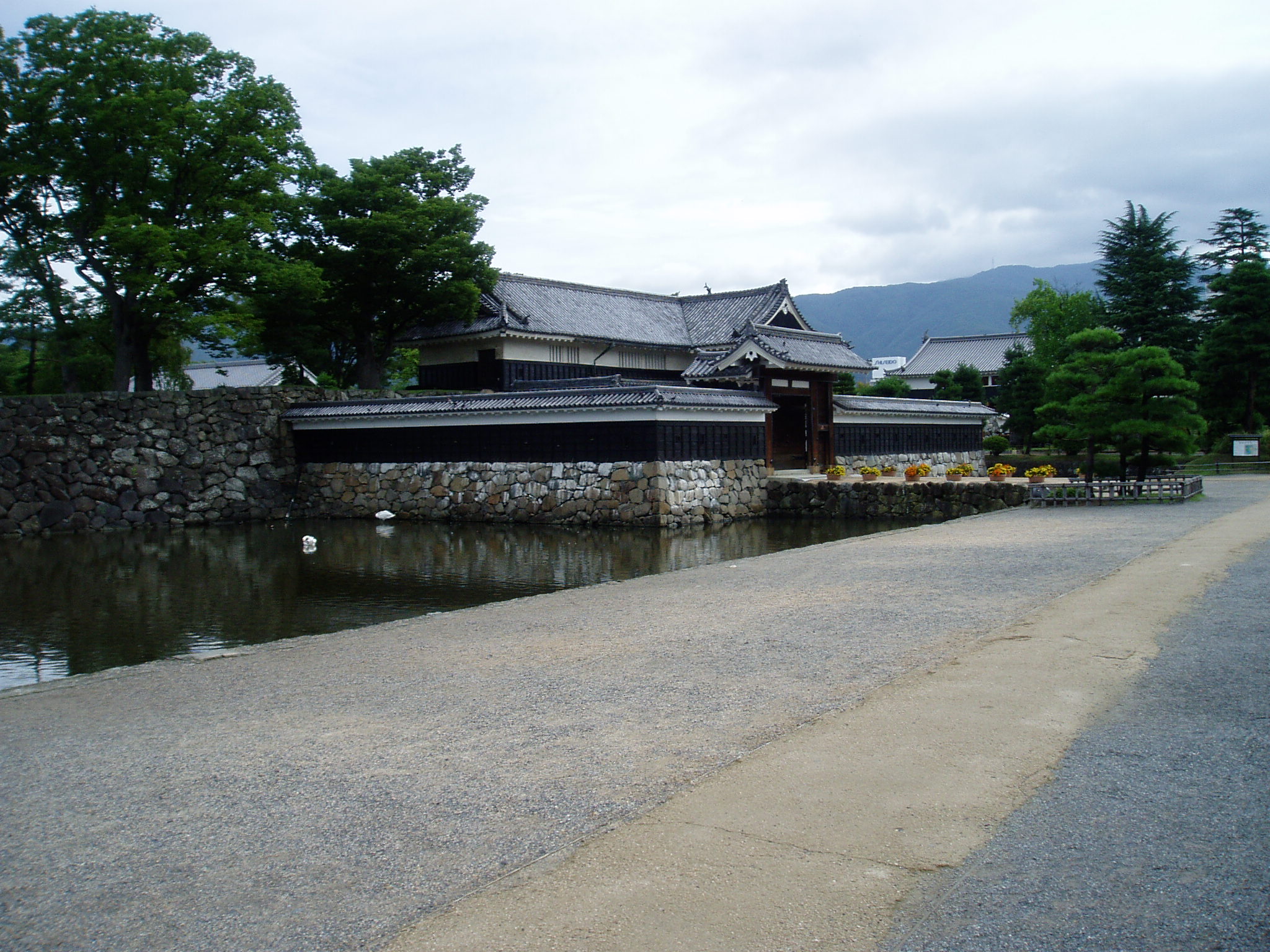
Matsumoto Castle has survived not just centuries, but the active efforts to destroy it. In 1876, arsonists burned the daimyo residence in the Ni-no-Maru enclosure -- the fire settled a political argument about where to locate the new prefectural capital, tipping the decision to Nagano city over Matsumoto. Only a storehouse from the Edo period survived. The castle was designated a National Historic Site in 1930, and in 1952 all five main keep structures received National Treasure status, unlocking government funding for a major restoration from 1950 to 1955 that required completely dismantling and rebuilding the structures. The Black Gate was reconstructed in 1990, the square drum gate in 1999. Then on June 30, 2011, a magnitude 5.4 earthquake cracked the inner walls of the main tower in roughly ten places. The crow staggered but did not fall. One of only twelve original tenshu surviving in all of Japan, Matsumoto endures -- black walls reflected in still water, moon-viewing room open to the sky.
From the Air
Located at 36.239°N, 137.969°E in the center of Matsumoto city, in the broad Matsumoto Basin of Nagano Prefecture. The castle and its moat are visible from altitude as a dark complex surrounded by water in the urban grid. The Japanese Alps (Northern Alps / Hida Mountains) rise dramatically to the west. Matsumoto Airport (RJAF) lies approximately 5 nautical miles south-southwest. Best viewed at 3,000-5,000 feet AGL approaching from the west to see the castle against the alpine backdrop. Clear weather offers views of the 3,000-meter peaks framing the basin.