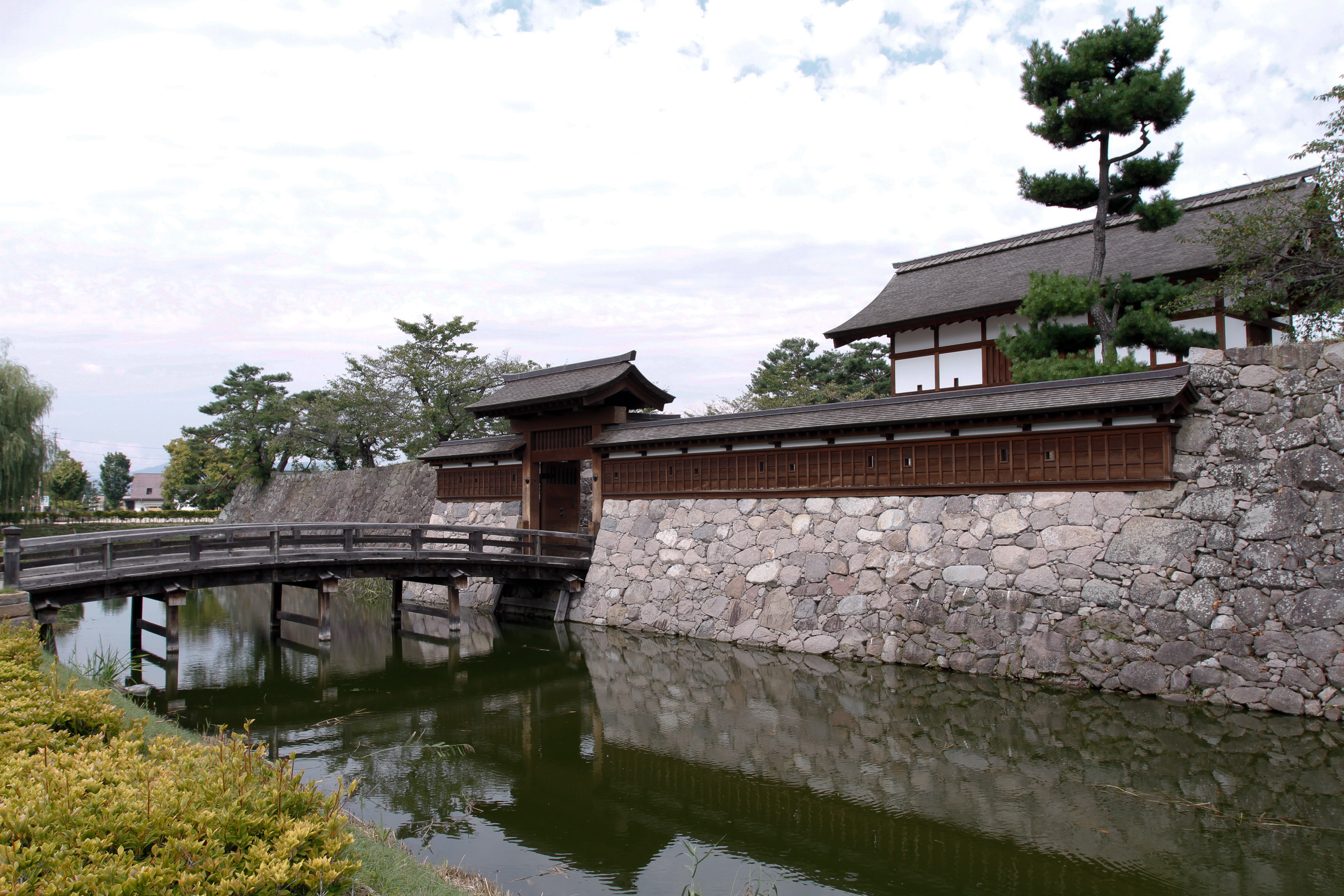
Matsushiro Castle: A Fortress That Refused to Stay Standing
In 1560, the warlord Takeda Shingen ordered his strategist Yamamoto Kansuke to build a fortress on the flatlands of northern Shinano Province. The location was strategic: between the main channel of the Chikuma River and a former riverbed, with water serving as both moat and menace. Shingen needed a forward base for his ongoing war against Uesugi Kenshin, and the nearby plain of Kawanakajima had already become one of the most storied battlefields in Japanese history. The castle that rose from the river flats would carry several names over the centuries -- Kaizu Castle first, then Matsushiro Castle -- but its story would be defined less by the men who built it than by the forces that tried to destroy it: fire, flood, earthquake, and finally, the deliberate hand of a nation dismantling its feudal past.
A Fortress Between Rivers
Matsushiro Castle occupies a landscape shaped by water. The Chikuma River flows along one side, and a former channel of the same river serves as a broad outer moat on the north. This geography gave the castle natural defenses but also a recurring curse: flooding. The castle and its surrounding jokamachi -- the castle town that grew up around it -- suffered repeated inundation over the centuries. The castle's design was concentric, rings within rings. The Central Bailey, or Hon-Maru, stood at the heart, originally topped by a tenshu -- a main tower -- that was later replaced by a smaller yagura watchtower. Around the Hon-Maru ran a moat, then the Second Bailey, the Ni-no-Maru, with earthen ramparts and stone-reinforced gates. A wide dry moat separated the second ring from the Third Bailey, the San-no-Maru. The daimyo's palace and administrative offices occupied the Hana-no-Maru enclosure adjacent to the main fortifications.
Warlords and the Shadow of Kawanakajima
Takeda Shingen built Kaizu Castle for war. His conflict with Uesugi Kenshin for control of northern Shinano Province produced the Battles of Kawanakajima, a series of clashes fought on the plain just north of the castle between 1553 and 1564. The battles became legendary in Japanese culture -- two of the greatest warlords of the Sengoku period, evenly matched, returning to the same ground again and again. Kosaka Masanobu, a retainer of the Takeda clan, served as the castle's first commander. The fortress was Shingen's southern anchor in the conflict, a staging ground from which troops could be deployed to the Kawanakajima plain. Though the battles produced no decisive victor, the castle endured long after both warlords had passed from history, transitioning from a military stronghold into the seat of a peacetime domain under the Tokugawa shogunate.
Fire, Flood, and Earthquake
If the castle's origin was war, its ongoing story was disaster. In 1717, fire destroyed most of the structures. Reconstruction came swiftly -- by 1718, partly funded by a donation of 10,000 ryo from the Tokugawa shogunate. But in 1742, the Chikuma River exacted its toll. A severe flood devastated the castle, and repairs dragged on for sixteen years, not reaching completion until 1758. The palace structures were relocated to the Hana-no-Maru enclosure in 1770 and rebuilt in 1804. Then in 1847, an earthquake -- likely the Zenkoji earthquake that devastated the broader region -- destroyed much of what had been rebuilt. The palace burned again in 1853, was rebuilt yet again, and a secondary palace outside the castle walls was completed in 1864. Each reconstruction was an act of stubborn persistence, a refusal to abandon a site that geography seemed determined to reclaim.
Dismantled by Design
The final destruction of Matsushiro Castle came not from nature but from politics. The Meiji Restoration of 1868 swept away the feudal order that had sustained Japan's castles for centuries. When the han system -- the network of feudal domains -- was formally abolished in 1871, the new government had no use for hundreds of castles across the country. Most of Matsushiro's remaining structures were dismantled that year, their timbers and stones repurposed. What the demolition crews left behind, an arsonist finished in 1873, burning the last standing buildings to the ground. Only the stone foundations remained -- walls and platforms of fitted rock outlining where baileys and gates once stood. Today, the site is a registered National Historic Site of Japan, its concentric moats and stone walls preserved as a quiet park in what is now a neighborhood of Nagano City. Cherry trees bloom along the old ramparts each spring, and visitors walk the perimeter where samurai once patrolled.
From the Air
Located at 36.57°N, 138.20°E in the Matsushiro district of southern Nagano City, Japan. From the air, the concentric moat system is visible as a geometric pattern of water channels and tree-lined embankments amid residential development. The Chikuma River flows nearby to the north. Look for the rectangular outline of the castle grounds -- the moats and stone walls create a distinctive footprint. Matsumoto Airport (RJAF) lies approximately 55 kilometers to the southwest. Best viewed from 2,000-4,000 feet AGL. The flat terrain of the castle site contrasts with the mountainous terrain surrounding the Nagano basin on all sides.