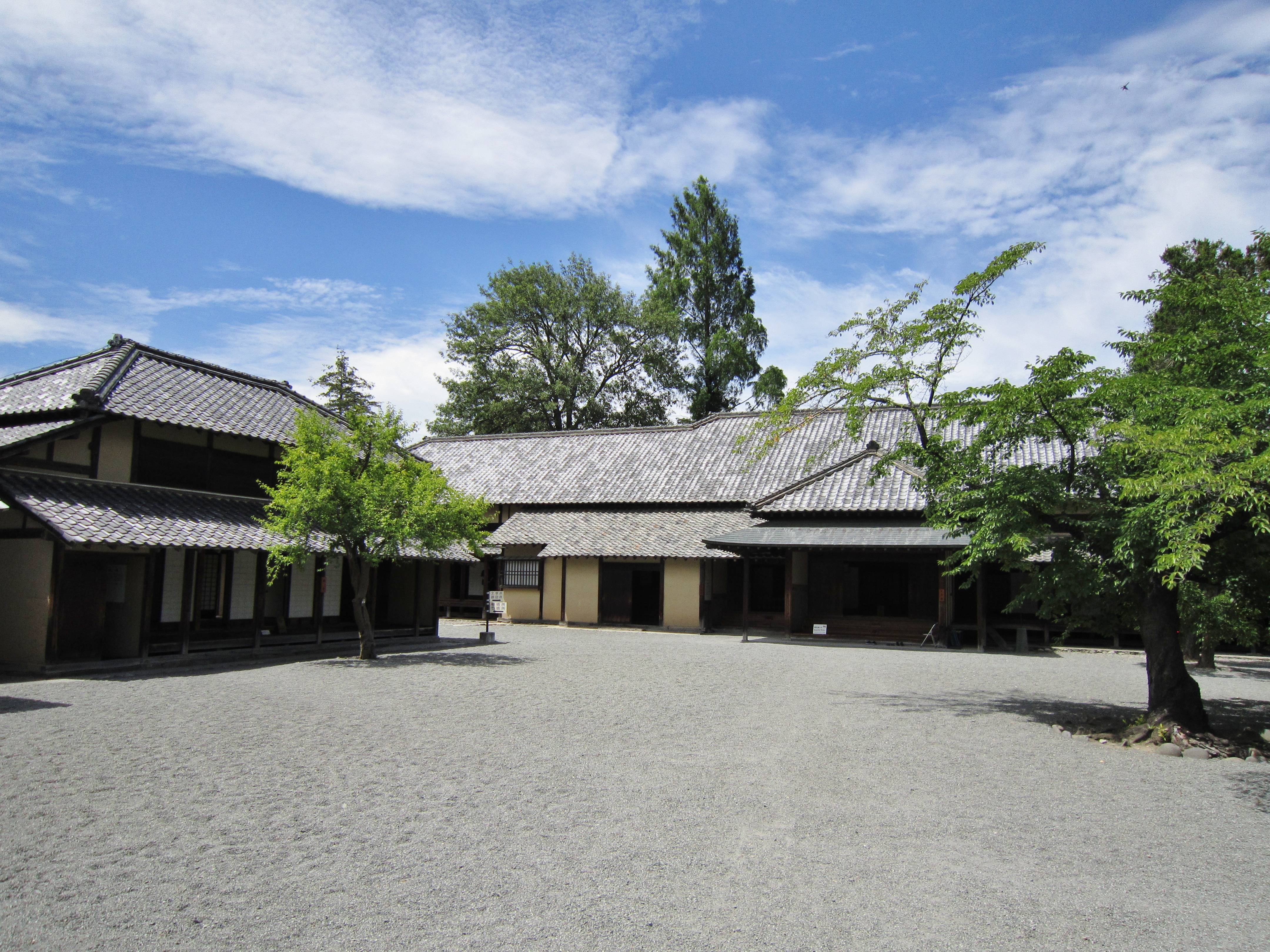
Matsushiro Literary and Military School
Of the more than 250 domain schools that once educated samurai across Japan, only one survives in nearly intact form. The Matsushiro Bunbu Gakko stands in the castle town of Matsushiro, a quiet neighborhood in southern Nagano City, its nine wooden buildings still arranged as they were when the first students filed through the gates in 1855. Walk the grounds today and you can still draw a bow on the archery range, kneel in the tea ceremony room, or stand in the dojo where young warriors once practiced swordsmanship. The school was not merely preserved by accident. It endured because Matsushiro kept using it, first as a military academy, then as an elementary school, and finally as a museum, each generation finding new purpose for the same sturdy halls.
A School Born from Fire
Construction began in 1852 under the 8th daimyo of Matsushiro Domain, Sanada Yukitsura, though the Sanada clan had been running smaller schools since the 6th daimyo, Sanada Yukihiro, opened one in 1758. The timing was not gentle. A devastating fire swept through the Matsushiro castle town during construction, destroying much of the surrounding district and delaying completion until 1855. When the doors finally opened, the school occupied 1,500 square meters of teaching space on a 3,089-square-meter site. The Sanada clan, who had governed Matsushiro for ten generations since relocating from Ueda in 1622, poured their vision of a modern warrior class into every room.
Where East Met West
The curriculum was radical for its time. Sakuma Shozan, the brilliant Edo-period scholar who advocated opening Japan to the wider world, shaped the school's philosophy. Students studied Chinese literature, Ogasawara-ryu etiquette, Chinese medicine, and martial arts alongside rangaku, the body of Western knowledge that filtered into isolationist Japan through Dutch traders. Western medicine, military science, and artillery all had a place in the classroom. In a striking departure from every other han school in the country, the Matsushiro school did not teach Confucianism, and no shrine to Confucius stood within the grounds. This was a school looking forward, not back.
The French Connection
As Japan's feudal order crumbled during the Bakumatsu period of the 1860s, the school's emphasis shifted heavily toward Western military science. French military instructors arrived to teach modern tactics. The domain also recruited Takeda Ayasaburo, a former instructor at the shogunate's Kaiseijo academy and the architect of the famous Goryokaku star fort in Hokkaido. These were not theoretical exercises. Japan was tearing itself apart, and the Sanada clan wanted their samurai ready for whatever came next. After the Meiji Restoration swept away the old order, the complex continued as a military academy until the abolition of the han system in 1871.
Centuries of Second Lives
Rather than fall to ruin like so many Edo-period structures, the school simply changed uniforms. From 1871 onward, it served as the Matsushiro Elementary School under the new national education system, a role it filled for nearly a century until the 1960s. A careful renovation from 1973 to 1978 restored the buildings to their original character, and the school opened as a museum. Today visitors can try their hand at archery on the original range, practice martial arts in the dojo, or participate in tea ceremony and flower arrangement in the same rooms where samurai sons once sat. The school was designated a National Historic Site of Japan in 1953, recognizing its singular status as a complete, surviving han school.
Matsushiro Beyond the School
The school sits within a broader samurai landscape. The ruins of Matsushiro Castle are a short walk away, and the Sanada Residence gives a sense of how the ruling family lived. A darker chapter lies beneath the surrounding mountains: during World War II, an elaborate network of tunnels was dug by forced laborers in 1944-45, intended to shelter the Emperor and Imperial government in case of an Allied ground invasion. Japan's surrender halted the project when the tunnels were roughly 75 percent complete. A 500-meter section is open to visitors, a sobering counterpoint to the school's more hopeful story of education and reform.
From the Air
Located at 36.563N, 138.196E in the Matsushiro district of southern Nagano City, nestled in a valley surrounded by mountains. From altitude, look for the grid pattern of the old castle town south of the main Nagano urban area. The nearest airport is Matsumoto Airport (RJAF/MMJ), approximately 60 km to the southwest. Nagano sits in a mountain basin in the Japanese Alps, so expect terrain on all sides. Best viewed at 3,000-5,000 feet AGL for context of the castle town layout.