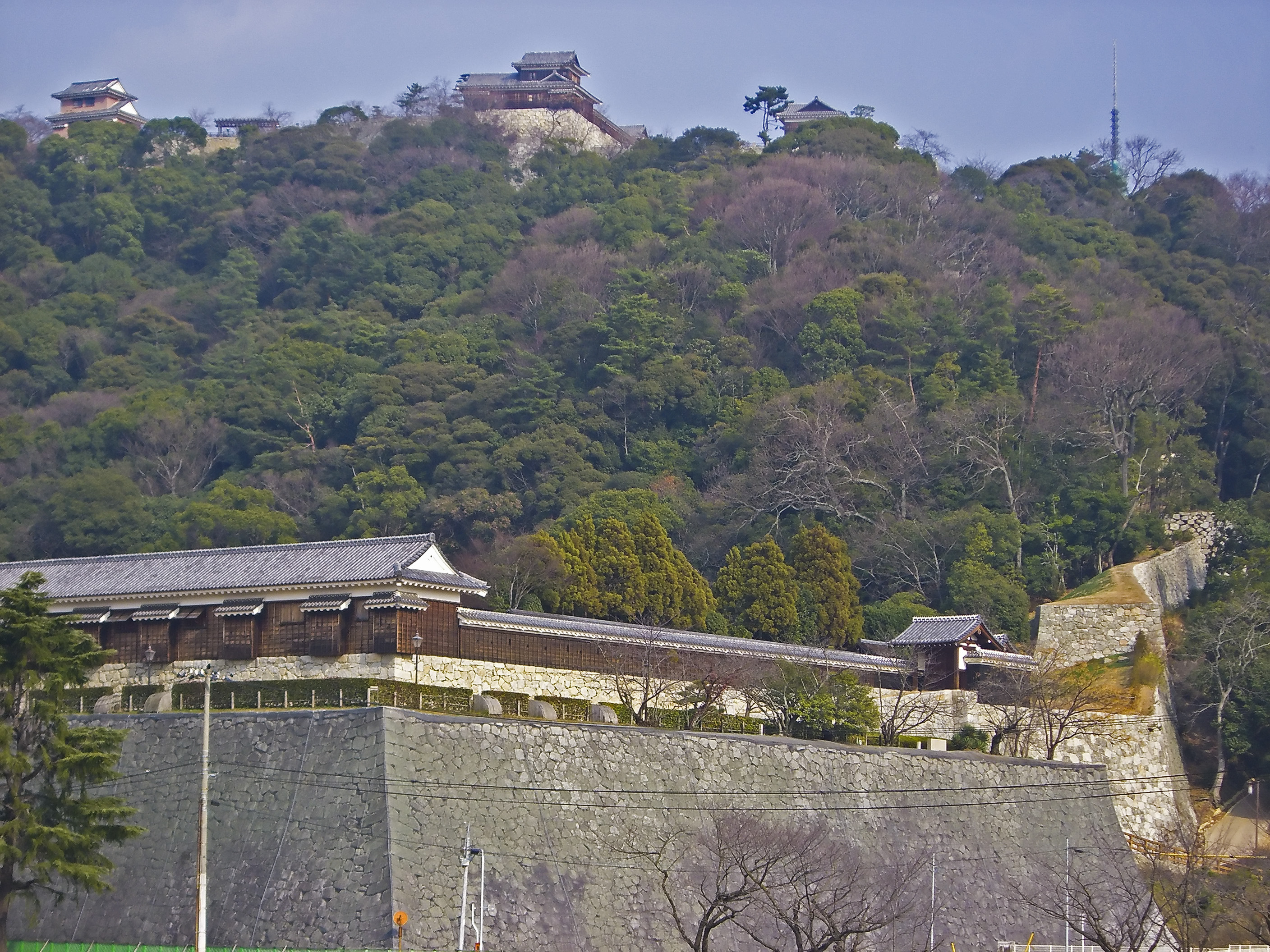
Matsuyama Castle (Iyo)
Lightning destroyed the keep in 1784. Seventy years later, in 1854, the twelfth lord of the domain rebuilt it -- despite chronic financial difficulties that had plagued Matsuyama for generations. Then came the firebombing of World War II, which destroyed eleven castle buildings. Then arson in 1949, which claimed the Tsutsu Gate and its flanking towers. Yet Matsuyama Castle endures. Its three-story tenshu is one of only twelve original castle keeps remaining in Japan, a survivor not through luck but through the stubborn determination of the people who kept rebuilding what war, weather, and crime tried to erase.
A Reward Written in Stone
The castle began as a reward for loyalty. Kato Yoshiaki, a general who distinguished himself at the Battle of Shizugatake in 1583, was appointed lord of a small domain on Shikoku by Toyotomi Hideyoshi. After Hideyoshi's death, Kato backed the winning side at the Battle of Sekigahara in 1600, and the Tokugawa shogunate rewarded him handsomely -- his domain swelled from 60,000 to 200,000 koku. In 1602, Kato began building his castle on Mount Katsuyama, a flatland-mountain site that placed the fortress high above the surrounding plain while keeping the castle town accessible below. Construction took twenty-five years. Kato never saw it finished -- he was transferred to Aizu Domain just before completion in 1627.
Three Clans, One Mountain
Gamo Tadatomo replaced Kato and completed the massive five-story tenshu, but he died in 1634 without heirs shortly after finishing the Ninomaru bailey. The shogunate then assigned Matsudaira Sadayuki from Kuwana Domain. His branch of the Matsudaira clan, the Hisamatsu-Matsudaira, were shinpan daimyo -- lords considered closely related to the ruling Tokugawa family. They would govern Matsuyama for the next 234 years, until the Meiji Restoration in 1868. Under Matsudaira Sadayuki, the tenshu was rebuilt at a reduced scale, shrinking from five stories to three in 1642. Despite the modesty of the revision, the castle remained formidable: stone walls, compound gates, and watchtower turrets created a layered defense that rewarded patience over force.
What Survived and What Was Lost
By 1935, Japan had designated the tenshu and thirty-four other structures at Matsuyama Castle as Important Cultural Properties. The recognition came too late for some. During World War II, the Matsuyama Air Raid destroyed eleven buildings, including the Tenjin yagura watchtower. In 1949, arson claimed the Tsutsu Gate and its eastern and western towers -- peacetime destruction that stung precisely because the war was over and the danger should have passed. What remains is still substantial: the original tenshu, six yagura watchtowers, and several gates, supplemented by reconstructed buildings that fill some of the gaps. In 2019, nine additional structures received designation as Registered Tangible Cultural Properties, extending formal protection to parts of the castle complex that had previously been unrecognized.
Cherry Blossoms on the Ramparts
Today Matsuyama Castle is a public park reached by ropeway or chairlift from the base of Mount Katsuyama -- or by a twenty-minute walk from JR Matsuyama Station for those who prefer to approach as the castle's original defenders did, on foot. In 1989, the castle grounds were selected as one of Japan's Top 100 Cherry Blossom Spots, and each spring the ancient stone walls disappear behind clouds of pink and white petals. The Japan Castle Foundation named it one of Japan's Top 100 Castles in 2006. From the tenshu's observation deck, Matsuyama spreads below in every direction -- the Seto Inland Sea glinting to the north, the mountains of interior Shikoku rising to the south, and the steam from nearby Dogo Onsen curling above the rooftops to the east. Four hundred years of upheaval distilled into a single panoramic view.
From the Air
Located at 33.85N, 132.77E atop Mount Katsuyama in central Matsuyama, Shikoku. The castle is a prominent hilltop landmark visible from the air against the surrounding flat city. Matsuyama Airport (RJOM) is approximately 5 km to the west. The Seto Inland Sea lies to the north. Best viewed at 2,000-4,000 feet where the castle's elevated position on the mountain is most dramatic against the urban landscape.