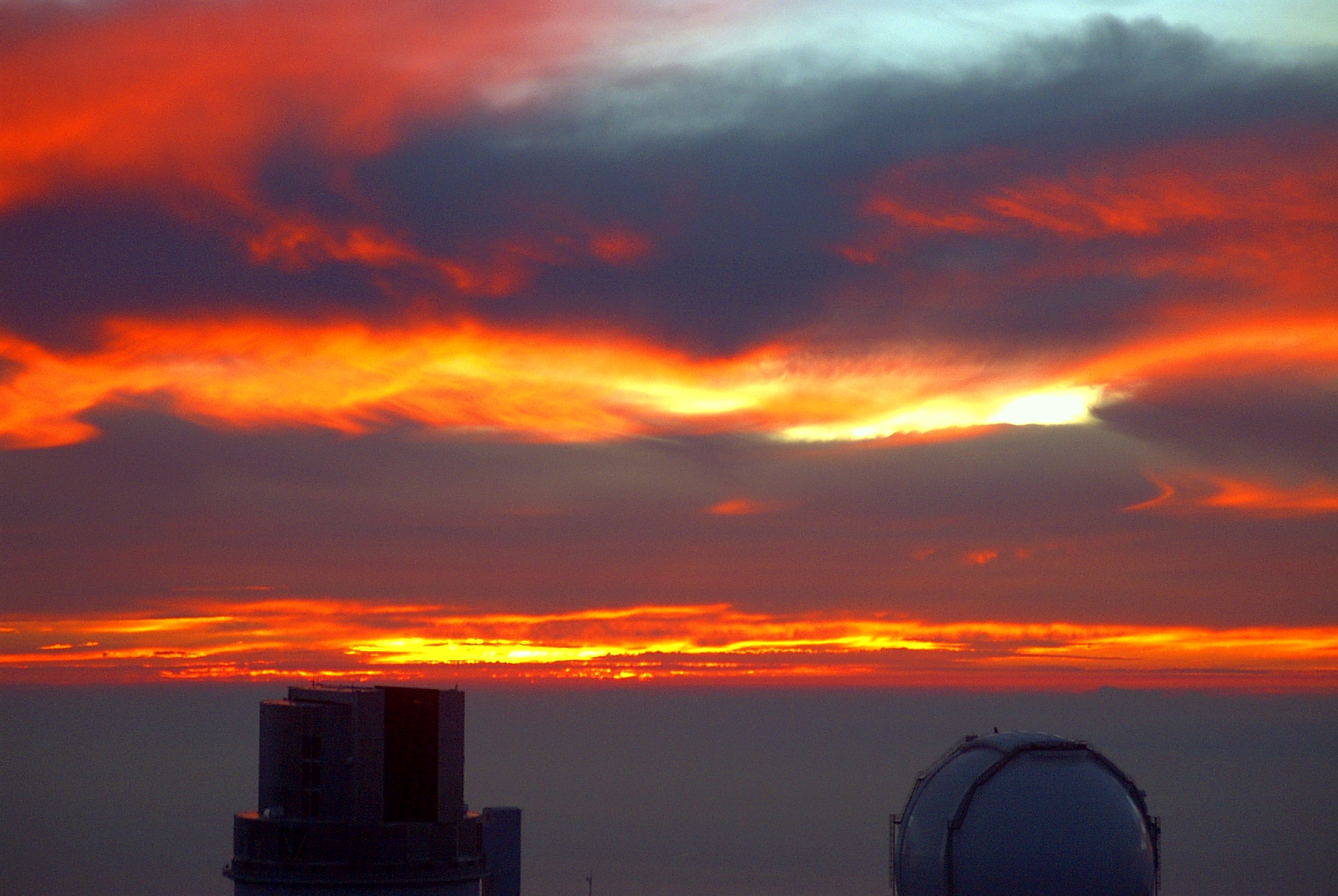
Mauna Kea Observatories
Gerard Kuiper was furious. The Dutch-American astronomer had identified Mauna Kea as the ideal site for infrared astronomy in the early 1960s, only to watch the University of Hawaii win the NASA contract to build there instead. Kuiper abandoned what he called "his mountain" and decamped to Arizona, but the summit he left behind would become the most productive astronomical site on Earth -- home to thirteen telescopes operated by eleven nations, perched on 525 acres of volcanic cinder that Native Hawaiians consider among the most sacred ground in the Pacific.
Where the Air Runs Out
At 4,207 meters, Mauna Kea's summit sits above 40 percent of Earth's atmosphere and nearly all of its water vapor. The air is so thin that astronomers arriving at Hale Pohaku, the research staging area at 9,300 feet, must acclimate for hours before ascending the final seven miles of unpaved road to the top. Some telescopes require observers to spend an entire night at the lower elevation before working at the summit. The reward for enduring this oxygen-starved landscape is some of the finest seeing conditions anywhere: dark skies free of light pollution, minimal atmospheric turbulence from the steady Pacific trade winds, and a median optical seeing at the Canada-France-Hawaii Telescope site of 0.43 arcseconds. The Hawaii Night Sky Protection Act, enacted in 2013, keeps the Big Island's streets deliberately dark -- a rare sacrifice of modern convenience for the clarity of ancient starlight.
A Mountain Stolen Twice
The history of the observatories is a story of competing claims. John Jefferies, a University of Hawaii physicist, won the NASA telescope contract over Kuiper and built a 2.24-meter telescope after the state agreed to construct an all-weather road to the summit. Building began in 1967 and first light came in 1970. By then, the U.S. Air Force and Lowell Observatory had already erected two smaller telescopes on the newly accessible peak. In 1973, Canada and France agreed to build the 3.6-meter CFHT, and the mountaintop telescope boom was underway. But access cut both ways. Skiers discovered the road and protested when it was closed during construction. Hunters raised concerns about wildlife. The Hawaiian Audubon Society found an ally in Governor George Ariyoshi. And Native Hawaiians -- kanaka oiwi -- watched the proliferation of domes on land they considered the dwelling place of gods and felt their sacred mountain being stolen a second time.
The Glass Forest
Today the Astronomy Precinct hosts a remarkable collection of instruments. The twin Keck telescopes, each with 10-meter segmented mirrors, were the world's largest optical telescopes when completed in the 1990s. Japan's Subaru Telescope carries one of the largest single-piece mirrors ever ground. The Gemini North telescope, funded by six nations, uses adaptive optics and a Gemini Planet Imager to photograph exoplanets a million times fainter than their host stars. The Submillimeter Array, eight radio dishes arranged in the shape of a Reuleaux triangle, helped produce the first-ever image of a black hole as part of the Event Horizon Telescope. And research conducted here on distant supernovae earned Saul Perlmutter, Brian Schmidt, and Adam Riess the 2011 Nobel Prize in Physics for proving that dark energy is accelerating the expansion of the universe.
Sacred Ground, Contested Sky
The 11,228-acre Mauna Kea Science Reserve sits on land protected by the U.S. Historical Preservation Act for its significance to Hawaiian culture. In Hawaiian tradition, the summit is the realm of the sky god Wakea and is considered the piko -- the navel -- connecting Earth to the heavens. The tension between scientific discovery and cultural reverence has only deepened over decades. A 1982 management plan designated 525 acres for astronomy and set aside the remaining 10,763 acres for natural and cultural preservation, but opposition continued to grow. The proposed Thirty Meter Telescope became a lightning rod, drawing thousands of protectors to blockade the access road in 2019. Three or four of the existing thirteen telescopes are now slated for decommissioning, and any new construction faces unprecedented scrutiny. The mountain that offers humanity its clearest view of the cosmos also demands the hardest question: whose vision of the sacred should prevail?
The View from Above
From the air, the observatory domes appear as a scattering of white pearls on the rust-red summit, improbably delicate against the volcanic terrain. On clear days the telescopes are visible from well below cruising altitude, their silhouettes unmistakable against the deep blue sky above the cloud deck. The summit often wears a cap of snow -- Mauna Kea means "white mountain" -- and the contrast between white snow, red cinder, and silver domes makes the scene one of the most striking in the Hawaiian Islands. Below and to the southeast, the city of Hilo spreads along the coast, close enough that some residents once complained they could see the observatory domes from town. It is a reminder that these instruments, designed to peer billions of light-years into the past, remain rooted in the contested present of a single island community.
From the Air
Located at 19.82N, 155.47W near the summit of Mauna Kea on Hawaii's Big Island, at an elevation of 4,207 meters (13,802 feet). Observatory domes are visible from cruising altitude as white structures on the rust-colored summit. Nearest airports: PHTO (Hilo International Airport, 28 nm southeast), PHKO (Kona International Airport, 40 nm west). The summit frequently rises above the cloud layer, making the domes easy to spot even when lower elevations are obscured. Best viewed from the east or south for the full panorama of telescope facilities.