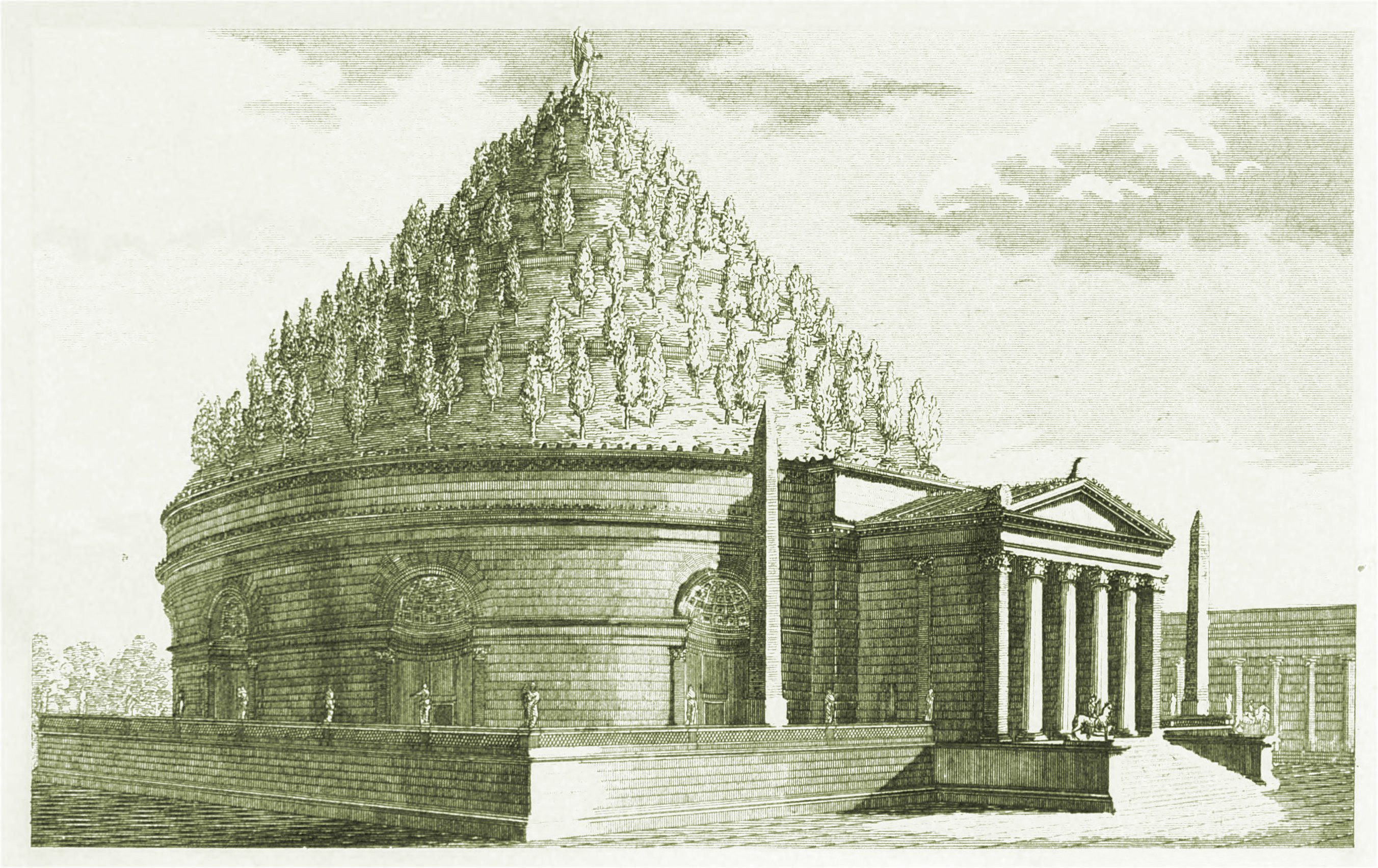
Mausoleum of Augustus
There is a medieval legend that Augustus ordered a basketful of earth from every province of the empire to be poured upon his tomb, so that he could rest beneath the soil of the entire world he had ruled. The story is false, but the ambition it describes was real. In 28 BC, fresh from his victory at the Battle of Actium, Augustus began constructing his mausoleum on the Campus Martius - and he built it on a scale that left no doubt about how he wanted posterity to remember him. Ninety meters in diameter and forty-two meters tall, faced in white travertine and crowned with cypresses, it was the largest circular tomb the ancient world had ever seen.
An Empire in a Tomb
The mausoleum was designed as a statement of dynasty. Concentric rings of earth and brick supported a structure that rose in tiers, possibly topped with a conical roof and a colossal bronze statue of Augustus himself. Twin pink granite obelisks flanked the arched entrance - both survived the centuries, though one now stands near the Basilica of Santa Maria Maggiore, moved there by Pope Sixtus V in 1587, and the other at the Quirinal fountain, relocated by Pope Pius VI in 1786. Inside, a corridor led to a central chamber with three niches designed to hold the golden urns containing the ashes of the imperial family. Bronze plaques mounted on pillars at the entrance bore the Res Gestae Divi Augusti, Augustus's own account of his accomplishments - essentially his autobiography, carved in metal for anyone entering his tomb to read.
Filling the Chambers
The first burial was not Augustus himself but his nephew Marcus Claudius Marcellus, who died in 23 BC - the young man Virgil eulogized in the Aeneid. Over the following decades, the mausoleum received the ashes of Rome's most powerful figures: Marcus Vipsanius Agrippa, Augustus's greatest general and son-in-law; Octavia Minor, Augustus's beloved sister; his grandsons Gaius and Lucius Caesar, both groomed as heirs and both dead before their time. After Augustus's own interment in AD 14, the tomb continued to accept imperial remains - Tiberius, Germanicus, Claudius, Agrippina the Elder, the infant Julia Drusilla. The last emperor for whom the mausoleum was opened was Nerva, who died in AD 98. By tradition, in AD 410, the Visigoths under Alaric broke into the vaults, stole the golden urns, and scattered the ashes across the floor - though some modern scholars consider this story unreliable.
Castle, Garden, Concert Hall
What happened to the mausoleum after Rome fell is a story of relentless reinvention. By the tenth century, earth and vegetation had buried it so deeply that Romans called it Mons Augustus - a hill, not a building. A chapel dedicated to the Archangel Michael was built on top. In the twelfth century, the Colonna family fortified it as a castle, just as Hadrian's mausoleum across the city had become the Castel Sant'Angelo. After the Colonna were banished in 1167, the structure passed through the hands of various Roman noble families who turned it into a garden. By the early twentieth century, the interior had been hollowed out and converted into a concert hall called the Augusteo, where audiences heard orchestral music inside the walls of a two-thousand-year-old tomb. Mussolini's government demolished the concert hall in the 1930s and cleared the surrounding buildings, intending to restore the mausoleum as a monument to imperial greatness.
The Long Reopening
Mussolini's restoration stalled, and for decades the mausoleum sat exposed but neglected - overgrown with weeds, used as a dumping ground for litter, surrounded by a piazza that felt more like an abandoned lot than a civic space. The opening of the Ara Pacis museum directly across the street in 2006 made the contrast embarrassing. In 2017, Italian authorities announced a six-million-euro grant from Telecom Italia to fund a comprehensive restoration, the first serious effort since the 1930s. Costs eventually expanded to eleven million euros. The mausoleum finally reopened to visitors in March 2021, after fourteen years of closure, though the central cylinder housing Augustus's actual burial chamber remained unrestored. The site closed again in June 2022 for further redevelopment of the surrounding piazza. Two thousand years after Augustus built a tomb meant to stand forever, Rome is still trying to figure out what to do with it.
From the Air
Located at 41.91N, 12.48E on the Campus Martius in central Rome, near the east bank of the Tiber. The circular footprint of the mausoleum is visible from low altitude, surrounded by the rectangular Piazza Augusto Imperatore. The Ara Pacis museum sits directly to the west, between the mausoleum and the river. Fiumicino Airport (LIRF) is approximately 28 km southwest. Ciampino Airport (LIRA) is about 17 km southeast. Best viewed at 2,000-4,000 feet to appreciate the circular structure amid the urban grid.