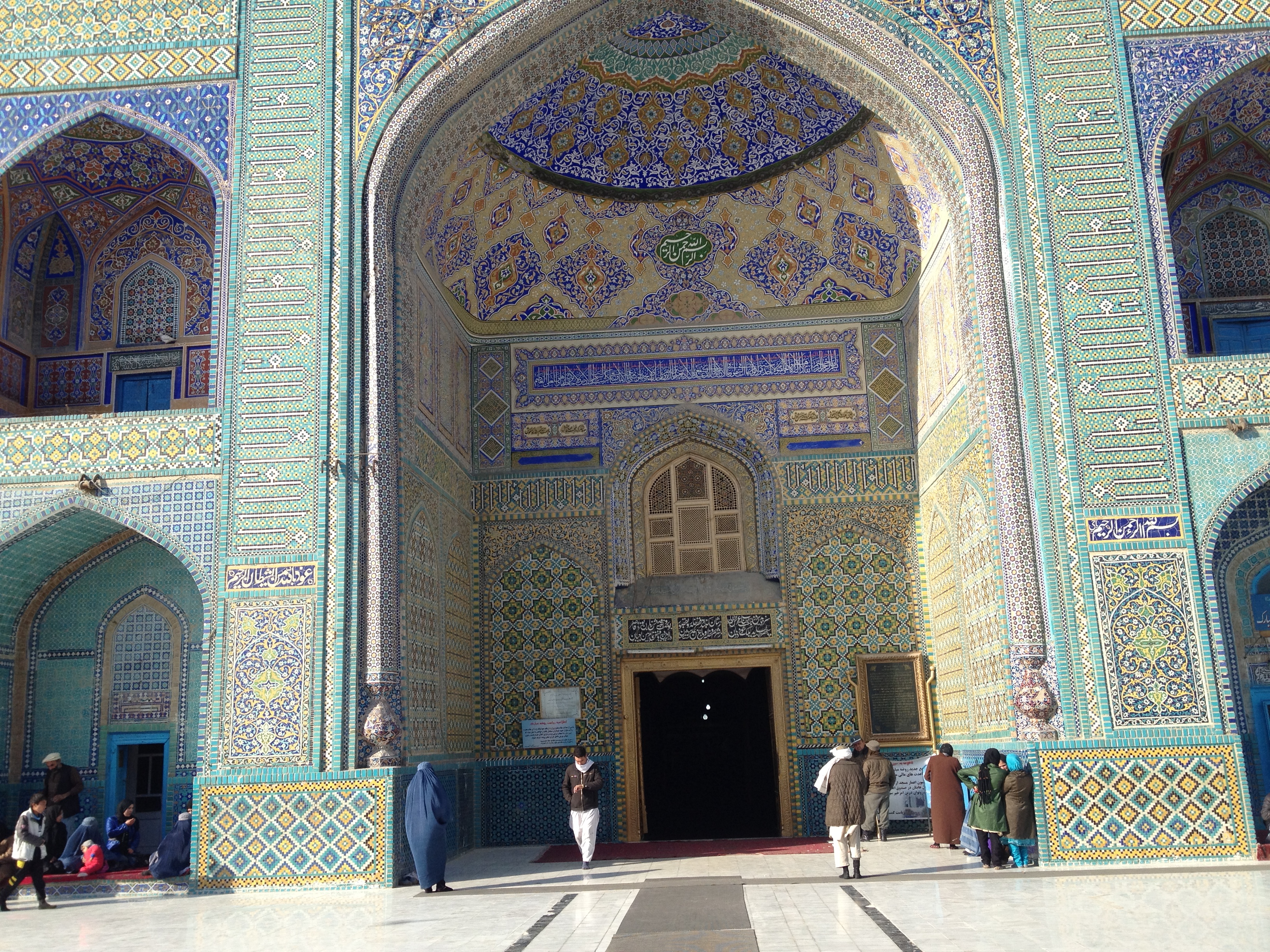
Mausoleum of Imam Ali
White pigeons swirl above blue tile. Families scatter grain in the courtyard while pilgrims circle the central tomb, and the scene has repeated itself for centuries at the Shrine of Hazrat Ali in the heart of Mazar-i-Sharif. Also called the Great Blue Mosque and the Mausoleum of Ali, this complex is the spiritual anchor of northern Afghanistan's largest city. It purportedly houses the remains of Ali ibn Abi Talib, the fourth caliph of Sunni Islam and the first Imam of Shia Muslims, making it one of the most significant pilgrimage destinations in the Islamic world. The city's very name, Mazar-i-Sharif, translates to 'Noble Shrine.'
A Tomb Wrapped in Legend
Whether Ali is truly buried here is a matter of faith rather than historical certainty. The earliest surviving written claim placing Ali's tomb in Balkh comes from the Andalusian traveler Abu Hamid al-Gharnati. Another tradition, recorded by the scholar Abd al-Ghafur Lari, holds that Muhammad al-Baqir, the fifth Shia Imam, assigned Abu Muslim the task of transferring Ali's body to the Khurasan region, though historians regard this account as apocryphal. What is certain is that the land around the shrine was already sacred ground before the current structure existed. A memorial mosque once stood here dedicated to Ali al-Balkhi, a Hanafi Muslim scholar and statesman who died on this site. The layering of meanings is fitting for a place where different traditions of Islamic devotion have converged for centuries.
Nine Centuries of Builders
The shrine's architectural history spans the breadth of Central Asian imperial power. The first recorded structure dates to 1136, when the Seljuk sultan Ahmad Sanjar commissioned a shrine on the site. Over the following centuries, successive rulers added to and renovated the complex. The Shaybanid emir Abd al-Mu'min ibn Abd Allah Khan built a dome. Berdi Beg, Khan of the Golden Horde who reigned from 1357 to 1359, contributed decorative elements. In 1910, a comprehensive renovation plan was developed for the entire complex. The result is a building that carries the fingerprints of multiple dynasties, each leaving its aesthetic signature in the tilework, domes, and minarets that define the present structure.
Blue Against the Dust
The mosque's blue tilework is arresting from the ground and visible from the air. In a landscape dominated by brown earth and the muted tones of mud-brick construction, the shrine's vivid ceramic surfaces announce themselves across the flat terrain of Balkh Province. The Central Asian tradition of tile decoration reaches a high point here, with geometric and floral patterns covering the exterior surfaces in shades of cobalt, turquoise, and white. The courtyard, where the famous white pigeons congregate, provides a public gathering space that functions as both sacred precinct and city commons. Pilgrims come year-round, but the site draws its largest crowds during Nowruz, the Persian New Year. At the traditional Janda Bala ceremony, a flag was raised in Ali's honor, and visitors would touch it hoping for good fortune in the coming year, though this ceremony has been officially halted in recent years.
A City's Living Heart
The shrine is not a relic. It is the active center of daily life in Mazar-i-Sharif. Families come to feed the pigeons. Men pray during Ramadan in its arcaded halls. Tourists, both Afghan and foreign, visit throughout the year regardless of their religious background. The shrine weathered the Taliban era and the violence that repeatedly engulfed the city, including the devastating massacre of 1998 when 400 civilians who had sought refuge within its walls were killed. A 2025 earthquake caused damage to the historic structure, drawing international concern. Through centuries of conquest, civil war, and natural disaster, the Blue Mosque has endured as both a monument to one of Islam's most revered figures and a place where ordinary life continues to unfold amid extraordinary surroundings.
From the Air
Coordinates: 36.71N, 67.11E. The Shrine of Hazrat Ali is the most prominent landmark in central Mazar-i-Sharif, easily identifiable from altitude by its large blue-tiled domes and courtyard complex. It sits in the geographic center of the city, capital of Balkh Province in northern Afghanistan. Nearest airport is Mazar-i-Sharif International Airport (OAMS), approximately 9 km to the east. Elevation approximately 380 meters (1,247 feet). The flat terrain of the northern Afghan plains provides clear visibility of the city and surrounding agricultural land.