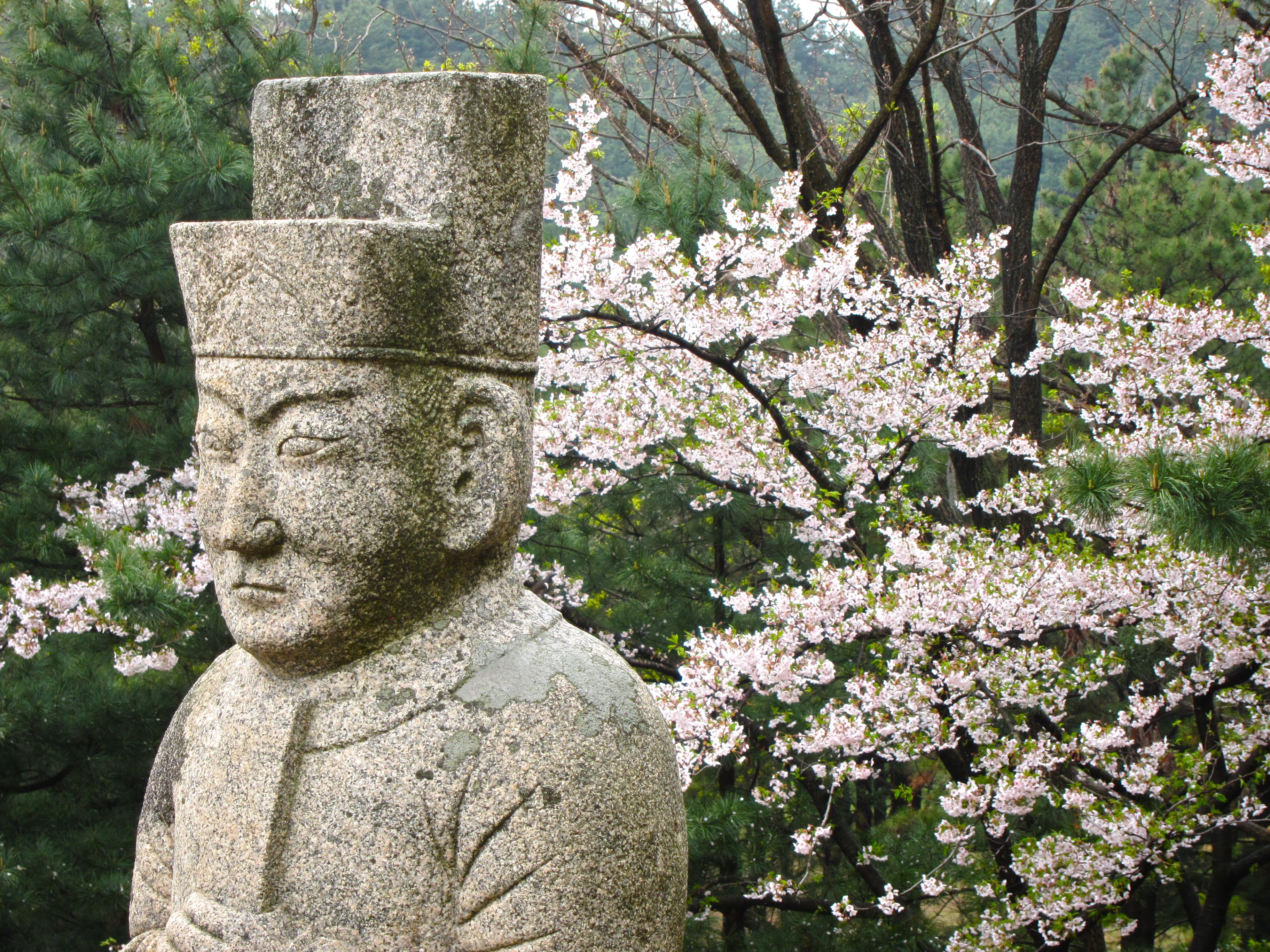
Mausoleum of King Kongmin
The story of King Kongmin's tomb begins with a misunderstanding that cost a young man his life. When the king's beloved wife -- the Mongolian princess Budashiri, known posthumously as Queen Indeok -- died in 1365, Kongmin was consumed with finding the perfect burial site. He summoned geomancer after geomancer, rejecting each one's recommendation. Finally, he issued a terrible ultimatum: the next geomancer to try would receive anything he desired if he succeeded, but would be executed on the spot if he failed. A young man stepped forward and pointed to a hillside outside Kaesong.
A Wave of the Handkerchief
The young geomancer led the king's officials to the spot where the tombs stand today. Meanwhile, Kongmin climbed the opposite mountain to survey the site from above. Before leaving, he had secretly instructed his advisors: if he waved his handkerchief, they should execute the man. When Kongmin reached the summit, exhausted from the climb, he dabbed his brow with his handkerchief and looked out over the landscape. The site was perfect -- exactly what he had been searching for. He hurried back down the mountain to personally congratulate the young geomancer, only to discover that his advisors had seen the gesture and carried out the execution. The king's anguished cry of dismay, according to local legend, gave the opposite mountain its name. It is a fitting origin story for a tomb complex that embodies both extraordinary devotion and senseless loss.
Two Mounds, Two Worlds
The Mausoleum of King Kongmin -- formally the Hyonjongnung Royal Tomb -- consists of two separate burial mounds set into a hillside in Haeson Village, near Kaesong. Hyonnung holds the remains of Kongmin himself, the thirty-first king of the Goryeo dynasty, who reigned from 1351 to 1374. Jongnung contains Queen Indeok, born as the Mongolian princess Budashiri. Their marriage had been a political arrangement -- Goryeo kings were required to marry Mongol princesses during the period of Yuan dynasty domination -- but by all accounts Kongmin's grief at her death was genuine and consuming. Construction on the tombs began in 1365 and took seven years to complete, finishing in 1372. The twin mounds, side by side on their granite bases, represent two civilizations joined in life and in death: Korea and Mongolia.
Guardians of Stone Along the Spirit Road
The approach to the tombs follows a traditional "spirit road" lined with stone statues of military officers and Confucian officials, silent sentinels standing watch over the path the dead were believed to travel. Stone sheep and stone tigers flank the burial mounds themselves -- the sheep representing gentleness, the tigers fierceness, together embodying the balance of um and yang (the Korean pronunciation of yin and yang). Every element of the tomb's design reflects meticulous consultation with geomancers, astrologers, and mathematicians, all employed to ensure the site possessed good pung su -- the Korean practice of feng shui. The carved granite bases, the precise orientation of the mounds, the placement of each guardian figure: nothing was left to chance. Among the royal tombs scattered around Kaesong, Kongmin's is the best preserved, having largely avoided the extensive restorations that the North Korean government applied to other Goryeo burial sites.
Dynamite and Loss
The tombs survived five centuries of dynastic change, war, and neglect -- but not the Japanese occupation. In 1905, looters blasted open the burial chamber with dynamite and stripped it of its relics. Most of the artifacts were believed to have been taken to Japan, and they have never been recovered. Kongmin's coffin, at least, was saved and is now exhibited in the Goryeo Museum in Kaesong. The violence of the looting -- dynamite applied to a structure that had stood intact since the fourteenth century -- makes the tomb's surviving beauty all the more remarkable. The stone guardians still stand along the spirit road, the granite bases still hold their earthen mounds, and the hillside location that a young geomancer chose with his life still commands the landscape around Kaesong. Nominated for UNESCO World Heritage status, the mausoleum is listed as North Korean National Treasure number 123.
From the Air
Located at 37.98N, 126.47E in Haeson Village, near Kaesong, North Korea. The twin burial mounds are visible from low altitude on a hillside surrounded by forested terrain. The site is approximately 10 km west of central Kaesong and roughly 65 km northwest of Seoul. Gimpo International Airport (RKSS) is about 60 km to the south. The DMZ lies approximately 15 km to the south. Look for the cleared hillside with the characteristic paired mounds and the spirit road approach.