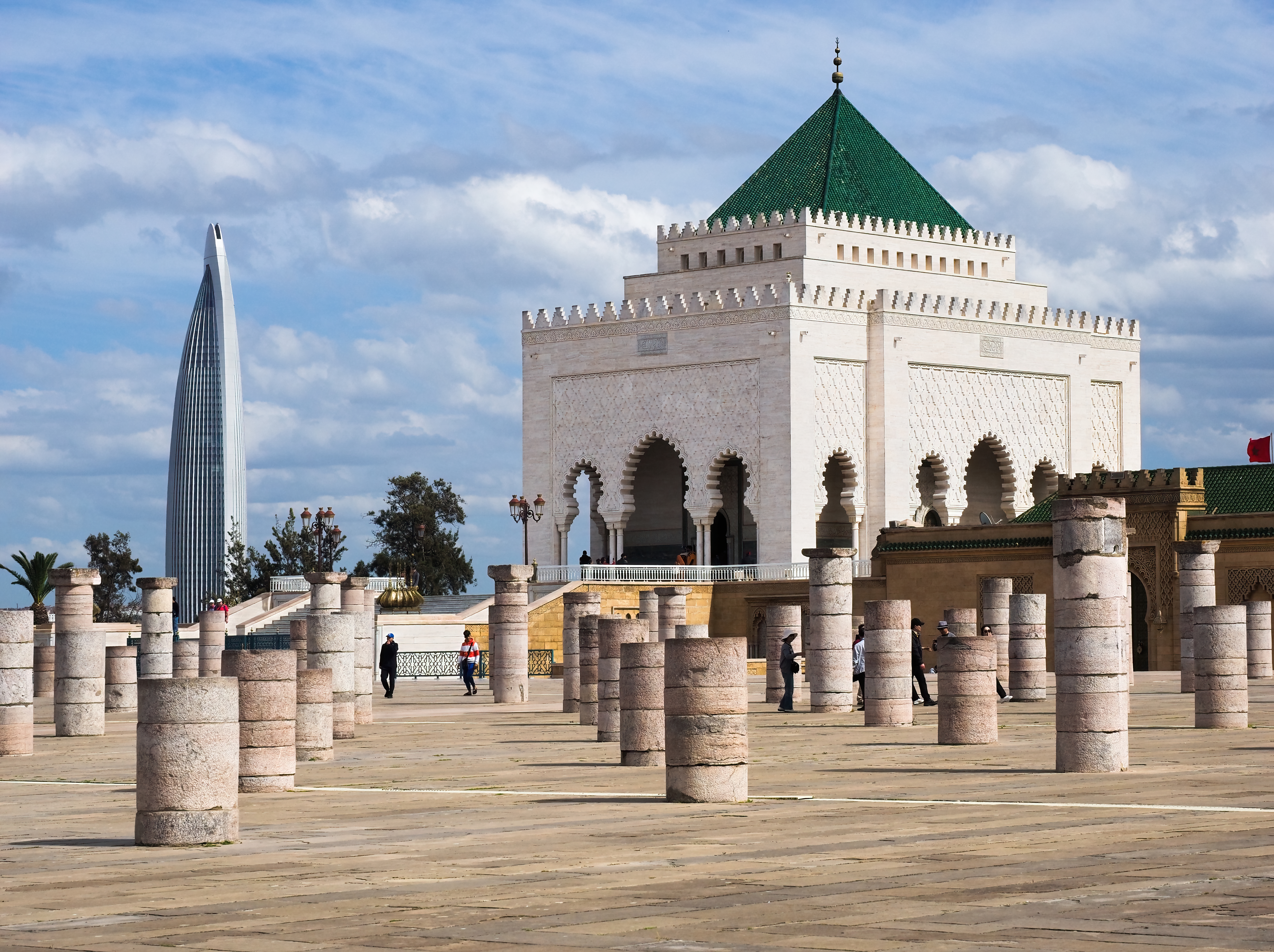
Mausoleum of Mohammed V
A reader of the Quran sits beside the tomb, chanting softly. The dome overhead is carved from mahogany and inlaid with colored glass, casting filtered light across walls sheathed in zellij tilework. The cenotaph itself is white onyx, carved by the craftsman Ibn Abdelkrim. This is the Mausoleum of Mohammed V, and it manages something rare in monumental architecture: it feels both grand and intimate, a national shrine that functions as a place of quiet devotion.
A King Who Won Independence
Mohammed V died in 1961, five years after leading Morocco to independence from France. His son Hassan II commissioned the mausoleum as a tribute to the father of modern Morocco, selecting a site of extraordinary symbolic weight: the esplanade of the unfinished Hassan Tower, where the 12th-century Almohad caliph al-Mansur had once dreamed of building the largest mosque in the western Islamic world. The juxtaposition is deliberate. Mohammed V's resting place sits among the ruins of an 800-year-old architectural ambition, linking his legacy to the deepest roots of Moroccan sovereignty. Hassan II himself was buried here upon his death in 1999, and their brother Prince Abdallah was interred in 1983.
Vietnamese Architect, Moroccan Craft
The mausoleum was designed by Vietnamese architect Cong Vo Toan, an unexpected choice that produced a distinctive building. Vo Toan used reinforced concrete as the structural skeleton but clad the exterior in white marble, creating a building that reads as traditional Moroccan from the outside while employing thoroughly modern engineering within. The exterior features porticos of Moorish arches, polylobed and decorated with the sebka motif characteristic of Moroccan Islamic design. The pyramidal roof is covered in green tiles, the traditional color of Islam and of the Alaouite dynasty. Inside, zellij tilework covers the walls in geometric patterns, and chased brass elements catch the light filtering through the colored glass dome. The effect is of entering a jewel box scaled to architecture.
A Complex of Monuments
The mausoleum does not stand alone. It anchors the southeastern corner of the Hassan Tower esplanade, which is itself a remarkable space defined by the rows of stone columns from the never-completed Almohad mosque. To the west, at the esplanade's opposite corner, an open-air pavilion with rows of arches was designed as a museum for the Alaouite dynasty. Between these two structures, a purpose-built mosque completes the complex. This mosque was deliberately built at a lower level so that it would not obstruct views between the mausoleum and the pavilion. Its hypostyle interior, divided between men's and women's sections, includes a marble-paved courtyard. Royal guards in white and red uniforms stand at attention at the mausoleum's entrance, motionless in the North African sun.
Between Ancient Columns
Walking through the esplanade toward the mausoleum means passing through the ghost of al-Mansur's mosque. The stone columns, weathered and rounded by eight centuries of Atlantic wind, stand in orderly rows like an open-air cathedral without a roof. They frame the white marble mausoleum in a way no modern architect could have planned -- the ancient and the modern existing in a single sightline. From the broad steps below the mausoleum, the view encompasses the Hassan Tower rising to the northwest, the columns stretching across the platform, and the city of Rabat spreading outward beyond. The site was included in Rabat's UNESCO World Heritage designation in 2012, recognized as part of the shared heritage of a city that has been a capital, in one form or another, for nearly a thousand years.
From the Air
Coordinates: 34.023N, 6.822W. The mausoleum is adjacent to the Hassan Tower on the south bank of the Bou Regreg river, easily identifiable by its green pyramidal roof and white marble walls. The orderly field of ancient columns on the esplanade is visible at moderate altitudes. Nearest airport: GMME (Rabat-Sale, 4 km northeast). The Kasbah of the Udayas sits at the river mouth to the northwest.