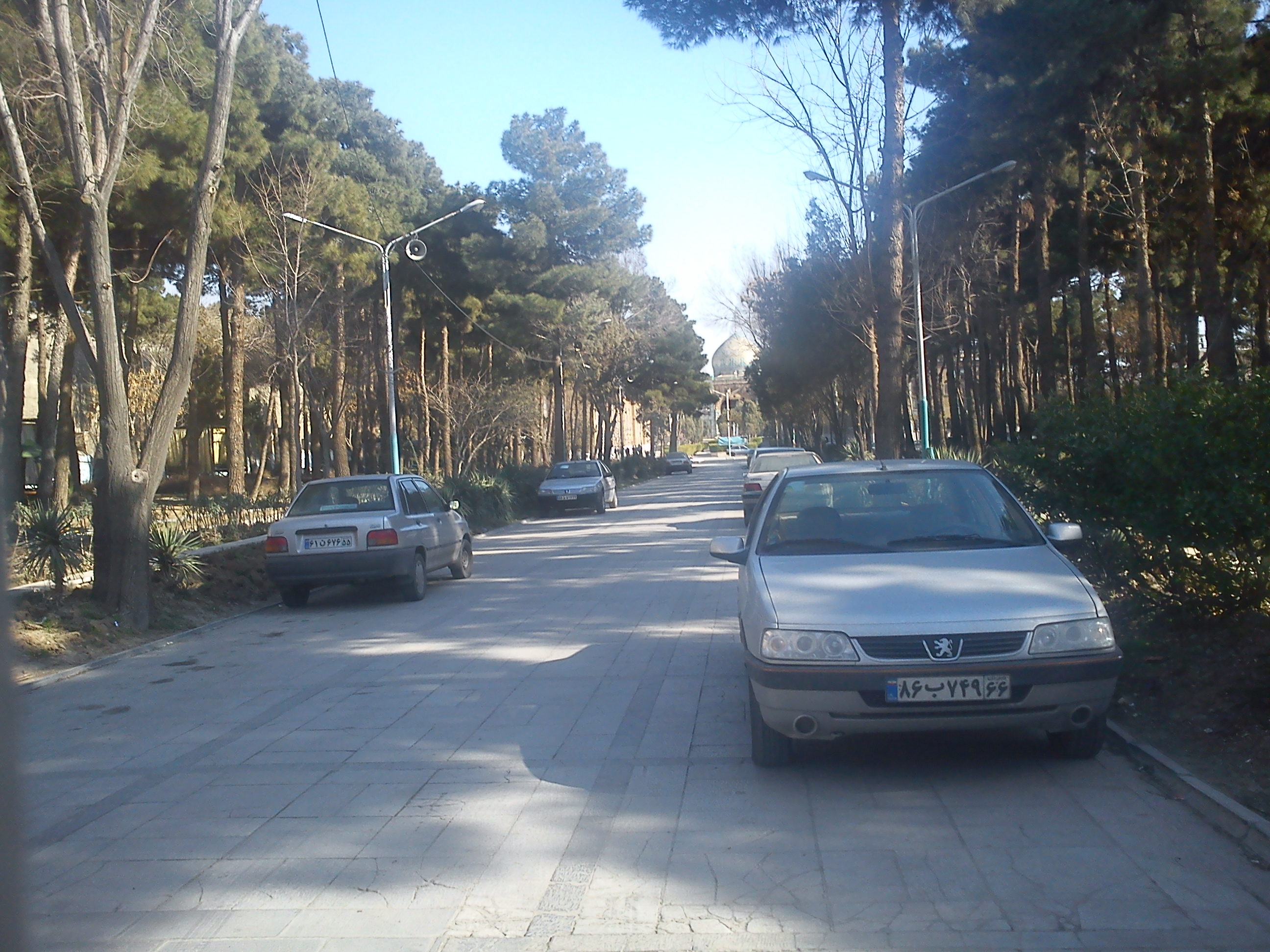
Mausoleum of Reza Shah
There is nothing to see. That is the point. In the southern Tehran district of Rey, near the ancient Shah Abdol-Azim Shrine, an empty lot marks where a 25-meter-tall mausoleum once stood. Completed in 1950, demolished in 1980, the tomb of Reza Shah Pahlavi -- Iran's penultimate emperor -- was built to last forever and destroyed in less than a month. The building is gone. The body it contained has never been conclusively found. What remains is a mystery that speaks to how nations settle scores with their own past.
A Tomb Modeled on Napoleon's
Reza Shah died in exile in South Africa in 1944, deposed by the Allied powers three years earlier. His body traveled a winding route home: from Egypt by train and plane, with stops in Mecca and Medina, then by air to Ahvaz, and finally by rail to Tehran. The funeral took place in Rey on 8 May 1951, attended by his son Mohammad Reza Shah, the entire Pahlavi family, and Prime Minister Mohammad Mosaddegh. The mausoleum they gathered around had been designed by Mohsen Foroughi, Keyqobad Zafar, and Ali Sadeq -- pioneers of modern Iranian architecture. Its circular colonnade and central sarcophagus of blue Izmir marble were inspired by Napoleon's tomb at Les Invalides in Paris. The complex stretched across 9,000 square meters, its dome deliberately built seven meters shorter than the neighboring shrine, a gesture of deference to the religious site beside it.
Power and Ceremony
For nearly thirty years, the mausoleum served as a stage for Pahlavi legitimacy. Foreign leaders paid their respects -- Queen Elizabeth II in 1961, Emperor Haile Selassie of Ethiopia in the same decade. The golden jubilee of the Pahlavi dynasty was celebrated here in 1976, fifty years after Reza Shah's coronation. Other prominent figures were buried alongside the founder: the assassinated Prime Minister Haj Ali Razmara, General Fazlollah Zahedi, the assassinated Prime Minister Hassan Ali Mansur, and Prince Ali-Reza Pahlavi, who died in a 1954 plane crash in the Alborz Mountains. The mausoleum gathered the dynasty's honored dead in one place, making it both a shrine and a political statement.
Twenty Days of Destruction
After the Islamic Revolution toppled the monarchy on 11 February 1979, the new government moved to erase the Pahlavi legacy. Ayatollah Sadegh Khalkhali -- the revolutionary judge known for his ruthlessness -- supervised the demolition of the mausoleum beginning in April 1980. Not everyone agreed. Sadegh Ghotbzadeh and President Abolhassan Banisadr proposed converting the site into a museum honoring victims of the Pahlavi regime. Ayatollah Khomeini rejected the idea. The destruction took about twenty days. In his memoirs, Khalkhali admitted the building proved extraordinarily difficult to demolish, a testament to the quality of its construction. When the revolutionaries opened the sarcophagus, they claimed to find it empty.
The Missing Emperor
What happened to Reza Shah's remains became one of Iran's most persistent mysteries. The revolutionaries suggested Mohammad Reza Shah had secretly removed his father's body before fleeing the country in January 1979. Empress Farah Pahlavi denied this in a 2015 documentary, stating plainly: "He is still buried there." Biographers Houchang Nahavandi and Yves Bomati offered a third version -- that the body had been moved before the revolution to a secret location known to only a few. Then, in April 2018, construction workers expanding the Shah Abdol-Azim Shrine stumbled upon a mummified body at the site of the former mausoleum. Officials said it belonged to Reza Shah. The body was reburied in the same area. When Prince Ali-Reza's remains were sought during the original demolition, they were never found. The mausoleum kept some of its secrets even as it was torn apart.
What Absence Tells
The site was added to the Iran National Heritage List in 1977 and removed after its destruction in 1980. Today, the absence speaks as loudly as the building once did. The shrine next door still stands. The avenue that Reza Shah's successors cut through Rey to lead processional traffic to the tomb still exists, now leading nowhere in particular. Monuments are built to fix memory in place, to declare that a version of history is permanent. The mausoleum's destruction was its own declaration -- that no dynasty's version of the past is safe from the next one's revision. In a country where the struggle over historical narrative remains as fierce as any political contest, the empty ground in Rey is its own kind of monument.
From the Air
Located at 35.59N, 51.43E in Rey, a historic district in southern Tehran, Iran. The site lies adjacent to the Shah Abdol-Azim Shrine, which is visible from the air as a prominent domed structure. Nearest airport is Mehrabad International Airport (OIII), approximately 15 km to the northwest. Imam Khomeini International Airport (OIIE) is about 40 km to the south. Best viewed at 3,000-5,000 feet AGL. The area sits in the flat southern reaches of Tehran, south of the main urban core.