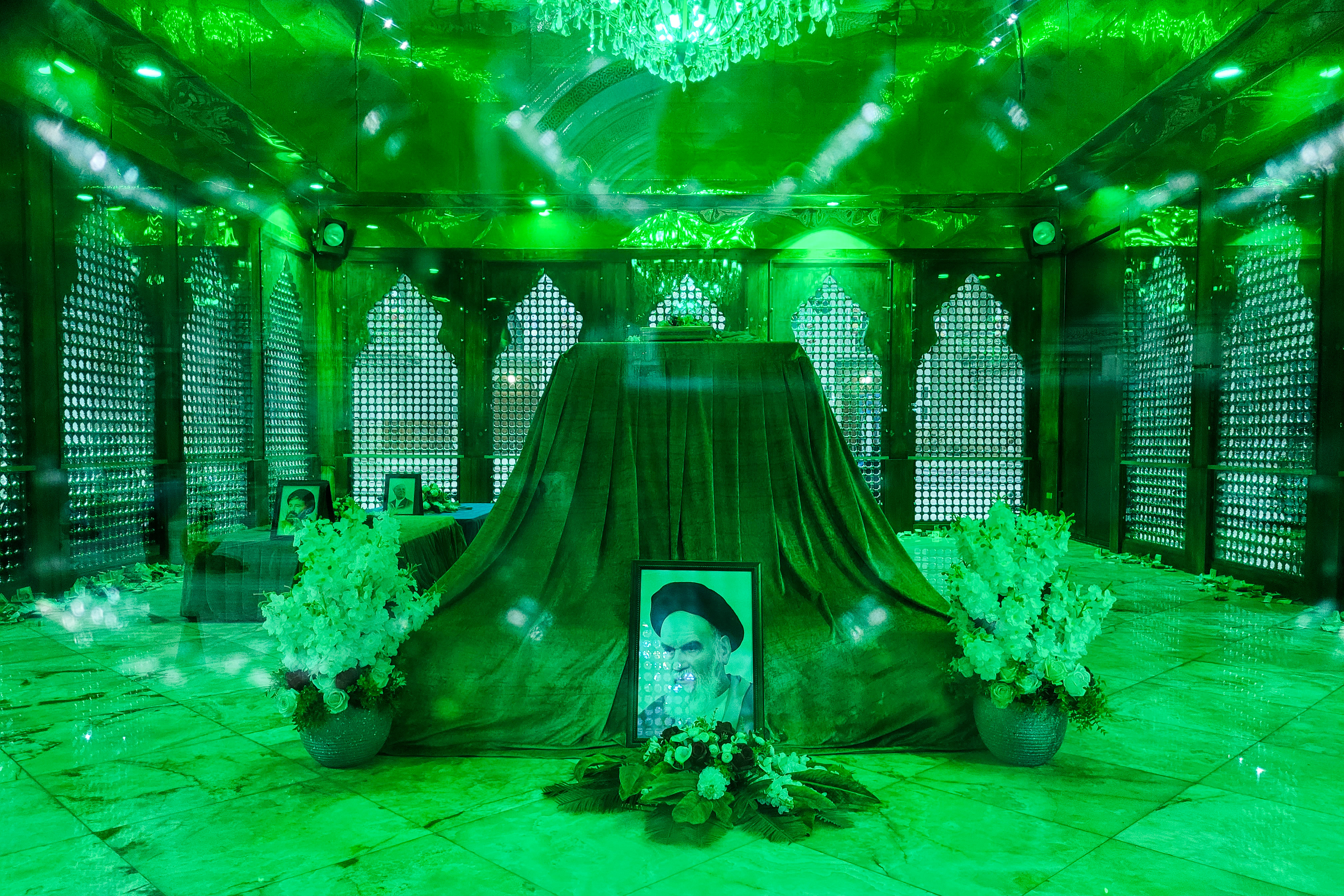
Mausoleum of Ruhollah Khomeini
Four golden minarets rise from the southern edge of Tehran, marking a structure so vast it has its own shopping mall, its own university, and parking for twenty thousand cars. The Mausoleum of Ruhollah Khomeini -- known to Iranians as the Haram Motahhar, the Holy Shrine -- is not merely a tomb. It is a statement built in concrete, steel, and gold leaf about the scale of one man's legacy and the political order he set in motion. Construction began within days of Khomeini's death on June 3, 1989, as millions of mourners overwhelmed the funeral procession so completely that the coffin had to be airlifted by helicopter. The chaos of that burial foreshadowed the ambition of what would follow: a funerary complex spread across two thousand hectares, still expanding more than thirty-five years later.
A Shrine in the Cemetery
The mausoleum sits within Behesht-e Zahra -- the Paradise of Zahra -- Iran's largest cemetery, where hundreds of thousands of graves stretch across the arid plain south of the capital. The choice of location was deliberate. Behesht-e Zahra holds the remains of soldiers killed in the Iran-Iraq War, protesters who died during the 1979 Revolution, and generations of ordinary Tehranis. Placing Khomeini among them was meant to project humility, though the building itself communicates something different. Designed by Mohammed Tehrani, the shrine features a massive rectangular plaza engineered to accommodate enormous crowds. The tomb structure includes a qibla wall and a maqsura, elements that give it the architectural grammar of a mosque, though scholars have classified it as a Hussainia -- a hall for Shia commemorative gatherings. Non-Muslims are welcomed inside, a deliberate policy of accessibility uncommon among major Shia shrines.
Tombs and Power
Khomeini does not rest alone. His wife Khadijeh Saqafi and his second son Ahmad Khomeini are interred in the complex, along with several figures who shaped the Islamic Republic. Former President Akbar Hashemi Rafsanjani, a pragmatist who helped guide the country through the Iran-Iraq War and its aftermath, was buried here after his death in 2017. Former Vice President Hassan Habibi and Lieutenant General Ali Sayad Shirazi, assassinated in 1999, also lie within the complex. The mausoleum functions as a kind of political pantheon, its occupants chosen carefully to reinforce narratives of revolutionary continuity. Each year on June 4, the anniversary of Khomeini's death draws government officials, foreign ambassadors, and throngs of supporters. His grandson, Seyyed Hassan Khomeini, oversees the shrine's upkeep -- a custodial role that carries its own political weight in Iranian public life.
Under Attack
The mausoleum's symbolic importance has made it a target. In June 2009, a suicide bomber detonated near the shrine, killing only himself but injuring three pilgrims. The attack came during the turbulent aftermath of Iran's disputed presidential election, though no group claimed responsibility in connection with the protests. Eight years later, on June 7, 2017, a coordinated assault struck the mausoleum and Iran's parliament simultaneously. Three gunmen opened fire while a suicide bomber detonated explosives inside the shrine complex. One female attacker was captured alive. The Islamic State claimed responsibility for the attacks, which killed seventeen people across both locations. It was the first major IS-claimed attack on Iranian soil, shattering the country's sense of insulation from the group's campaign of violence across the region.
Ambition in Gold and Concrete
The numbers behind the mausoleum defy easy comprehension. The Iranian government has reportedly spent two billion dollars on the complex, which continues to grow. Beyond the tomb itself, the site encompasses a cultural and tourist center, a university for Islamic studies, a seminary, and commercial facilities. The scale invites comparisons with the grandest funerary monuments in history, though the mausoleum's architectural language is distinctly modern -- glass, steel, and reinforced concrete alongside traditional Islamic decorative elements. The four minarets, each standing approximately ninety-one meters tall, are visible from kilometers away, an intentional beacon on Tehran's southern approach. For the pilgrims who stream in daily, the mausoleum offers a tangible connection to the revolution's founding figure. For the government, it is a stage where power is performed and legitimacy renewed.
From the Air
Located at 35.5492N, 51.3665E, south of Tehran proper within the vast Behesht-e Zahra cemetery. The four tall minarets and golden dome are visible from considerable altitude on approach. Nearest major airport is Tehran Imam Khomeini International Airport (OIIE), approximately 30 km to the southwest. Mehrabad International Airport (OIII) lies 15 km to the north within the city. Best viewed from 3,000-5,000 feet on a clear day; the complex's sheer footprint -- 2,000 hectares -- is unmistakable against the surrounding cemetery and semi-arid terrain.