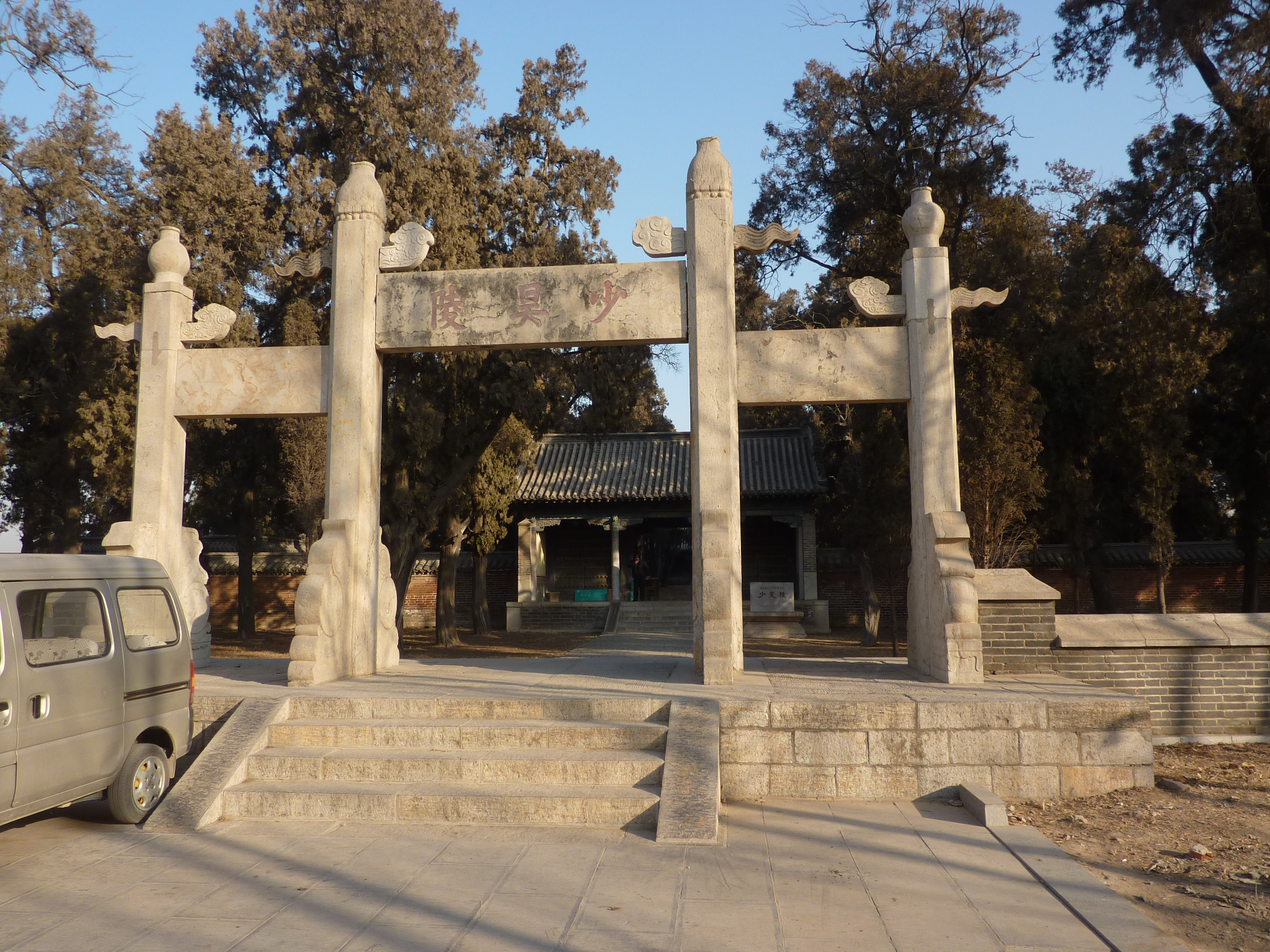
Mausoleum of Shaohao
Most visitors mistake the pyramid for the tomb. On the eastern outskirts of Qufu, a stone step-pyramid rises behind a sacrificial hall, looking every bit like a burial monument. But the pyramid is actually Shou Qiu -- a legendary hill associated with the Yellow Emperor, encased in stone during the 12th century. The real tomb sits just a few meters behind it: a large earthen tumulus where Shaohao, the Yellow Emperor's son, was reportedly laid to rest in an age so distant it blurs into myth.
Father and Son in Stone
Shaohao occupies a peculiar place in Chinese mythology. As the son of the Yellow Emperor -- the legendary ancestor of the Chinese people -- he bridges the gap between pure myth and the semi-historical rulers of early China. His mausoleum on the outskirts of Qufu was originally separate from the Shou Qiu monument, but a 12th-century renovation merged the two sites into a single complex. That renovation also added a shrine dedicated to the Yellow Emperor himself and other buildings, creating a compound that honored both father and son. By the time the tomb was renovated again in 1738 during the Qianlong era, the rest of the complex had disappeared, so a new sacrificial hall was built in front of the Shou Qiu pyramid, and the earthen tumulus behind it was enclosed within the walls.
Neolithic Echoes
In 1978, excavations of the grounds within the enclosure yielded artifacts that complicated the site's mythology with harder evidence. Archaeologists recovered stone axes and shovels identified as Neolithic, along with ceramics from the same period. The tomb mound itself has never been formally excavated, so its true age and contents remain unknown. But the Neolithic finds suggest that people were living and working on this site thousands of years before any Chinese dynasty existed -- before anyone wrote down the stories of the Yellow Emperor and his son. The artifacts hint at a continuity of human habitation that may explain why later generations chose this particular spot to honor their mythological ancestors.
The Pyramid That Is Not a Tomb
The Shou Qiu step-pyramid, which visitors so often mistake for Shaohao's burial, has its own story. The original Shou Qiu was a natural hill revered as the birthplace of the Yellow Emperor. When it was encased in stone in the 12th century, the result was a modest step-pyramid topped with a small pavilion. The pavilion contains a statue whose identity has shifted over time -- since the Qing dynasty reorganization of the site, it has been identified as Shaohao, though this was not always the case. The proximity of the pyramid and the tumulus has confused visitors for centuries, but the confusion itself speaks to how thoroughly mythology has saturated this landscape. Every mound, every stone, every structure carries a story that reaches back to the origins of Chinese civilization.
From the Air
Located at 35.61N, 117.03E on the eastern outskirts of Qufu, Shandong Province. The mausoleum complex with its distinctive pyramid-like structure is a small site best viewed from lower altitudes. Nearest airport is Jining Qufu Airport (ZLJN). The site is approximately 4 km east of the main Confucian sites in central Qufu.