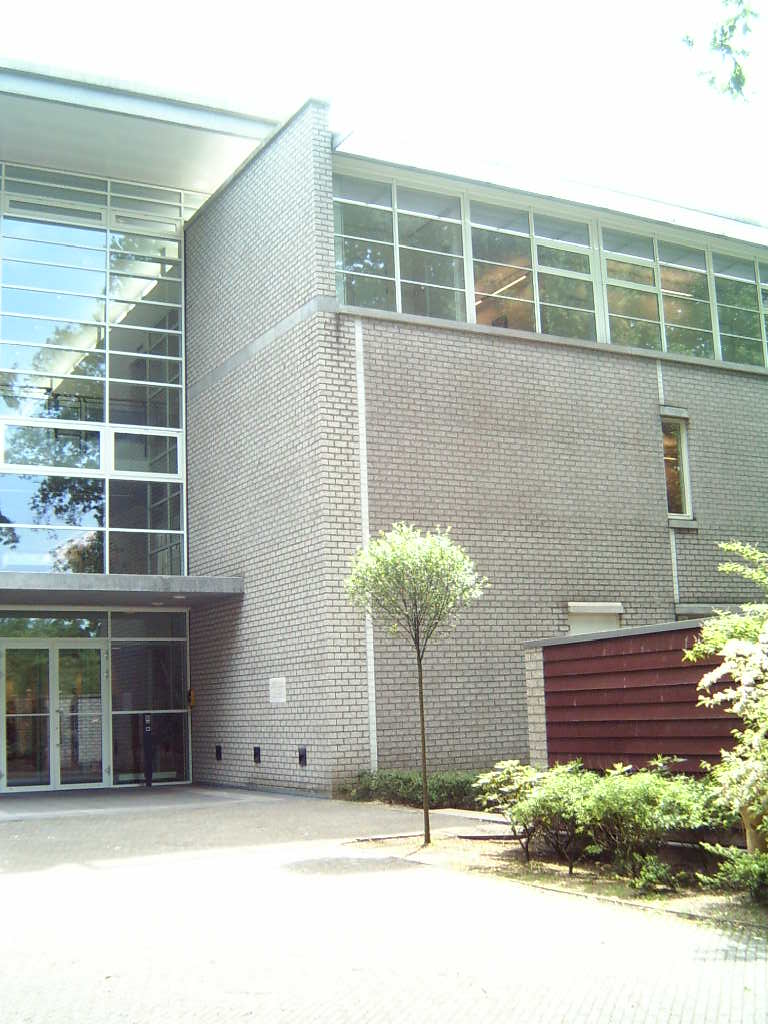
Max Planck Institute for Psycholinguistics
Most research institutes name themselves for what they do. The Max Planck Institute for Psycholinguistics is unusual in being the only institute on Earth that does what it does at this scale. Founded in 1980 by the Dutch psycholinguist Pim Levelt, tucked onto the campus of Radboud University Nijmegen, it is one of the very few Max Planck Institutes the German society has chosen to plant outside Germany itself. Its single subject is the human capacity for language: how a sentence forms in the mind before it leaves the mouth, how a baby learns to mean something with a noise, why a stroke in one specific patch of cortex can take away nouns but leave verbs intact, what variations in the human genome let our species do this at all.
An Institute For One Question
There are about eighty Max Planck Institutes. They study everything from astrophysics to economic history. Almost all of them are in Germany. The Psycholinguistics Institute is the rare exception. Pim Levelt, then one of the most influential figures in the science of how speech is planned and produced, convinced the Max Planck Society in 1980 that the new institute should be built where Dutch linguistics was strongest, on the edge of Nijmegen. According to the Web of World Research Centers ranking, it sits second among all Max Planck Institutes for scientific visibility, despite being only the eighth largest. It is, in other words, a small place with an outsized reach into the world's understanding of how the human mind moves words around.
Four Departments, One Brain
The institute is built around four research departments, each looking at language from a different scale. The Language and Genetics department, founded in 2010 under Simon Fisher, uses molecular methods to chase down the DNA variations that affect human communication. Fisher's group works not only with people who have language-related disorders but with the general population, trying to trace how human genomes ever produced a language-ready brain at all. The Neurobiology of Language department, led by Peter Hagoort, scans living brains in the act of comprehending and producing speech. The institute houses a high-density EEG lab and a virtual-reality lab, and through its sister institute next door, the Donders Centre, has access to a 275-channel MEG system and MRI scanners running at 1.5, 3, and 7 tesla. Down the hall, the Language Development department, headed by Caroline Rowland, watches how very young children acquire their first language; the Psychology of Language department, led by Antje Meyer, examines what cognitive machinery underlies fluent adult speech.
The Quiet Archive of Vanishing Tongues
Of perhaps 7,000 languages spoken today, about half are expected to disappear before the end of this century. One of the institute's longest-running projects has been to record them before they go. Since 2000, with funding from the Volkswagen Foundation, the institute has built and curated an international digital archive of endangered languages, with field recordings, transcripts, and analyses from roughly fifty different documentation projects. The Language and Cognition department, run for over two decades by Stephen Levinson before it closed in 2017, used the world's linguistic diversity as a kind of natural laboratory. Field researchers traveled to communities that had never had their language formally described and then brought the data back to Nijmegen, where it was analyzed against everything from child development theory to phylogenetic models borrowed from biology. Many languages were described systematically here for the first time.
Why Nijmegen, Of All Places
The choice of Nijmegen, more than four decades on, looks less surprising than it once did. The city sits at a crossroads of Dutch, German, and English linguistic traditions, with a university that produced Pim Levelt and Stephen Levinson and has gone on producing world-leading psycholinguists. The Max Planck building shares its block with the Donders Institute for Brain, Cognition and Behaviour, so a researcher working on a hypothesis about how the brain integrates word meaning can walk down the corridor and book time on a 7-tesla MRI. Former departments and groups, like Anne Cutler's Language Comprehension department, which ran from 1993 to 2013 and reshaped how scientists think about decoding continuous speech, are continually replaced with new directions. The institute keeps reorganizing around whatever frontier looks most worth crossing next, which is perhaps the most psycholinguistic thing about it: language is the one thing humans are best at, and we still do not really understand how we do it.
From the Air
Coordinates 51.818°N, 5.857°E, on the Radboud University campus on the south side of Nijmegen, just east of the city center. The campus is recognizable from the air as a cluster of modern blocks set in green grounds, with the Sint Annastraat axis running northeast toward the old town and the Waal river beyond. Eindhoven Airport (EHEH) lies about 55 km southwest; the city itself sits at the northern edge of the Reichswald forest, which crosses into Germany a few kilometers east. Clearest views in mid-morning when sun lights the campus from the southeast.