The May 15 Incident: The Coup That Nearly Killed Charlie Chaplin
Charlie Chaplin arrived in Tokyo on May 14, 1932. The next day, eleven young Imperial Japanese Navy officers burst into the official residence of Prime Minister Inukai Tsuyoshi and shot him dead. Chaplin had been on their list too. The conspirators calculated that murdering the world's most famous entertainer at a reception hosted by the prime minister would provoke a war with the United States, creating the chaos they needed to overthrow Japan's civilian government. But when the assassins struck, Chaplin was not at the prime minister's residence. He was watching a sumo wrestling match with Inukai's son, Inukai Takeru -- an afternoon outing that almost certainly saved both their lives. The failed attempt to kill a comedian and the successful murder of a head of state together form one of the strangest and most consequential episodes in modern Japanese history: the May 15 Incident, a turning point that cracked open the door to military rule.
A Treaty, a Grudge, a Plot
The roots of the May 15 Incident lay in naval politics. The 1930 London Naval Treaty imposed strict limits on the size of the Imperial Japanese Navy, and the treaty's ratification infuriated junior officers who saw it as a humiliation imposed by weak civilian politicians. A movement grew within the officer corps -- young men barely out of their twenties, steeped in ultranationalist ideology, convinced that parliamentary democracy was corrupting the emperor's divine authority. They wanted military rule, and they were willing to kill for it. The conspirators drew support from the League of Blood, or Ketsumei-dan, a right-wing organization that had already carried out assassinations earlier that year. Civilian ultranationalists including Shumei Okawa, Mitsuru Toyama, and Kozaburo Tachibana joined the plot. The plan was ambitious: assassinate the prime minister, bomb financial institutions, knock out electrical substations, and plunge Tokyo into darkness and disorder.
Eleven Shots in the Residence
On the evening of May 15, the officers -- most of them barely twenty years old -- forced their way into the prime minister's official residence. Inukai Tsuyoshi, seventy-six years old and one of Japan's most experienced politicians, confronted his assassins directly. His last words were an appeal to reason -- roughly translated as 'If we could talk, you would understand' -- to which his killers replied, 'No more discussion.' They shot him. Simultaneously, other conspirators attacked the residence of Makino Nobuaki, the Lord Keeper of the Privy Seal, and hurled hand grenades into the headquarters of Mitsubishi Bank in Tokyo. Electrical transformer substations were also targeted. But the broader uprising never materialized. The coup had no support among senior military leadership, and without widespread participation, the violence remained isolated. The conspirators, having murdered the prime minister and thrown a few grenades, did something almost absurd: they hailed a taxi, rode to police headquarters, and surrendered themselves to the Kempeitai military police without resistance.
110,000 Petitions Written in Blood
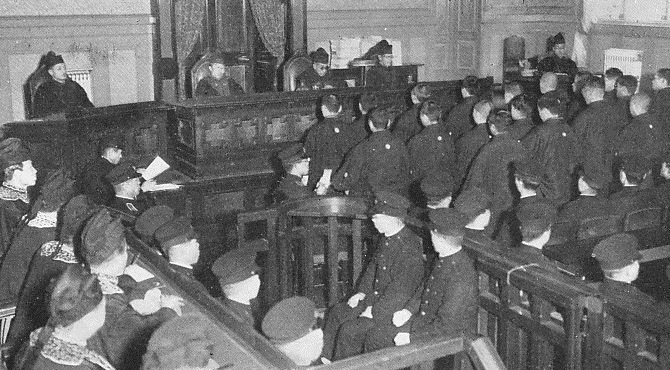
The trial that followed revealed something far more alarming than the assassination itself. The eleven officers used the courtroom as a stage, proclaiming their loyalty to the emperor and appealing for government reforms. Japanese public opinion turned sharply in their favor. By the end of the trial, the court had received 110,000 clemency petitions from sympathizers across the country, many signed in blood. Nine young men from Niigata went further: they asked to be tried in place of the defendants and sent the court a jar containing their own severed pinky fingers as proof of sincerity. The sentences were shockingly light. None of the assassins received the death penalty. The message was unmistakable: in 1930s Japan, murdering an elected leader in the name of the emperor was a forgivable act. Democratic governance lost its hold. Military influence over government deepened steadily through the decade, and within five years Japan would be at war with China, and within nine, with the United States.
The Crack in Democracy's Wall
Inukai Tsuyoshi was the last prewar prime minister of Japan to be chosen through party politics. After his assassination, no party leader would hold the office again until after World War II. The May 15 Incident did not overthrow the government in any formal sense -- the conspirators surrendered, were tried, and were sentenced. But the light punishments and enormous public sympathy demonstrated that the rule of law could bend under the weight of nationalist fervor. The incident, combined with the February 26 Incident four years later in 1936, eroded the foundations of civilian control over the military. The prime minister's official residence in central Tokyo, where Inukai was killed, still stands -- a quiet compound in a neighborhood of government buildings, its significance unmarked by the scale of what happened inside. Charlie Chaplin, for his part, continued his tour of Japan unharmed, apparently unaware of how close he had come to becoming a casus belli.
From the Air
Located at 35.673°N, 139.744°E in the Nagatacho government district of central Tokyo, near the National Diet Building and the Prime Minister's Official Residence. From altitude, the district is identifiable by its concentration of large government buildings and green spaces including the Imperial Palace grounds to the northeast. Best viewed at 2,000-4,000 feet AGL. Tokyo Haneda Airport (RJTT) lies approximately 8 nautical miles to the south. The Imperial Palace moat system and the distinctive green rectangle of the palace grounds are the primary visual navigation landmarks in this area.