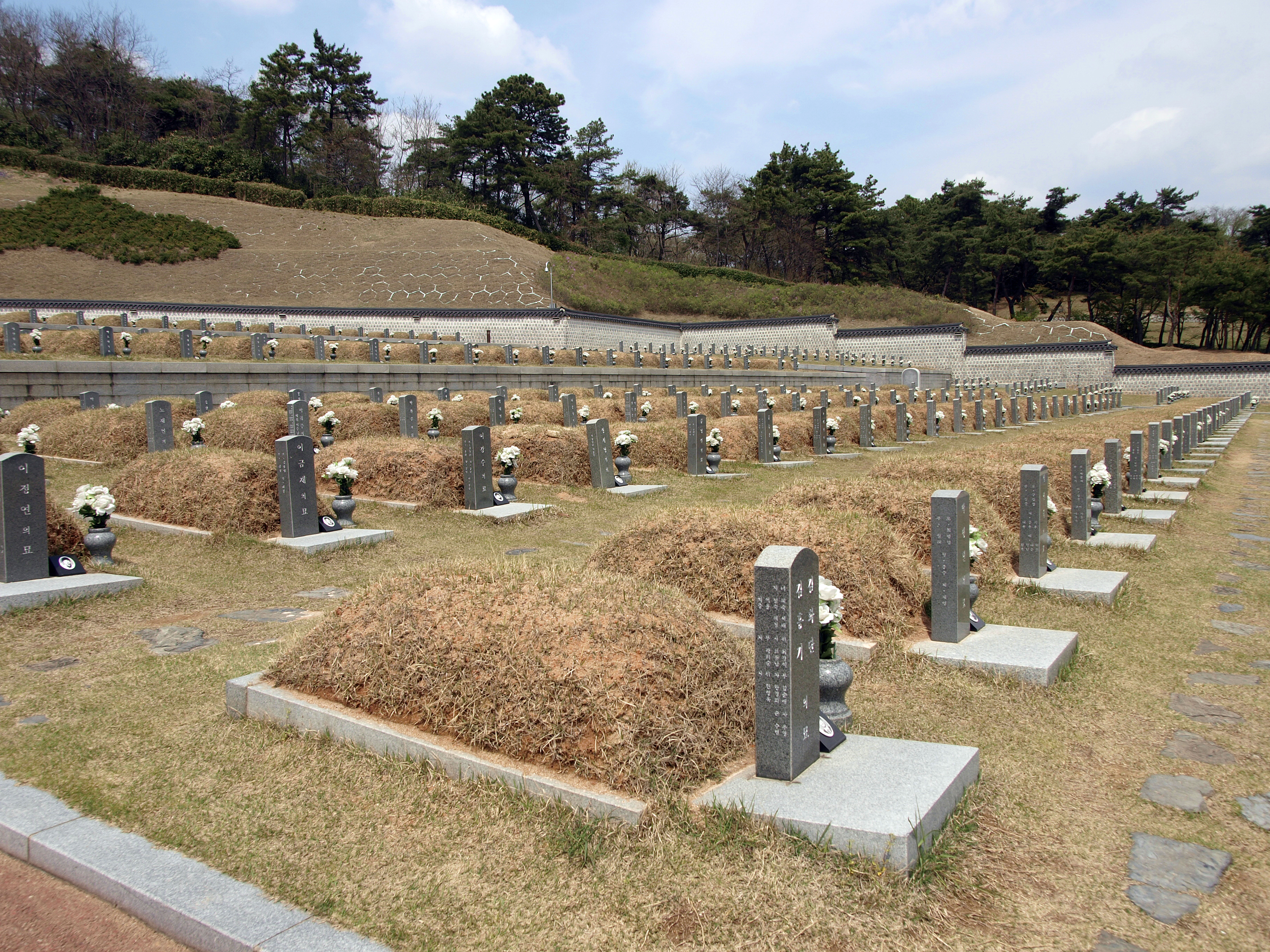
May 18th National Cemetery
Some of the dead were delivered to Mangweol-dong Cemetery in garbage trucks. For seventeen years, that indignity was compounded by the threat that the military government might destroy the graveyard entirely -- erase even the evidence of the lives it had taken. Instead, the graves became a pilgrimage site, the cemetery a 'holy ground for democracy,' and the dead became more powerful than the dictatorship that killed them.
From Garbage Trucks to Holy Ground
The original Mangweol-dong Cemetery was never meant to be a national monument. It was where the victims of the May 1980 Gwangju Uprising were hastily buried -- students, taxi drivers, office workers, teenagers -- after South Korean military forces crushed the city's pro-democracy resistance. Under Chun Doo-hwan's dictatorship, even visiting the graves was an act of political defiance. The military made plans to demolish the cemetery, recognizing its growing symbolic power. But the plans were never carried out. Every May, on the anniversary of the uprising, citizens gathered at Mangweol-dong to honor the dead and, in doing so, to insist on a truth the government refused to acknowledge. The cemetery became inseparable from the democratic movement itself -- not just a place to mourn but a place to resist.
A Nation Reckons
As South Korea democratized in the late 1980s and 1990s, the political meaning of the Gwangju dead shifted from subversive to sacred. Under President Kim Young-sam, the movement to transform the burial site into a democratic shrine gained official support. A new cemetery was built in 1997, and the bodies from Mangweol-dong were exhumed and re-interred with the dignity they had been denied in death. The old cemetery was restored to its former state as a historical site. On 27 July 2002, President Kim Dae-jung -- himself a Jeolla native who had been sentenced to death for his alleged role in the uprising -- elevated the new cemetery to national status by presidential decree. It was renamed the National Cemetery for the May 18th Democratic Uprising on 30 January 2006. The cemetery has a burial capacity of 784.
Monuments in Stone and Memory
The cemetery's Memorial Monument consists of two parallel pillars rising 40 meters, designed after the traditional Korean dang-gan-ji-ju flagpole structure. A Memorial Hall offers visitors an interactive experience of the uprising's events, including historical records, tributes to victims, and a virtual tour of key landmarks in the democratic movement. The Portrait Enshrinement Tower, shaped like a dolmen -- a prehistoric tomb form found throughout Korea -- displays portraits of the buried on its interior walls. The Seungmoru exhibition space screens video footage of the uprising. Relief sculptures titled 'Seven Scenes From History' trace Korea's resistance to oppression across centuries, placing the Gwangju dead within a continuum of struggle that stretches far beyond 1980. On the grounds, the Hill of Democracy is planted with 'Trees of Democracy,' and the Gateway to History contains photographs and documentaries that ensure no visitor leaves without understanding what happened here.
The Names on the Hill
Among those buried here is Lee Han-yeol, born in Hwasun County in 1966, a democratic movement activist fatally wounded during a demonstration at Yonsei University during the June 1987 Democracy Movement. His death, captured in a photograph that became iconic, sparked further protests that accelerated the end of military rule. Other graves belong to student leaders from Chonnam National University, militia members who served as spokespeople during the uprising's five days of citizen self-governance, and ordinary people whose names were unknown to anyone outside their families until the day they stepped into the streets. Every May, the cemetery fills with visitors -- families of the dead, veterans of the movement, schoolchildren learning history that was suppressed for a generation. The cemetery stands not just as a memorial to the Gwangju Uprising but as proof that a nation can confront the worst chapters of its own history and choose to remember rather than to forget.
From the Air
Located at 35.24N, 126.94E in the northern outskirts of Gwangju, South Korea. The cemetery's formal layout, twin memorial pillars (40 m tall), and surrounding green space are visible from moderate altitude. Gwangju Airport (RKJJ) is approximately 8 nm to the southwest. The site sits on elevated terrain with clear sightlines to the city center where the 1980 uprising occurred. Best viewed at 2,000-4,000 ft.