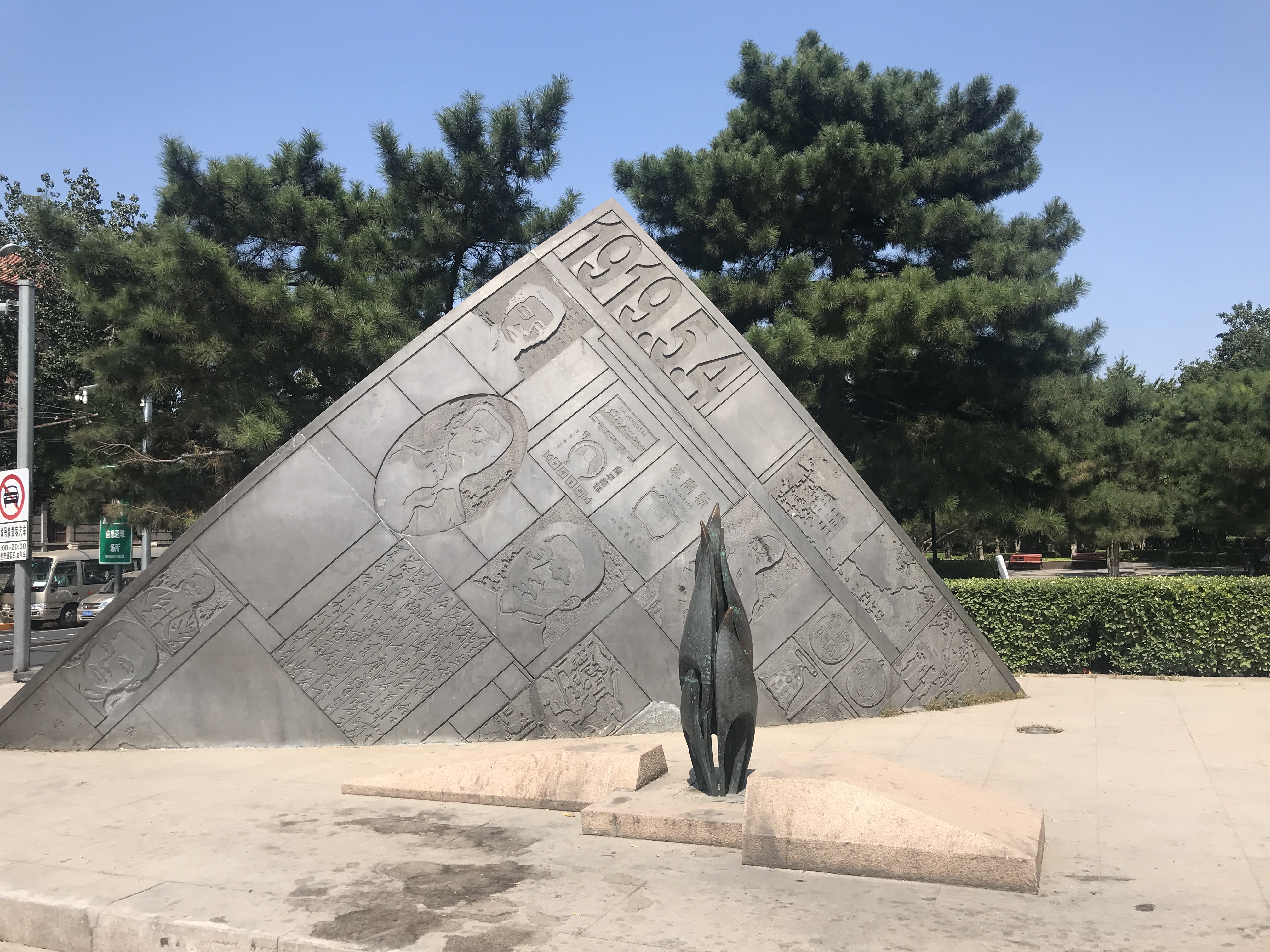
May Fourth Movement
On a spring afternoon in 1919, roughly 3,000 students from thirteen universities marched to Tiananmen to demand something their government seemed unwilling to provide: dignity. The Treaty of Versailles had just awarded Japan control of former German territories in Shandong province, and China's own diplomats appeared ready to accept the humiliation. What began as a protest against a single treaty decision became something far larger, a movement that challenged the foundations of Chinese culture, politics, and identity. The May Fourth Movement, as it came to be known, produced many of the political leaders who would shape the next fifty years of Chinese history.
The Spark at Versailles
China had entered World War I on the Allied side, sending roughly 140,000 laborers to support the war effort in Europe, hoping that victory would mean the return of German-held territories in Shandong province. Instead, the Treaty of Versailles transferred those territories to Japan, honoring secret agreements made during the war. The decision felt like a betrayal. China had contributed to the Allied victory only to be treated as a pawn in negotiations between greater powers. When news reached Beijing, students at Peking University and other institutions began organizing. On May 4, they marched. The protest was not spontaneous; it built on years of frustration with what many Chinese intellectuals saw as their country's weakness on the world stage, a weakness they increasingly blamed on traditional Confucian values and the political structures those values supported.
From Protest to Movement
What happened on May 4 in Beijing quickly outgrew the capital. Strikes and demonstrations spread to Shanghai, Tianjin, and other cities. Workers, merchants, and ordinary citizens joined what had started as a student protest. The movement's demands expanded beyond the Versailles treaty to encompass a wholesale rejection of the old order. Intellectuals associated with the broader New Culture Movement, which had been gathering force since 1915, seized the moment to push for the replacement of classical Chinese with vernacular writing, the adoption of Western science and democratic ideas, and the dismantling of what they saw as a feudal social hierarchy. The irony was that these cosmopolitan, overwhelmingly urban reformers framed their cause in the language of nationalism while looking abroad for inspiration. They were populists in rhetoric but elitists in practice, concentrated in universities and publishing houses far from the rural majority they claimed to represent.
The Fires of Zhao Jialou
The May 4 march did not end peacefully. After gathering at Tiananmen, the students marched to the Legation Quarter, where foreign embassies were located, but were turned away by police. Redirecting their anger, they converged on the residence of Cao Rulin, a diplomat they accused of selling out Chinese interests to Japan. The crowd set fire to his house at Zhao Jialou. Cao escaped, but Zhang Zongxiang, the Chinese minister to Japan, was found inside and beaten. Police arrested thirty-two students. The violence shocked many moderates but galvanized the movement's supporters. Across China, strikes shut down businesses and schools in solidarity with the arrested students. Under pressure, the government released the detained protesters and dismissed Cao and two other officials seen as pro-Japanese. China's delegation at Versailles, responding to the domestic pressure, ultimately refused to sign the treaty.
Seeds of Revolution
The May Fourth Movement's most enduring consequence was the generation of leaders it produced. Among those radicalized by the events of 1919 were many who would go on to found or lead the Chinese Communist Party, including Chen Duxiu and Li Dazhao. Mao Zedong, then a library assistant at Peking University, was deeply influenced by the intellectual ferment around him. The movement also strengthened the Kuomintang, which drew energy from the same anti-imperialist sentiment. In this sense, May Fourth planted the seeds of both major political forces that would compete for control of China over the following three decades. The movement's cultural legacy was equally profound. It accelerated the shift from classical to vernacular Chinese in literature and education, democratizing access to the written word. It introduced Western philosophical traditions to a generation of Chinese thinkers, and it established student activism as a legitimate, even expected, form of political engagement. Tiananmen, where the marchers gathered that May afternoon, became a symbol of popular protest that would echo through the rest of the century.
From the Air
Located at 39.91°N, 116.39°E, centered on Tiananmen Square in central Beijing. The square and surrounding government buildings are clearly visible from altitude. Best viewed at 3,000-5,000 feet. Nearest airport: Beijing Capital International (ZBAA), approximately 25 km northeast.