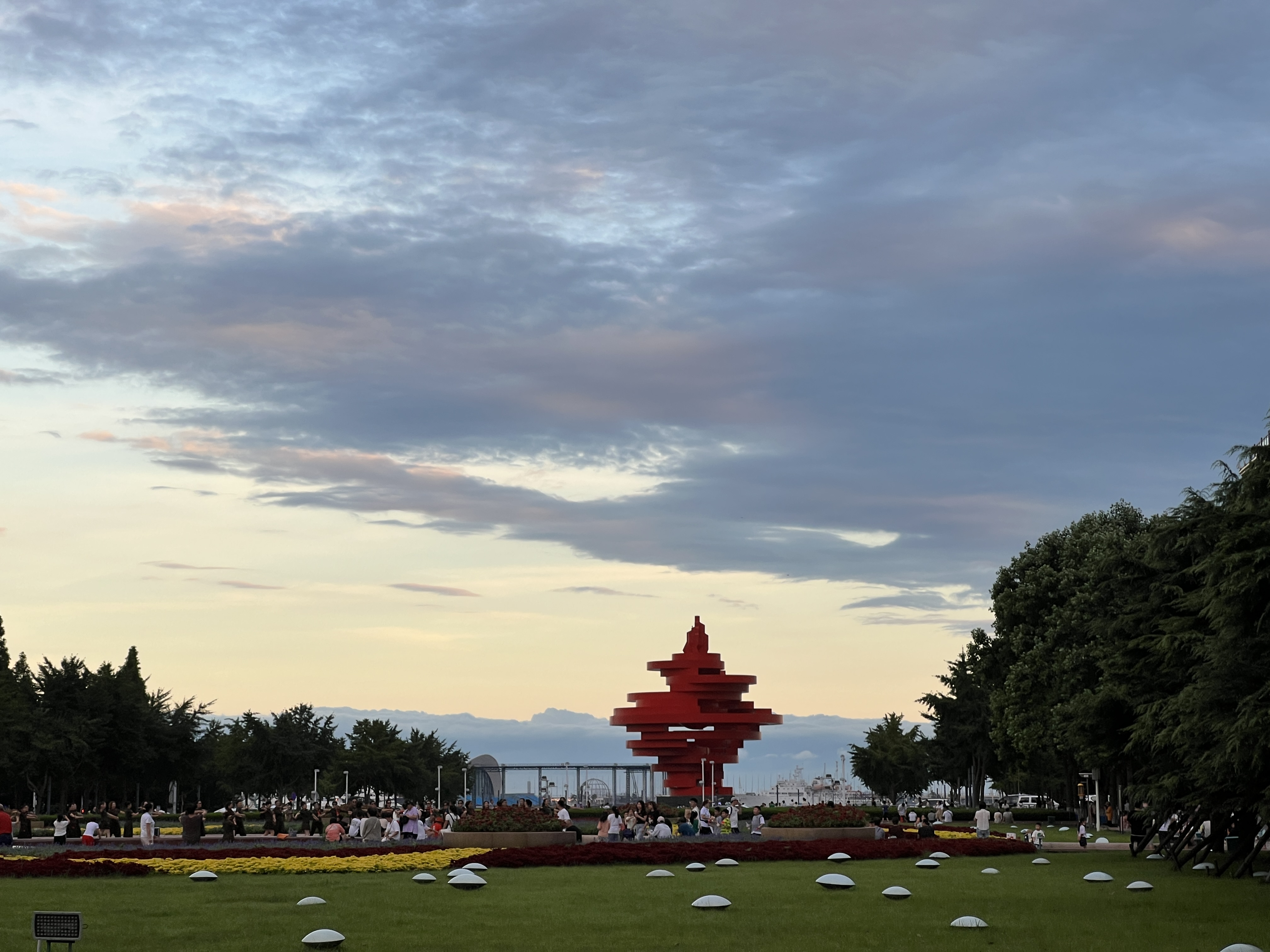
May Fourth Square
The sculpture rises 30 meters above the waterfront, a spiraling column of Chinese red steel that weighs more than 500 tons. Called "Wind of May," it is the largest steel urban sculpture in China, and its shape captures something that cannot be held: the force of a historical moment when an entire nation's anger found its voice. May Fourth Square sits in the heart of Qingdao's central business district, ten hectares of granite-paved open space stretching from the municipal government building to the edge of Fushan Bay. The square was named in 1997 to commemorate an event that happened in Beijing in 1919 -- but the betrayal that sparked it happened here, in this coastal city that was bargained away at the peace table.
The Shandong Betrayal
In 1919, China attended the Paris Peace Conference as a victorious ally in World War I, confident that the former German colony of Qingdao would be returned to Chinese sovereignty. Germany had held the Kiautschou Bay concession since 1898; Japan had seized it in 1914. Surely the peace would restore what war had taken. Instead, Article 156 of the Treaty of Versailles transferred German concessions in Shandong, including Qingdao, to Japan. China's allies had traded its territory for Japanese support in the war. When news of the decision reached home, patriotic students in Beijing marched in protest on May 4, 1919, launching what became the May Fourth Movement -- a cultural and political upheaval that reshaped Chinese intellectual life and planted the seeds of revolutionary change. The Beiyang government ultimately refused to sign the treaty, and China declared the end of its war with Germany separately in 1919, signing its own peace in 1921.
Wind of May
Sculptor Huang Zhen designed the "May Wind" to embody the patriotic energy of that uprising. The sculpture is 27 meters in diameter, its spiraling form suggesting a tornado of collective will. The color is deliberately chosen: Chinese red, the hue of celebration and revolution alike. Placed near the seaside edge of the square, the sculpture frames views of Fushan Bay and the high-rise buildings that line the eastern and western boundaries. The square itself is divided into north and south sections. The north connects to the Qingdao Municipal People's Government building. The south opens onto the bay, where a coastal park called Liangxin Beach provides a gentler transition from political monument to ocean. A circular fountain occupies the center, surrounded by green lawns and paved areas laid with patterns in locally quarried Qingdao granite.
A Stage for Modern China
May Fourth Square has become more than a memorial; it is Qingdao's civic stage. In June 2018, the 18th meeting of the Shanghai Cooperation Organization was held in the city, and a new sculpture commemorating the summit was unveiled in the square. Light shows projected onto the surrounding high-rises have marked occasions from the Mid-Autumn Festival to national celebrations, transforming the square's waterfront into a canvas of color visible across Fushan Bay. China Central Television has filmed special programs here, often using the "May Wind" as a backdrop. The square functions as a gathering place where history and contemporary life intersect: tourists photograph the sculpture, families stroll the lawns, and the memory of a century-old student protest persists in the name of every street sign and subway station nearby. The phrase "weak nations have no diplomacy" -- a lesson drawn from the Shandong betrayal -- is part of the square's founding purpose, carved into the civic consciousness of a city that learned that lesson firsthand.
From the Air
Located at 36.061N, 120.380E along Fushan Bay in Qingdao's central business district. The 10-hectare square is flanked by high-rise buildings and the municipal government. The red "Wind of May" sculpture (30 meters tall) is a distinctive landmark from the air. Nearest airport is Qingdao Jiaodong International Airport (ZSQD). The square and its waterfront setting are visible from 3,000-6,000 feet, with the red sculpture identifiable against the green lawns.