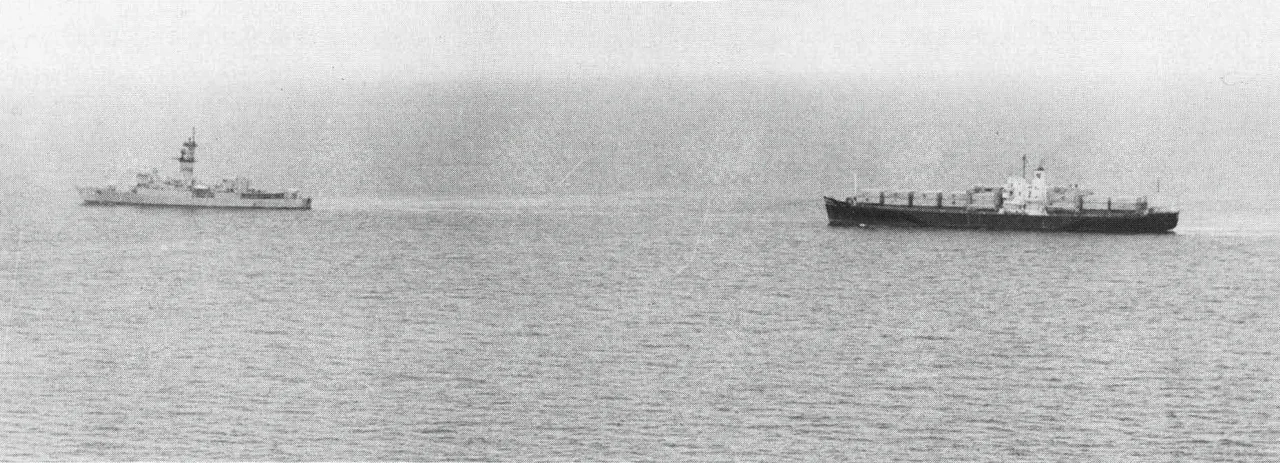
_tows_SS_Mayaguez_away_from_Koh_Tang_island,_Cambodia,_on_15_May_1975.jpg)
Mayaguez Incident
At 06:07 on the morning of 15 May 1975, Khmer Rouge radio broadcast that the SS Mayaguez would be released. Thirteen minutes later the first American helicopter set down on a beach on the island of Koh Tang, and what is usually called the last battle of the Vietnam War began. The ship's crew were not on Koh Tang. They had been taken off it the day before and were some forty kilometres away on another island, where that same morning they were told they could go back to their ship. By the time they were safely aboard a US destroyer, three helicopters had been shot out of the sky and men had been dying on Koh Tang for close to four hours.
Six Miles Off Poulo Wai
The Mayaguez was a container ship owned by Sea-Land Service, built in 1944 as a wartime freighter and later rebuilt into one of the first American all-container vessels. She was running from Hong Kong to Sattahip in Thailand with routine freight, government and military containers, and ninety empties. On the afternoon of 12 May she passed close to Poulo Wai, an island in waters Cambodia claimed and the United States did not recognise. At 14:18 a Khmer Rouge Swift Boat fired across her bow; when Captain Charles T. Miller slowed, a rocket-propelled grenade followed. He got an SOS away and stopped.
The seizure was less arbitrary than it looked from Washington. Phnom Penh had fallen twenty-five days earlier, the Khmer Rouge were fighting Vietnamese forces over these very islands, and their navy had been stopping foreign shipping for weeks — Thai fishing boats, a South Korean freighter, a Panamanian vessel. No general warning had reached American shipping.
A Test Case
President Gerald Ford was told at his morning briefing, and the National Security Council convened that afternoon. Saigon had fallen twelve days before. What was said in that room was mostly not about a ship. Vice President Nelson Rockefeller argued the crisis would be "judged in South Korea" and called for a violent response; Brent Scowcroft later put the objective plainly: to make clear that the United States, having just left Southeast Asia under ignominious circumstances, still understood its interests and was prepared to protect them.
There was no diplomatic channel to the Khmer Rouge, so Ford asked Kissinger to work through Beijing. The Chinese refused to accept the note.
Twenty or Thirty Men
The rescue was assembled in roughly two days. Marines of BLT 2/9 would assault Koh Tang, where the crew were believed to be held. A company of 1/4 Marines would board the Mayaguez herself from the destroyer escort USS Harold E. Holt. Aircraft from the carrier USS Coral Sea would strike the mainland. Planners estimated twenty to thirty Khmer Rouge on the island, and reports of heavy anti-aircraft fire coming from it were never passed to the Marines who would land there.
There were more than a hundred defenders, placed on Koh Tang on 1 May by a district commander named Em Son and dug in behind machine guns, recoilless rifles and mortars covering both usable beaches. Those emplacements had been built to stop a Vietnamese landing. Nobody had built them with Americans in mind.
The council knew the crew might not be there at all. Kissinger's reasoning carried the decision: taking the island if they were not there was easier to explain than failing to take it if they were.
Four Hours Behind
Of the eight helicopters in the first wave, three were destroyed and four more damaged past use. Knife 31 took two rocket-propelled grenades on the approach to East Beach and went down burning fifty metres offshore; thirteen men died in the crash, in the water, or on the sand trying to reach cover. The survivors swam for two hours before a ship's boat found them. A platoon that did get ashore on East Beach was cut off for twelve hours.
While that was happening, the crew of the Mayaguez were put aboard a Thai fishing boat at Koh Rong Sanloem and sent back toward their ship. A patrol aircraft spotted them at 09:35. At 09:49 they were aboard the USS Henry B. Wilson, unharmed, all of them. Ford went on national television at 11:27 to announce the rescue of the crew, which is not what had occurred, and at Kissinger's urging declined to call off the airstrikes on Kompong Som and Ream until the Marines were off the island.
The Arithmetic
Forty-one Americans died, and the figure is usually given whole when it should not be. Twenty-three of them — eighteen Air Force security policemen and five aircrew — were killed on 13 May when their helicopter crashed in Thailand on the way to the staging base, before anyone reached Cambodian water. The other eighteen died in the operation itself: thirteen with Knife 31, one airman in the ditching of Knife 21, one Marine killed on West Beach, and three Marines left alive on Koh Tang when the last helicopter lifted off, who were later killed by their captors. Fifty men were wounded.
Cambodian losses were estimated at thirteen to twenty-five killed on Koh Tang, with an unknown number aboard the sunken patrol boats and on the mainland beneath the airstrikes. Nobody counted them. No list of their names exists.
Ford's approval rating rose eleven points, then fell sharply as the details came out. The names of the American dead are the last names carved on the Vietnam Veterans Memorial.
From the Air
The action centred on Koh Tang at 10.302°N, 103.134°E, in the Gulf of Thailand about 52 km southwest of Sihanoukville, Cambodia. The Mayaguez was seized near Poulo Wai, about 32 miles further out from Koh Tang and some 60 miles off Sihanoukville; the crew were held at Koh Rong Sanloem, about 40 km northeast of Koh Tang and much closer to the mainland — the geography that defeated the operation is visible in one glance from altitude. Recommended viewing altitude 6,000–10,000 ft, from which Koh Tang's two northern coves and the surrounding archipelago read clearly against shallow water. Nearest airports: Sihanouk International (VDSV) about 60 km northeast, on the site of the former Ream airfield struck during the operation; Phu Quoc International (VVPQ), Vietnam, about 85 km southeast; Phnom Penh International (VDPP) about 220 km northeast. Best visibility in the November–April dry season; the southwest monsoon brings low cloud and haze from May onward.
Nearby Stories
- Koh Rong Sanloem 13 km away
- Koh Seh 18 km away
- Koh Poulo Wai 33 km away
- An Thoi Naval Base 34 km away
- Bokor Hill Station 35 km away
- Battle of Pailin 257 km away
- U-Tapao: The Airfield Built on a Shipyard 322 km away
- Krue Se Mosque 380 km away