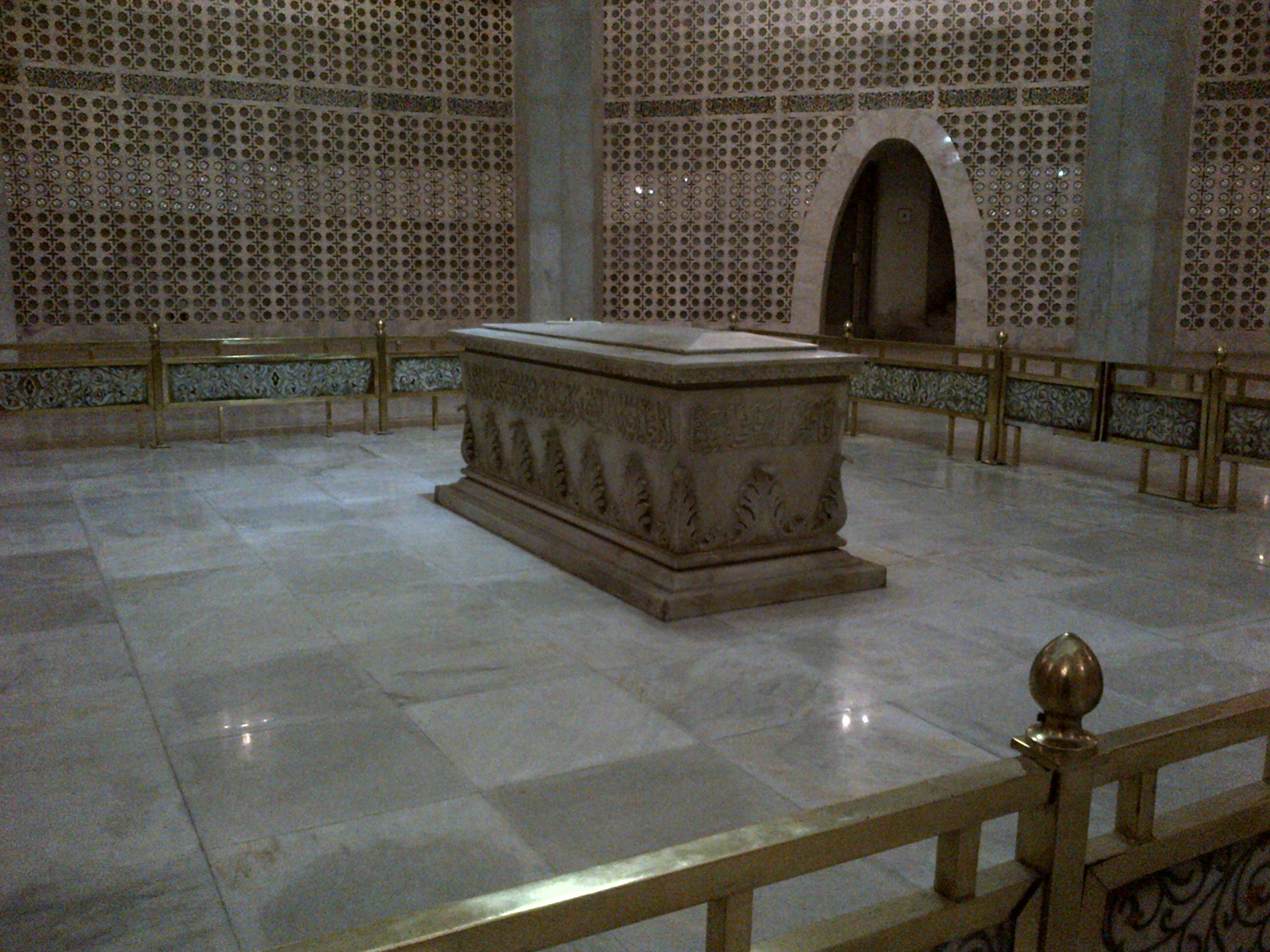
Mazar-e-Quaid
For years after Muhammad Ali Jinnah's death in 1948, the founder of Pakistan lay beneath nothing more than a white marble slab on a raised plinth. His grave fell into neglect. An Indian architect was selected to design a mausoleum in 1954, then dismissed. A British architect won an international competition, but the design was contested. It took until 1971, twenty-three years after Jinnah's death, for the Mazar-e-Quaid to be completed. The long struggle to build it says as much about the young nation as the monument itself.
A Monument Searches for Its Form
The Quaid-e-Azam Memorial Fund was established in 1949 to gather proposals for a fitting memorial. By 1952, a small dome had been added over the grave, along with a cabinet displaying Jinnah's personal effects. But the site continued to deteriorate. In 1957, the Government of Pakistan held an international design competition. British architect William Whitfield of the Raglan Squire and Partners firm produced the winning entry — an avant-garde star-shaped concrete structure that never got built. Fatima Jinnah rejected the proposal on multiple grounds, including that it had been awarded to a British national. She assumed control of the Memorial Fund and commissioned Yahya Merchant, a Bombay-based architect who had been a personal friend of Jinnah, to design the monument instead. Merchant's design was shaped by the Samanid Mausoleum in Bukhara, Uzbekistan, built between 892 and 943 CE, whose influence can be seen in the final structure's proportions and geometric simplicity.
White Marble and Green Light
The completed mausoleum is clad in white marble, with curved arches and copper grills set on an elevated 54-square-meter platform. The building rises 43 meters from a 4-meter-high base, with an entrance in each wall and fifteen successive fountains leading to the platform from one side. Inside, a four-tiered crystal chandelier donated by the People's Republic of China casts green light across the inner sanctum. The mausoleum sits within a 53-hectare park laid out in a neo-Mughal style, and at night, powerful spotlights project beams onto the white marble, making the structure visible across central Karachi.
Five Graves Beneath One Dome
Jinnah does not rest alone. His sister Fatima Jinnah, known as Mader-e Millat, Mother of the Nation, lies in a grave to the north, distinguished by black floral ornamentation at its base. Four graves are arranged in a row: Liaquat Ali Khan, Pakistan's first Prime Minister, and his wife Begum Ra'ana Liaquat Ali Khan lie side by side. Nurul Amin, the eighth Prime Minister, rests between them and Sardar Abdur Rab Nishtar, a stalwart of the Muslim League from Peshawar. All the graves are made of Italian white marble in box-type sarcophagi on triple bases. A subtle distinction separates the founder from the rest: the sides of Jinnah's sarcophagus diverge outward, while the others taper inward.
Where the Nation Gathers
Official and military ceremonies bring the nation to Mazar-e-Quaid on Pakistan Day (March 23), Independence Day (August 14), the anniversary of Jinnah's death (September 11), and his birthday (December 25). Foreign dignitaries visit during state tours. On Independence Day 2017, the mausoleum was illuminated with a 3D projection mapping show, casting images of Pakistan's history across the white marble walls. The mausoleum occupies a prominent location in the Jamshed Quarters locality at the end of Muhammad Ali Jinnah Road, surrounded by large traffic rotaries and the dense urban energy of a city that has grown far beyond anything its founder could have imagined.
From the Air
Located at 24.875N, 67.041E in central Karachi at the northern edge of the colonial-era core. The white marble mausoleum within its 53-hectare park is clearly visible from altitude, particularly at night when illuminated by spotlights. The building stands 43 meters tall. Jinnah International Airport (OPKC) is approximately 12 km to the east. The surrounding neo-Mughal gardens and traffic rotaries make the site a recognizable landmark.