Mazunte: From Slaughterhouse to Sanctuary
The name might mean "please deposit eggs here." That is one etymology - from the Nahuatl phrase maxotetia - and it carries an unintended irony, because for decades the turtles that deposited their eggs on Mazunte's beaches were not being welcomed. They were being slaughtered. By the 1970s, this small village on the Pacific coast of Oaxaca was the center of Mexico's sea turtle hunting industry, complete with its own processing plant. The turtles came by the hundreds of thousands; the hunters met them on the sand. When Mexico finally imposed an absolute ban on turtle meat and eggs, Mazunte lost its livelihood overnight. What happened next is a story of reinvention so thorough that the village's slaughterhouse site now houses an aquarium dedicated to keeping turtles alive.
Nine Hundred Thousand Arrivals
The numbers are staggering. In 1997, the Centro Mexicano de la Tortuga counted approximately 900,000 sea turtles arriving at nearby La Escobilla beach during a single nesting season. These mass nestings, called arribadas, happen over a few nights following a full moon, when thousands of olive ridley sea turtles haul themselves onto the sand simultaneously to dig nests and lay eggs. The nesting season generally begins in May and runs for several months. Olive ridleys make up the majority, but hawksbill turtles, prietas - a subspecies of green turtle - and some leatherback turtles also nest in the area. All but one of Mexico's marine turtle species visit these beaches. Volunteers from the Centro Mexicano monitor the nesting sites, measuring and tagging females as they come ashore, collecting eggs for incubation at the center, and later releasing hatchlings from the same beaches where they were gathered. On many occasions, the public can participate in these releases - standing ankle-deep in the Pacific as hundreds of tiny turtles scramble toward the surf.
Soap, Shampoo, and Anita Roddick
When the turtle trade ended, Mazunte needed income. Conservation alone could not feed families. In 1993, Anita Roddick, founder of The Body Shop, was invited to visit the village and was impressed by the community's efforts to rebuild around ecology rather than extraction. An agreement followed: cosmetics made in Mazunte with local ingredients would be distributed through The Body Shop's international network. By 1996, this collaboration had evolved into Cosmeticos Naturales de Mazunte, a cooperative of fifteen families producing their own line of shampoo, conditioner, bath gels, soap, and other products. The cooperative operates with support from both local organizations and the Mexican federal government, and its products remain a point of pride in a village that had to invent a new economy from scratch. Meanwhile, annual festivals sprang up to draw visitors: the Spring Equinox Festival, the International Dance Festival, and the Jazz Encounter, all founded after Hurricanes Pauline and Rick devastated Mazunte in 1997 and the community needed yet another reason for outsiders to come.
Sacred Hill, Pirate Lookout
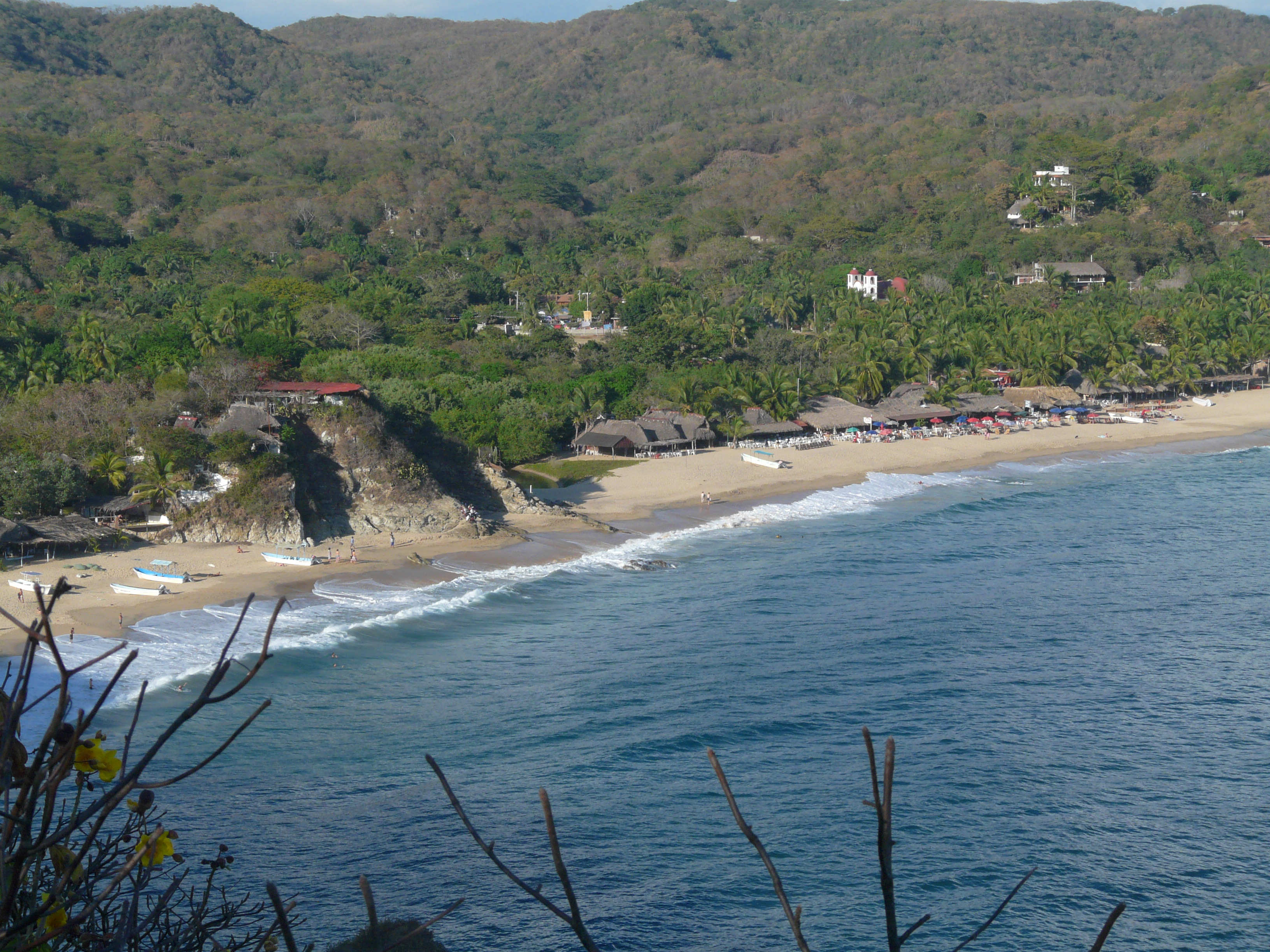
At the far western end of Mazunte's one-kilometer beach, a rocky peninsula called Punta Cometa juts into the Pacific. It is the southernmost point in the state of Oaxaca, and its elevation offers 180 degrees of ocean visibility - a fact not lost on the Aztecs, who built a small defensive wall around it in pre-Hispanic times. The remnants are still called the corral de piedra, the stone corral. During the colonial period, both Spanish forces and pirates used the same vantage point to survey approaching ships. Locals also know it as Cerro Sagrado - Sacred Hill - and stories persist of Aztec or pirate treasure hidden somewhere on the promontory. Today Punta Cometa draws hikers rather than lookouts. A small virgin beach called Mermejita sits on its western flank, and the point serves as a stopover for migratory birds and marine mammals, including whales passing through during their seasonal journeys. From the summit, the view stretches in every direction: beach to the east, open ocean to the south, and the dark green wall of the Sierra Madre del Sur rising behind the village.
Where the Slaughterhouse Stood
The Centro Mexicano de la Tortuga was founded by the Mexican federal government in 1991, the same year the turtle trade ban took full effect. It occupies four hectares right next to the beach, on or near the site of the former slaughterhouse - a deliberate geographical irony. The center functions as both aquarium and research facility, containing specimens of all marine turtles native to Mexico along with six freshwater and two land turtle species. Outdoor tanks hold turtles of different ages, and both natural and artificial incubators protect eggs until hatching. The buildings were designed to blend with the surrounding architecture, traditional and modern alike. Research here focuses on developing techniques to manage and increase turtle populations while promoting ecological tourism. The facility receives about 60,000 visitors a year. For a village that once killed turtles for a living, the center represents something more than conservation. It represents the possibility that a community can look at the thing it destroyed, understand what it lost, and build something entirely different in the same spot.
From the Air
Located at 15.67N, 96.55W on the Pacific coast of Oaxaca, wedged between a one-kilometer beach and the Sierra Madre del Sur. Punta Cometa, the southernmost point of Oaxaca state, juts into the ocean at the western end of the beach and is visible as a rocky promontory from altitude. Nearby La Escobilla beach to the west is one of the world's most important olive ridley nesting sites. Nearest airports: Huatulco-Bahias de Huatulco International Airport (MMBT/HUX), approximately 45 km east; Puerto Escondido Airport (MMPS/PXM), approximately 65 km west. Coastal Highway 200 is visible as a ribbon paralleling the shore. Best viewed at 2,000-5,000 feet. The village itself is tiny - look for the cluster of structures between beach and mountain.