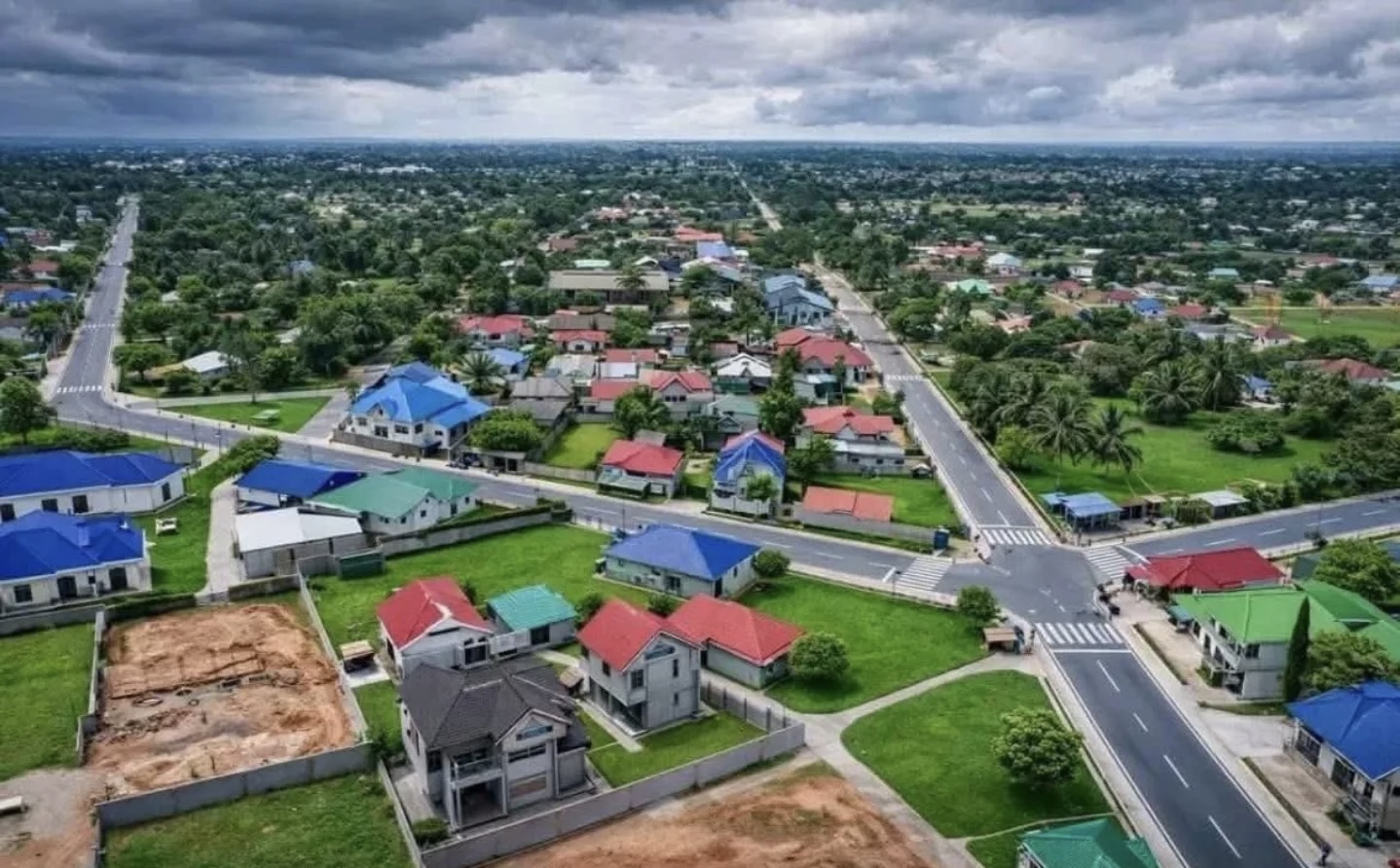
Mbuji-Mayi
The name means "Goat-Water" in Tshiluba, after the river that winds through Luba country in south-central Congo. It is an oddly pastoral name for a city sitting on one of the largest industrial diamond deposits on Earth. Mbuji-Mayi -- formerly Bakwanga -- is thought to be the Democratic Republic of the Congo's second-largest city, though nobody knows its exact population. Estimates range from 1.5 million to 3.5 million. What is certain is that this remote capital of Kasai-Oriental Province has been shaped, exploited, and repeatedly convulsed by the gems buried under its streets.
A Company Town in the Bush
Diamonds were first discovered here in 1907, but their true value was not recognized until 1913. The Societe miniere de Bakwanga, known as MIBA, built a mining camp and proceeded to plan the city around its own needs. Labor camps, mining zones, and living quarters were laid out with corporate precision. MIBA did not want a city -- it wanted an extraction operation. Fearing theft, the company monitored everyone who entered or left the region. Every resident needed a permit. Indefinite settlement was nearly impossible. There was little agriculture, almost no independent commerce, and no higher education for the Congolese population. By the late 1950s, fewer than 40,000 people lived in what was essentially a private fief. Even the homes of top MIBA executives were sometimes demolished when the company wanted to access the diamonds underneath.
The Diamond Republic
When the Congo gained independence in 1960, the political chaos that followed reached Bakwanga quickly. Albert Kalonji, a Luba politician, declared the secessionist state of South Kasai with the city as its capital. The experiment lasted barely two years. Central government troops arrived, arrested Kalonji, and retook Bakwanga by October 1962. The city was renamed Mbuji-Mayi after the local river -- an attempt to signal reconciliation among Luba factions. But diamonds continued to dictate the city's fate. Smuggling, always endemic, surged after independence as government control eroded. By the 1980s and 1990s, under Mobutu's indifferent rule, the central government sent almost nothing to Mbuji-Mayi -- no money for roads, schools, or hospitals. The city that produced a significant share of the world's industrial diamonds was left to fend for itself.
The Man Who Ran Mbuji-Mayi
Into the vacuum stepped MIBA, and with it, Jonas Mukamba Kadiata Nzemba. Appointed CEO by Mobutu in 1986, Nzemba became the de facto governor of the city. MIBA repaired roads, paid soldiers, and supplied water and electricity from its own power station. The company set aside $5 to $6 million annually -- roughly eight percent of its budget -- for a social fund that rebuilt infrastructure and helped establish the University of Kasai. Nzemba also created CDEKO, a regional economic development group that spurred new agricultural ventures, a beer industry, and Wetrafa, a locally owned airline. He called himself a "brother" of opposition leader Etienne Tshisekedi while remaining a power broker in Mobutu's ruling party. When the First Congo War arrived in 1997, Nzemba initially sided with Mobutu, then switched allegiances as Kabila's rebels approached. The city fell on 4 April 1997 and looting by both sides devastated MIBA's operations. Nzemba was summoned to Goma by Kabila and held for days before his release.
Diamonds and Desperation
The diamonds that made Mbuji-Mayi valuable also made it dangerous. Amnesty International reported in 2002 that dozens of people were shot dead in the diamond fields, most of them suspected illegal miners. No state agents were prosecuted. Poverty drove people onto MIBA concessions where they risked being killed or detained in overcrowded facilities. A CDC investigation found the city's prison packed to six times capacity, with each inmate allotted less than a quarter of a square meter. Half were malnourished, and tuberculosis spread unchecked for years in the stagnant air. Meanwhile, residents drew drinking water from local rivers, fueling outbreaks of cholera. In 2020, the DRC government launched a $26.2 million project to improve the water supply -- an investment officials acknowledged would help but not solve the crisis.
A City That Persists
Mbuji-Mayi remains remarkably isolated. Despite its population, it has little connection to Kinshasa or Lubumbashi. Air travel through Mbuji Mayi Airport provides the most reliable link to the outside world. The city is divided into five communes -- Bipemba, Dibindi, Diulu, Kanshi, and Muya -- each headed by a burgomaster, a structure unchanged since 1968. What strikes a visitor is the paradox: a city of potentially millions, sitting atop staggering mineral wealth, where basic services remain inadequate and the relationship between the ground underfoot and the lives lived above it has never been reconciled. The goats that gave the river and city their name still wander the streets. Beneath them, the diamonds remain.
From the Air
Located at 6.12S, 23.60E in south-central DRC. Mbuji Mayi Airport (ICAO: FZWA) serves the city. The urban area is visible from altitude as a large sprawl in otherwise lightly developed terrain. The Mbuji-Mayi River is a prominent visual reference. Recommended viewing altitude: 10,000-20,000 ft to see the city's layout and surrounding mining areas. The region has a tropical wet-and-dry climate with good visibility in the dry season (May-September).