McArthur-Burney Falls Memorial State Park
One hundred million gallons of water surge from the rock face every day, winter and summer, drought and deluge. The flow never stops because Burney Falls draws from a source no weather pattern can touch: a vast underground reservoir trapped in million-year-old basalt. Theodore Roosevelt stood at this overlook and called what he saw the "Eighth Wonder of the World." Hollywood came calling, filming the railroad bridge scene from Stand By Me on nearby Lake Britton, while the 1988 fantasy film Willow used the falls as a backdrop during a traveling montage. But the falls themselves remain unchanged, a curtain of mist and thunder where ancient water finally reaches the light.
Water from Stone
The geology explains everything. A million years ago, volcanic eruptions blanketed this region in layer upon layer of basite, the black volcanic rock that now defines the landscape. Unlike solid granite, basalt is porous, riddled with tiny voids that trap and store water like an underground sponge. Snowmelt and rain seep downward through the rock, collecting in a reservoir that feeds Burney Creek from below. The creek emerges at and above the falls, cascading 129 feet into a mist-filled basin before flowing north to Lake Britton. The springs discharge 100 million gallons daily, roughly 4.4 cubic meters per second, a flow rate that remains constant regardless of seasonal variation.
Saved by a Family
Samuel Burney arrived in the 1850s, a pioneer settler whose name would outlast his memory. The McArthur family followed in the late nineteenth century, establishing themselves as landowners in Shasta County. As California developed and the pressure to dam, log, and develop remote waterfalls intensified, the McArthur descendants made a different choice. In the 1920s, they purchased the waterfall and surrounding land, then presented it as a gift to the state. McArthur-Burney Falls Memorial State Park became the second oldest park in the California State Parks system, a protected enclave where the falls could thunder on undisturbed.
Trails Through the Mist
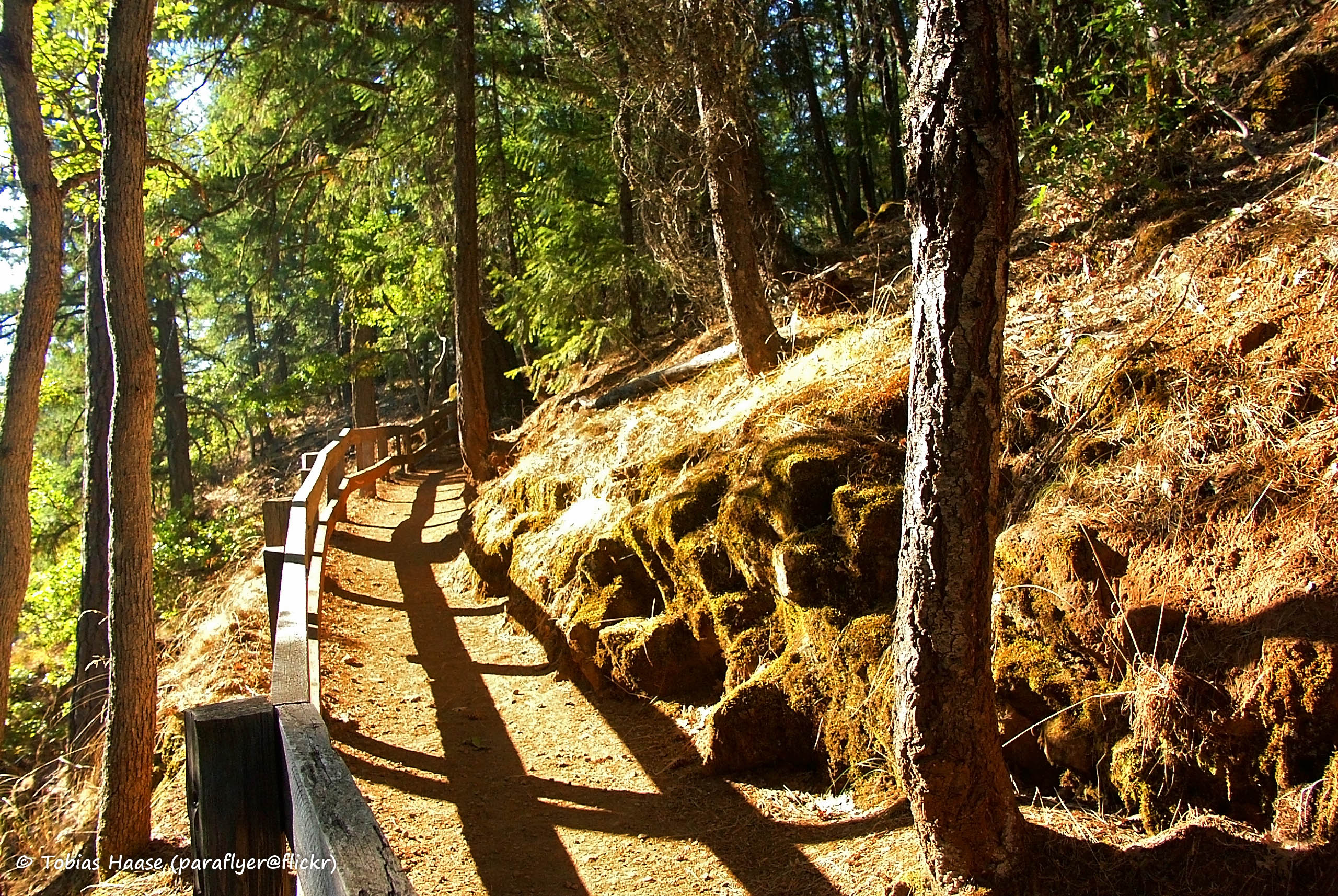
Three trails radiate from the visitor center, each offering a different relationship with the falls. The Falls Loop Trail descends from the overlook to the basin floor, crosses Burney Creek at Rainbow Footbridge, and climbs the opposite wall of the ravine before returning via Fisherman's Bridge. The Burney Creek Trail continues downstream through mixed coniferous forest, passing patches of white diatomaceous earth on its way to Lake Britton's swimming and boating area. The Headwaters Trail loops upstream to the springs that feed the falls, crossing the Pacific Crest Trail Footbridge where through-hikers pause to refill water bottles. The park store serves as a general delivery address for PCT hikers, a quiet service station on a 2,650-mile journey.
Hidden Nests Behind the Veil
Behind the curtain of falling water, in the perpetual twilight of the rock face, black swifts raise their young. The species nests in only a handful of sites across North America, seeking the specific combination of vertical rock, constant moisture, and protection from predators that the falls provide. The swifts arrive each spring, disappearing behind the cascade to lay their eggs in nests glued to wet stone. In December 1984, the uniqueness of this habitat helped earn Burney Falls designation as a National Natural Landmark, federal recognition of a waterfall that shelters rare life forms in its shadow.
The Lake Beyond
Burney Creek flows north from the falls into Lake Britton, a reservoir owned by Pacific Gas and Electric that extends well beyond the park boundaries. The water stays cold, fed by the same underground springs that supply the falls. Boaters exploring the lake's nooks and crannies encounter a railroad bridge that became famous in 1986 when director Rob Reiner filmed four boys crossing it in Stand By Me. The Pit River Dam anchors the lake's northern end, and PG&E maintains a villa for its employee association along the shore. Within the park, visitors rent canoes, kayaks, paddle boats, and motorized patio boats to explore a waterway that begins in volcanic basalt and ends in Hollywood memory.
From the Air
McArthur-Burney Falls Memorial State Park is located at 41.017N, -121.650W in Shasta County, Northern California, within the Cascade Range and Modoc Plateau region. From the air, Lake Britton is the primary landmark, a reservoir extending north from the park. Burney Falls creates a visible mist plume where Burney Creek enters the park from the south. The falls themselves are in a forested ravine and may be difficult to spot except at lower altitudes. The railroad bridge from Stand By Me crosses Lake Britton just outside park boundaries. Nearest airports include Fall River Mills Airport (O89) approximately 15 miles northeast and Redding Municipal Airport (KRDD) about 50 miles southwest. The Volcanic Legacy Scenic Byway passes nearby. Best viewing altitude is 3,000-5,000 feet AGL.