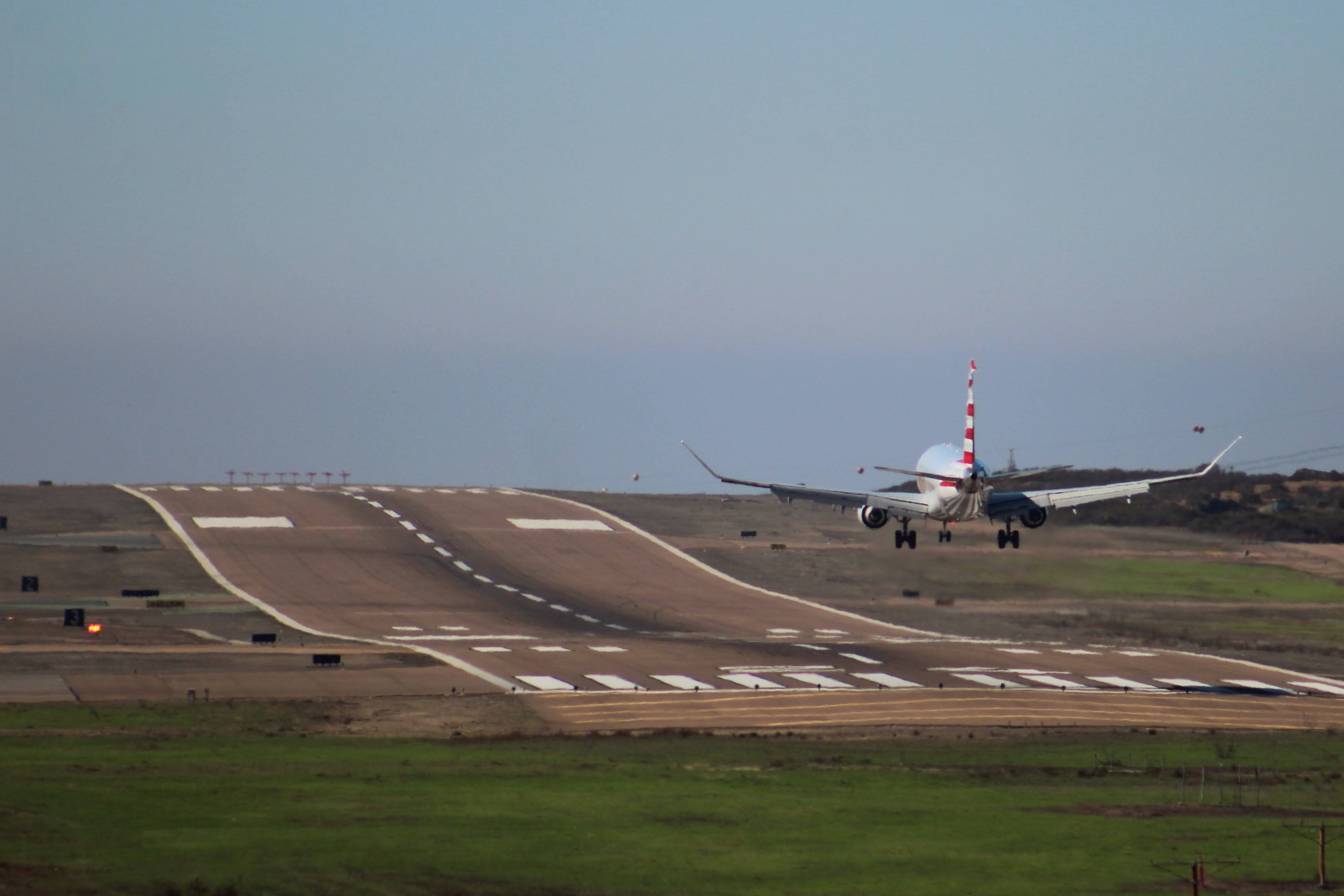
McClellan-Palomar Airport
Most airports wear a single three-letter identity. McClellan-Palomar Airport wears two. The FAA calls it CRQ; the international aviation body IATA calls it CLD. These mismatched identifiers are a minor bureaucratic oddity, but they capture something essential about this 466-acre field in Carlsbad — a place that has never quite fit a single category. It is too small for major carriers, yet it sits in one of California's fastest-growing coastal corridors. It inspired a Hollywood television production company's name. It has a history marked by ambition and setback in equal measure, and by the dense coastal fog that rises off the Pacific and can make a runway disappear without warning.
The Name and the Numbers
The airport covers 466 acres three miles southeast of downtown Carlsbad and is owned by San Diego County. Its single runway — designated 6/24, measuring 4,897 feet — is the source of most of the airport's commercial frustrations. That length comfortably handles turboprops and regional jets but proved too short for larger aircraft as airlines transitioned to all-jet fleets. When SkyWest phased out its Embraer EMB-120 Brasilia turboprops in 2015, United Express service ended; the replacement jets needed more pavement than Palomar could offer.
The airport's dual-code identity gave Lorimar Television part of its name. The production company that made Dallas and The Waltons took 'Lorim' from its founders' names, but the 'ar' came from the airport. That connection has long since faded into trivia, but it signals something about the airport's proximity to the entertainment and corporate world that fills North County San Diego.
An Airport's Revolving Door
The history of commercial service at McClellan-Palomar reads like a catalogue of good intentions and short runways. In 1977, Scenic Airlines flew propjet Metroliners to Palm Springs, Las Vegas, and Phoenix. By the 1990s, American Eagle and United Express combined to offer twelve daily nonstop flights to LAX. Then the jets got bigger. One by one, the airlines that had made the airport their regional home departed for longer runways elsewhere.
Periodic revivals followed. California Pacific Airlines announced ambitious service in 2018 to San Jose, Reno, Las Vegas, and Phoenix — then ceased operations just two months after launching, in January 2019. Its founder, Ted Vallas, spoke of resuming service until his operating certificate was revoked in October 2020. He died the following month at 99. JSX has operated semi-private charter services from the airport, filling a niche that the full-service carriers repeatedly found too narrow.
Fog, Accidents, and the Persistent Risk
The Pacific coast north of San Diego generates thick marine layer fog, and Palomar sits squarely in its path. That fog has contributed to several accidents in the airport's history. In January 2006, a Cessna Citation V crashed into a self-storage facility on landing, killing all four aboard. In July 2007, a King Air struck power lines after departing in dense fog before 6 a.m., killing both occupants. In September 2008, another aircraft crashed on final approach in fog conditions; a fourth incident that same year killed the solo pilot of a Beechcraft Bonanza after an aborted landing.
These incidents did not close the airport — general aviation activity remains steady, and corporate operations continue through Fixed Base Operators including Clay Lacy Aviation. But they underscore the real weight behind the weather advisories that pilots review before making an approach to runway 24 on a gray Carlsbad morning.
What the Airport Offers Today
Strip away the failed airline experiments and McClellan-Palomar reveals itself as what it has always been: a reliable general aviation field in a wealthy coastal corridor. Corporate jets, charter services including JSX semi-private flights, flight training, and maintenance operations sustain the field. Surf Air offered membership-based flights between Carlsbad and other California cities. Advanced Air has provided seasonal service to Mammoth Lakes.
The airport connects North County San Diego to the broader California air network for travelers who prefer to avoid the sprawl of Lindbergh Field. It is, in its way, perfectly suited to the community around it — oriented toward the small-scale, the personalized, and the occasional spectacular view of the Pacific on a day when the fog finally burns off.
From the Air
McClellan-Palomar Airport (CLD/CRQ) sits at 33.13°N, 117.28°W, elevation 331 feet MSL, 3 miles southeast of downtown Carlsbad. Single runway 6/24 at 4,897 feet. Marine layer fog is frequent, especially mornings; check ATIS before approach. The airport is clearly visible from the south on approach to runway 24. Nearest major airports: San Diego Lindbergh Field (SAN) 35 miles south, John Wayne (SNA) 45 miles north. Controlled airspace Class D.