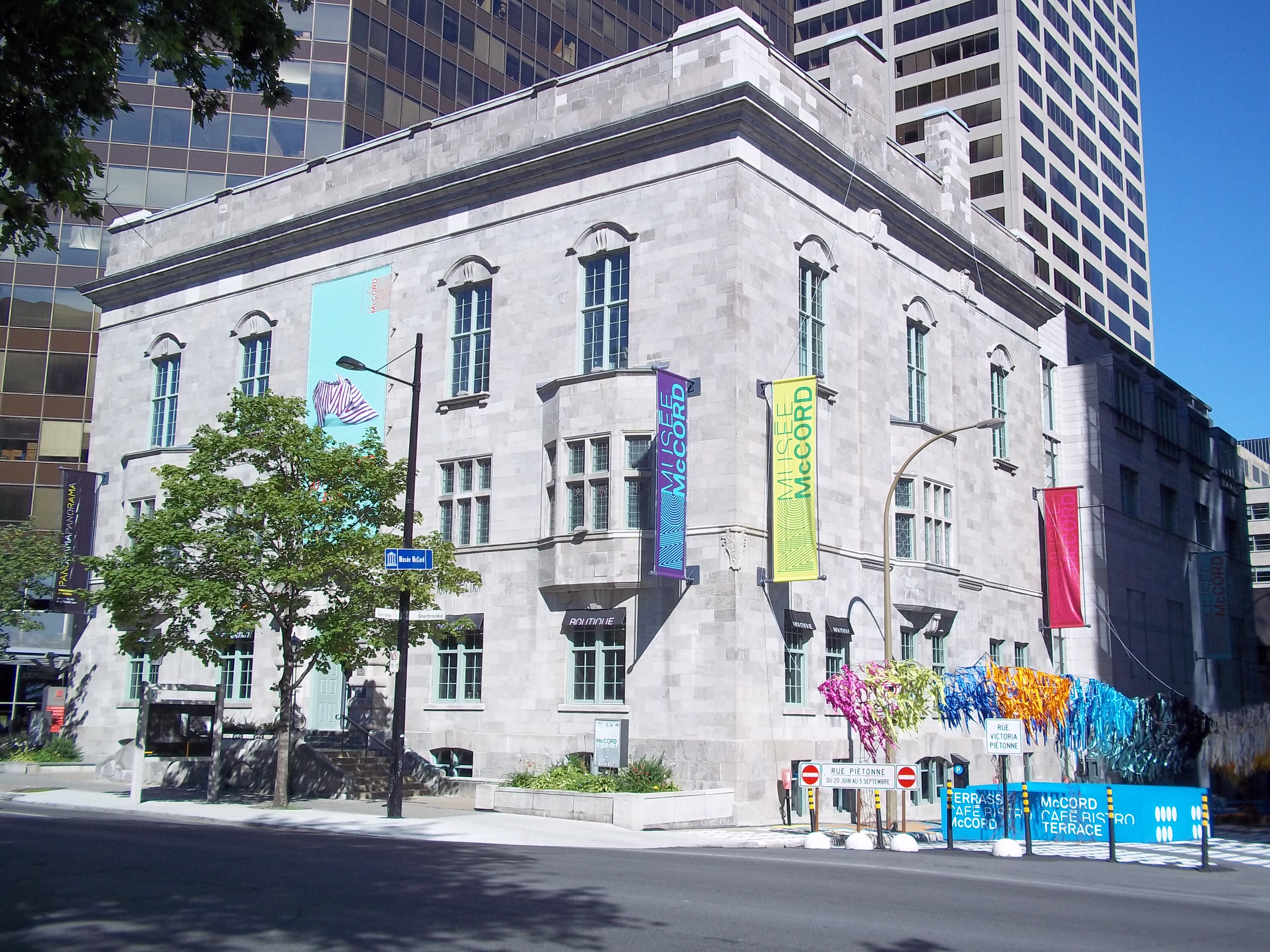
McCord Stewart Museum
North America's oldest known patchwork quilt was stitched in 1726. It now lives in a former student union building across the street from McGill University, surrounded by 2.5 million other objects that trace the social history of a city, a province, and a country. The McCord Stewart Museum exists because one man could not stop collecting. David Ross McCord spent decades from 1878 onward expanding the already considerable hoard his family had assembled since arriving in Canada, driven by an ambition to create nothing less than a national history museum in Montreal -- then Canada's undisputed metropolis. When he formally founded the museum in 1921, he handed over a collection so vast and eclectic that it remains one of the most comprehensive records of Canadian social life ever assembled under a single roof.
From Riot to Repository
The building that houses the McCord Stewart Museum carries its own rough history. For over sixty years, McGill University administered it as the seat of student government. That ended abruptly when riots targeted the Students' Society of McGill University, leading to the building's storming and several executives being taken hostage. McGill responded by constructing a more secure headquarters -- University Centre -- and the old building found a new purpose as a museum. The handoff was more than pragmatic; it gave McCord's growing collection a permanent downtown address with the university's scholarly infrastructure just steps away. Today the museum sits at the intersection of research and public engagement, supported by the governments of Canada, Quebec, and Montreal, along with a wide network of donors and sponsors.
Two Million Frozen Moments
The photography collection alone could fill a lifetime of looking. More than 2.15 million images span the entire history of the medium in Canada, from daguerreotypes and glass negatives of the 1840s to contemporary documentary portfolios. At the heart of this treasury sits the William Notman and Son Photographic Studio archive: 400,000 images, including 200,000 glass negatives, that chronicle Montreal and Canada from the 1840s through 1935. Notman was the most prominent commercial photographer in 19th-century Canada, and his studio captured everything from stormy winter days on Saint Catherine Street to formal portraits of the country's industrialists. Another 700,000 images from other photographers round out a visual record so complete that researchers can track the physical transformation of Montreal block by block across nearly two centuries.
Objects That Speak
Beyond the photographs, the museum's holdings read like an inventory of an entire civilization. The Indigenous Cultures collection holds more than 16,000 objects documenting the lives of First Nations, Inuit, and Metis peoples -- over 8,500 archaeological artifacts date back roughly 10,000 years, while 7,300 historical objects span from the early 1800s to 1945. The Dress, Fashion and Textiles collection of 27,000 garments includes that 1726 patchwork quilt alongside parasols, fans, and creations by Montreal's finest 20th-century designers. In 2019, the museum launched EncycloFashionQC, the first online encyclopedia devoted to Quebec fashion. The Material Culture collection adds another 63,000 objects: furniture, ceramics, folk art, sports equipment, and a major collection of 19th-century toys. Even the archives contribute 346 linear meters of manuscripts, journals, and correspondence from prominent Canadian families and institutions.
A Museum That Keeps Merging
The McCord has always grown by absorption. In August 2022, it formally became the McCord Stewart Museum after integrating the collection of the Stewart Museum, which had permanently closed in February 2021. That acquisition brought approximately 27,000 additional artifacts related to the European presence in New France and North America, strengthening the museum's coverage of the colonial period. Outside, the sculpture Totem urbain / histoire en dentelle by Pierre Granche greets visitors with an allegorical compression of Montreal's history into a single vertical form. Inside, the documentary art collection of 92,000 pieces -- paintings, miniatures, prints, and political caricatures spanning the 18th through 21st centuries -- ensures that the museum's portrait of Canadian life stays current as well as deep. What David Ross McCord started as a family passion project has become the custodian of a remarkable and ever-expanding heritage.
From the Air
The McCord Stewart Museum sits at 45.50N, 73.57W in downtown Montreal, directly across the street from the McGill University campus on Sherbrooke Street. The building is not individually distinctive from altitude but lies within the recognizable McGill campus area at the foot of Mount Royal. Best identified in context with McGill's Roddick Gates and the green expanse of the campus below Mount Royal. Montreal/Pierre Elliott Trudeau International Airport (CYUL) is 11 nm to the west. Montreal/Saint-Hubert Airport (CYHU) lies 9 nm to the southeast. Viewing altitude of 3,000-5,000 feet AGL recommended for downtown Montreal context.