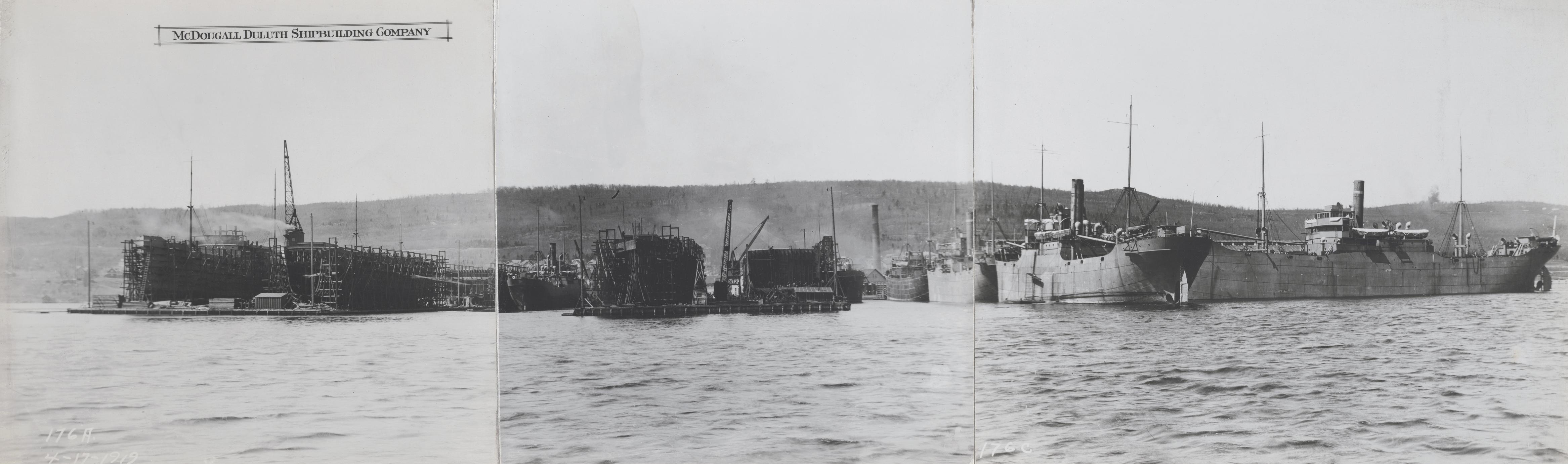
McDougall Duluth Shipbuilding Company
The USS Lakemoor never reached its first port of call. Built at 110 Spring Street in Duluth, Minnesota, the coal ship slid into the St. Louis River Estuary in early 1918, navigated the Great Lakes, threaded the St. Lawrence Seaway to the Atlantic, and was torpedoed by a German U-boat in the Irish Sea off Corsewall Lighthouse, Scotland, on April 11 of that year. All 46 crew members were lost. The Lakemoor was only the second hull completed at the McDougall Duluth Shipbuilding Company, a sprawling wartime shipyard founded by Alexander McDougall in 1917 on the western shore of Lake Superior. That a vessel built in the landlocked heart of a continent could meet its end in European waters speaks to the extraordinary ambition of the Twin Ports shipbuilding industry -- and to the ferocious appetite of global conflict.
The Whaleback Dreamer
Alexander McDougall was born in Scotland in 1845 and arrived on the Great Lakes as a young man, working the decks of sailing ships and steamers. By 1887, he had designed something entirely new: the whaleback barge, a rounded-hull vessel that rode low in the water and shed waves over its curved deck rather than fighting them head-on. He built seven of these distinctive barges in Duluth before opening the first shipyard on Lake Superior in December 1891, across the harbor in what is now Superior, Wisconsin. His company, the American Steel Barge Company, produced whalebacks and steamships for bulk cargo and passenger service on the Great Lakes. McDougall sold the operation in 1900, and it eventually became the Superior Shipbuilding Company, later Fraser Shipyards. But the discovery of iron ore on the Mesabi Range in 1890 had already transformed Duluth into a major shipping port, and McDougall was not finished.
A Town Built to Build Ships
When World War I created an urgent demand for cargo and naval vessels, McDougall opened his second shipyard in 1917, six miles west of the first, on the St. Louis River Estuary. He did not merely build a shipyard -- he built a city. The company town of Riverside sprang up alongside the slipways, housing 3,000 residents in worker accommodations that included an 800-seat theater, a hospital, a clubhouse, a general store, a boathouse, and a monthly newspaper called the Riverside Review. The town school opened in 1920 and would not close until 1982. The West Duluth riverfront now hosted two industrial company towns side by side: U.S. Steel's Morgan Park, which had opened in 1913, and McDougall's Riverside. McDougall's son, Alexander Miller McDougall, and businessman Julius H. Barnes managed daily operations. Barnes went on to become president of the U.S. Chamber of Commerce in 1922.
Ships for the Wars of the World
The yard's output was staggering. During World War I, McDougall Duluth launched coal ships, cargo vessels, oiler tankers, and Emergency Fleet ships. The USS Lake Portage was torpedoed off Audierne, France, in August 1918. Cargo ships bearing the names of American cities -- Fargo, Sioux Falls, Great Falls, La Crosse -- sailed to oceans they were never designed to see. After McDougall sold the yard in 1922, Julius Barnes renamed it Barnes-Duluth Shipbuilding and continued private contracts through the interwar years. When World War II arrived, the yard produced fully outfitted warships. In 1943 alone, Barnes-Duluth built twelve coastal tankers loaned to Britain under Lend-Lease, plus seven lake tankers. Walter Butler purchased the yard in 1943, renamed it Walter Butler Shipbuilders, and delivered C1-M cargo ships under the Emergency Shipbuilding Program until the war ended and the yard closed in 1945.
What the Water Remembers
Today the site at 110 Spring Street is the Spirit Lake Marina, also called the West Duluth Marina, offering docks and berths for recreational boats on the river and lake. Only two buildings remain from the original shipyard campus of more than two dozen structures. The Riverside company town band, which once played noon lunchtime concerts during the workweek and performed at the 1919 Minnesota State Fair, is a memory preserved in photographs. So are the two company baseball teams -- the Cubs of the shipyard and the Giants from the U.S. Steel iron works. In 2014, commercial boat building returned to the site when Symphony Boat Company began constructing recreational vessels at the marina, the first new boats built there since 1945. The water of the St. Louis River Estuary still flows past the old slipways, carrying no trace of the warships it once launched toward the Atlantic.
From the Air
Located at 46.707°N, 92.204°W on the St. Louis River Estuary at the western end of Lake Superior. The former shipyard site, now Spirit Lake Marina, sits along the river approximately 6 miles west of downtown Duluth. Duluth Sky Harbor Airport (KDYT) is east along the waterfront; Duluth International Airport (KDLH) is northwest of the city. The Twin Ports area -- Duluth, Minnesota, and Superior, Wisconsin -- is visible as a long ribbon of development along the lakeshore. Approach from the south over the St. Louis River for the best view of the estuary and former industrial waterfront. The Aerial Lift Bridge and harbor breakwater make excellent visual references at 3,000-5,000 feet AGL.