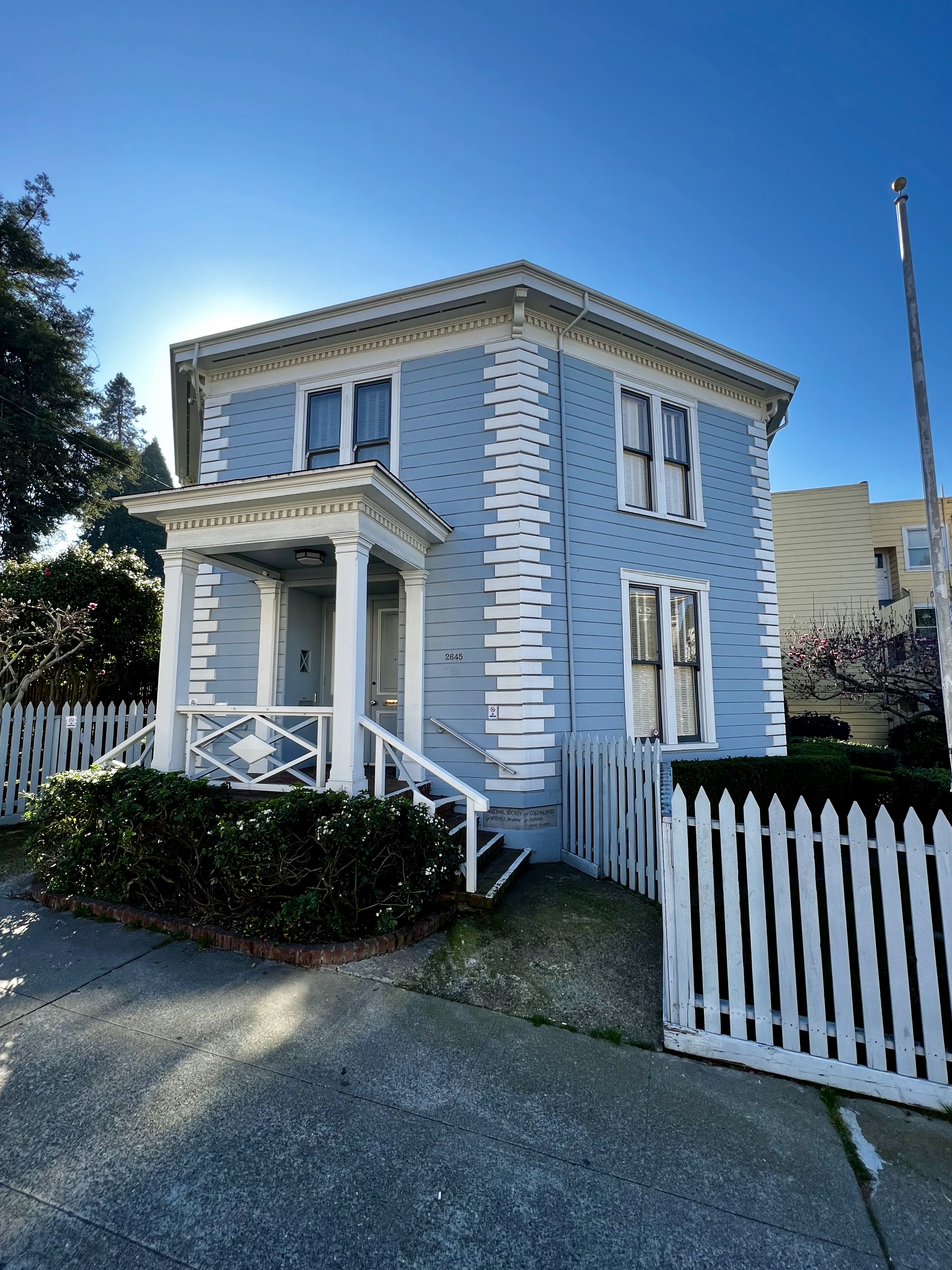
McElroy Octagon House
San Francisco once had several octagonal houses, built during a mid-nineteenth-century fad inspired by Orson Squire Fowler's 1848 book arguing that eight-sided homes were healthier, more efficient, and better lit. Only two survive. The McElroy Octagon House at 2645 Gough Street, built in 1861 by William C. McElroy, is one of them -- a curious architectural survivor that outlasted earthquakes, fires, and a century of urban development.
Fowler's Theory
Orson Squire Fowler's 1848 book A Home for All promoted octagonal houses as superior to rectangular ones, arguing that the shape enclosed more floor area per foot of exterior wall, admitted more light through more windows, and promoted better air circulation. The theory caught on as a minor architectural fad, and octagonal houses appeared across the United States in the 1850s and 1860s. San Francisco, always receptive to unconventional ideas, built several.
Surviving the Centuries
The McElroy Octagon House suffered major damage in the 1906 earthquake but was spared from the subsequent fires, which were stopped at Van Ness Avenue to the east. The house was purchased by the National Society of The Colonial Dames of America in California in 1951 and moved across Gough Street to its current location at 2645 Gough Street in 1952, when restoration began. The Society maintains it as a small museum. The interior displays Colonial and Federal period decorative arts -- an irony, since the octagonal form was distinctly mid-nineteenth-century rather than Colonial.
An Odd Geometry
Standing inside an octagonal house is disorienting in a pleasant way. Rooms are trapezoidal. Walls meet at angles other than ninety degrees. The central staircase spirals through a space that feels simultaneously more open and more intimate than a conventional house. The McElroy Octagon House is open to the public on limited days, offering visitors a chance to experience a spatial geometry that fell out of fashion before the Civil War ended -- preserved not because anyone planned to keep it, but because the city failed to tear it down.
From the Air
Located at 37.797778N, 122.426389W in the San Francisco Bay Area. Nearby airports: KSFO (San Francisco International), KOAK (Oakland International).