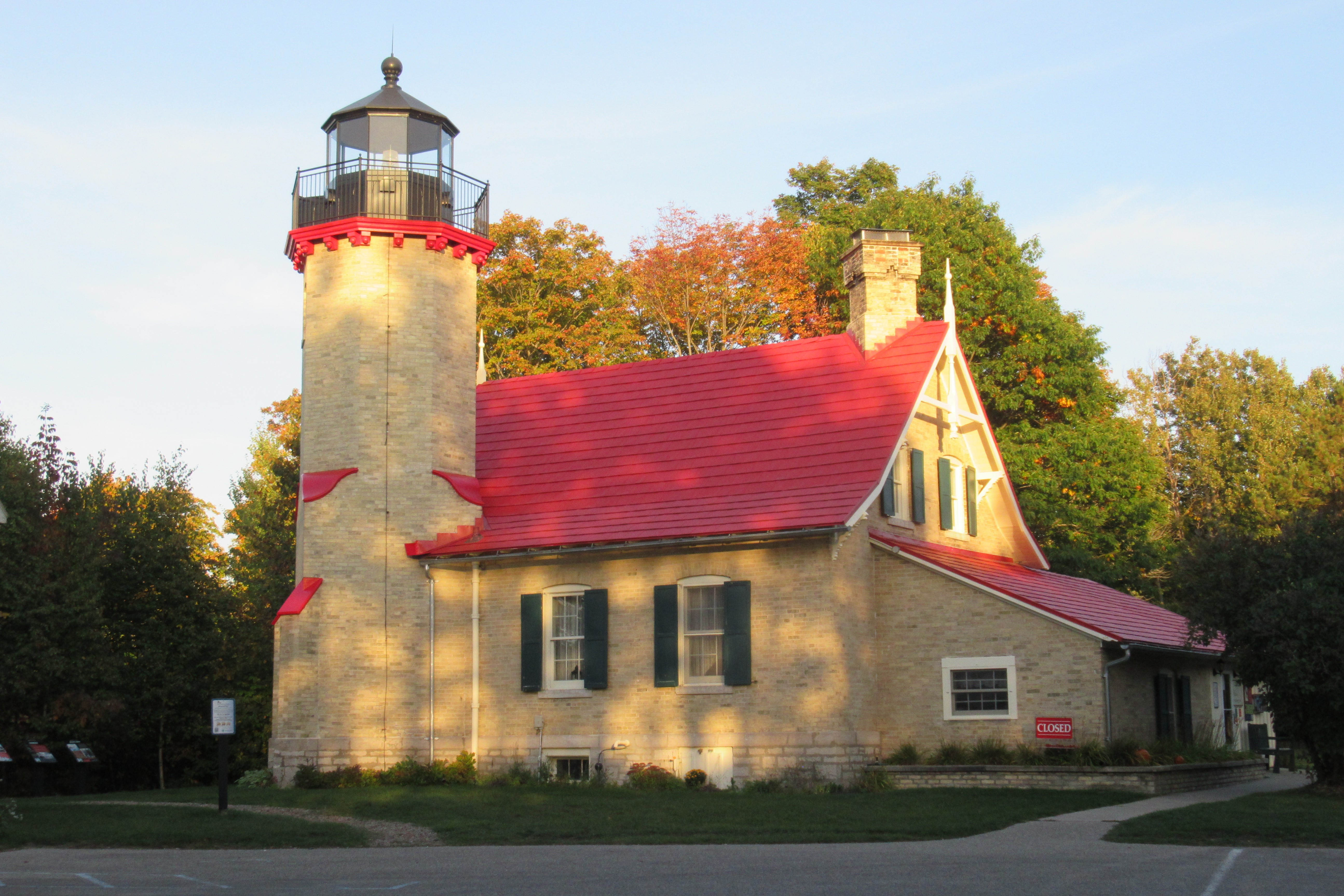
McGulpin Point Light
For 37 years, James Davenport trudged through Michigan snow to a small brick lighthouse on a rocky point west of Fort Michilimackinac. He was the only keeper McGulpin Point Light ever had, and his weekly letters to the District Inspector in Milwaukee did more than report on cracked window panes and leaking mortar. They tracked the ice. Every spring, while other keepers waited for orders, Davenport sent dispatches on whether the Straits of Mackinac were still locked solid or beginning to fracture. He was the only straits keeper to file such frequent reports, and the Inspector used them to determine when Great Lakes navigation could safely resume. A single man, watching ice from a single point, opening the shipping lanes for an entire system of lakes.
Norman Gothic on the Waterline
The United States Lighthouse Board completed McGulpin Point Light in 1869 at a cost of $20,000. The structure is a true lighthouse -- a light tower physically attached to the keeper's living quarters, built as a one-story brick dwelling in what has been called a Norman Gothic style. The design proved so effective that the Board replicated it across the Great Lakes: Eagle Harbor Light in 1871, White River Light in 1875, and Sand Island Light in 1881 all followed the same 1868 blueprint. Chambers Island Light and Eagle Bluff Light, both guarding the treacherous "Death's Door" passage in Wisconsin, are mirror images of the McGulpin plan. For a modest structure on a remote Michigan point, it cast a remarkably long architectural shadow.
Replaced and Forgotten
In 1906, the Lighthouse Board decided that the newer Old Mackinac Point Light, built in 1892, was doing an adequate job marking the straits on its own. McGulpin Point was deactivated. The lantern room atop the tower was removed, and the building was sold into private ownership, beginning a quiet century as someone's home. The lighthouse that had guided mariners through one of the most dangerous narrows in the Great Lakes became a lakefront cottage. Generations passed. The Peppler family eventually put the property on the market in 2005, asking $1.75 million. By early 2008, the price had dropped to $974,900. The lighthouse seemed destined to remain a private curiosity.
A County Takes the Wheel
In June 2008, the governing board of Emmet County voted to purchase McGulpin Point Lighthouse and its surrounding lakefront property -- including Lake Michigan shoreline -- for $710,000. The county allocated an additional $25,000 for signs, plaques, a flagpole, and promotional materials to announce the lighthouse as a new historic resource of the Straits of Mackinac region. But the real work was structural. Working with the Great Lakes Lighthouse Keepers Association and private donors, the county commissioned Moran Iron Works in Onaway, Michigan, to fabricate a replica of the vanished lantern room. In April 2009, the new lantern room was lifted into place atop the tower, and a light was installed inside it.
Relighting the Straits
On May 30, 2009, roughly 1,200 people gathered on the McGulpin Point grounds for a relighting ceremony. Frank Ettawageshik of the Little Traverse Bay Bands of Odawa Indians delivered an invocation, followed by a performance from four Native American drummers. United States Senator Debbie Stabenow and Emmet County Board of Commissioners chairman James Tamlyn switched on the light. After 103 years of darkness, McGulpin Point was once again a functioning navigational aid. The restored lantern produces a single-flash white light with a three-second duration, visible to mariners in the Straits of Mackinac and charted on NOAA navigation maps as a private Aid to Navigation. Today the site operates as a museum and historic site, with tours available and overnight accommodations offered at the McGulpin Point Cottage on the grounds.
From the Air
McGulpin Point Light sits at approximately 45.787N, -84.772W on the northern shore of Michigan's Lower Peninsula, roughly three miles west of Fort Michilimackinac and the Mackinac Bridge. The small brick lighthouse is best spotted from 1,500-2,500 feet AGL when approaching along the Lake Michigan shoreline. It sits on a low, rocky point -- look for the distinctive tower attached to the one-story dwelling. Pellston Regional Airport (KPLN) is approximately 14 nm to the south-southwest, and Mackinac Island Airport (KMCD) is about 9 nm east. The Mackinac Bridge towers serve as the primary visual reference for locating this light. Fog is common in the straits, particularly in spring.