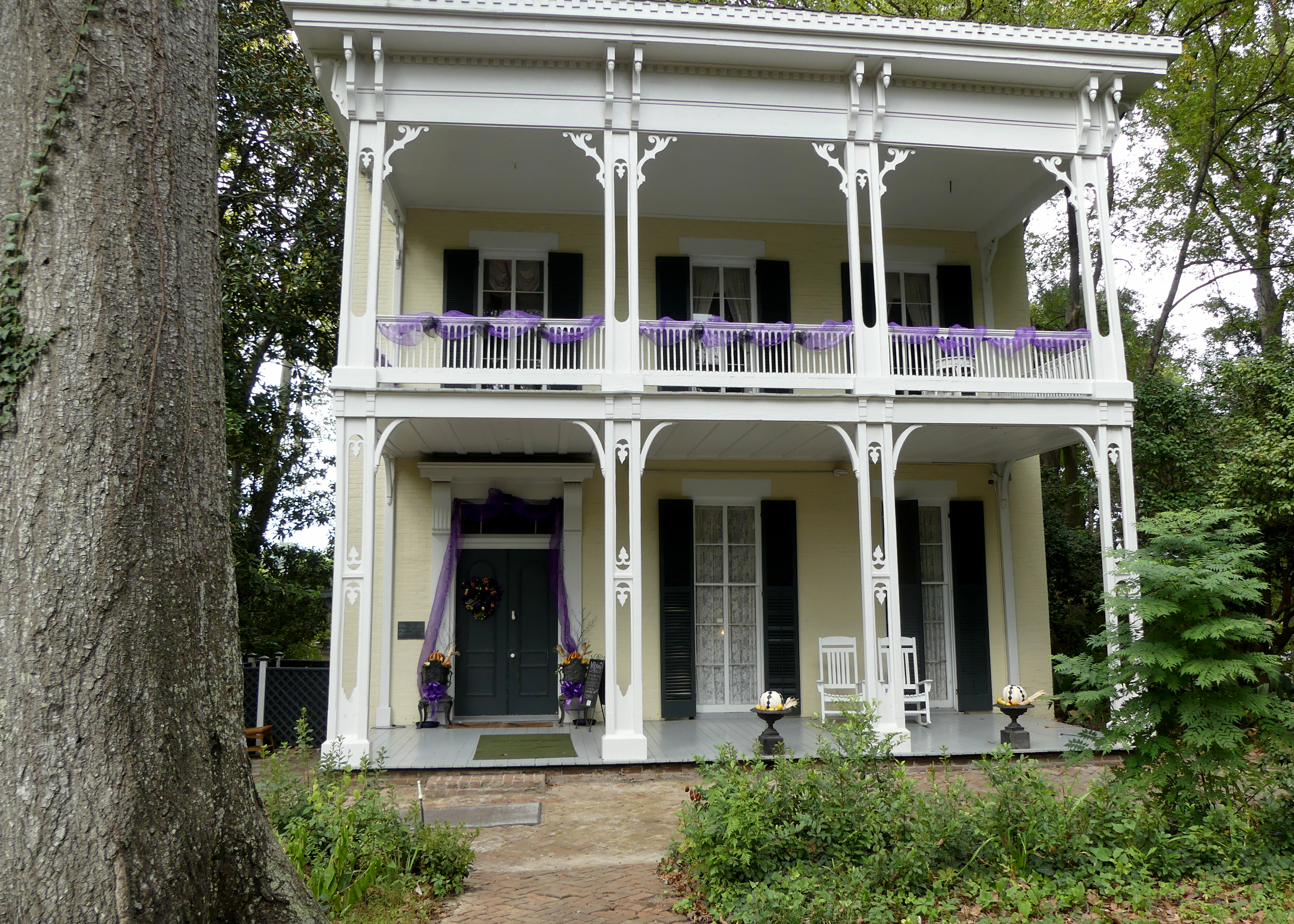
McRaven House
National Geographic called it the "Time Capsule of the South," and the name fits. McRaven House in Vicksburg, Mississippi, is not one house but three, each built by a different owner in a different era, fused together into a single structure that reads like a layered archaeological dig of antebellum life. Walk through its rooms and you pass from the rough-hewn frontier of 1797 through the refined Empire style of the 1830s and into the columned grandeur of Greek Revival before the Civil War. No architect planned this progression. History simply accumulated here, one addition at a time, on a piece of ground that has witnessed pioneer hardship, wartime carnage, and decades of silent decay.
Three Houses in One
Andrew Glass built the first section around 1797 as a way station for travelers heading along the Natchez Trace toward Nashville. It was modest by any standard: a kitchen on the ground floor, a single room above it. That pioneer core still stands, its hand-hewn timbers darkened by more than two centuries. In 1836, Sheriff Stephen Howard purchased the property and added a dining room and bedroom in the Empire architectural style. His wife, Mary Elizabeth Howard, died during childbirth in the middle bedroom that same year. Then in 1849, John H. Bobb expanded the house dramatically, adding a Greek Revival facade with the ornamental cornices and ceiling medallions that remain today. Three owners, three eras, three distinct styles, all under one roof.
Shrapnel and Bricks
When the Siege of Vicksburg engulfed the city in 1863, McRaven found itself at the center of the storm. Its proximity to the railroad made it a target, and the house was battered by cannon fire from both Union and Confederate forces. It served as a Confederate field hospital and campsite. Shrapnel damage to the attic rafters, discovered during a later restoration, bore silent witness to the bombardment. The following year, on May 18, 1864, owner John Bobb threw a brick at soldiers of the 46th United States Colored Infantry who were crossing his property. The brick struck Sergeant William Anderson in the head, fracturing his skull. Anderson shot Bobb in self-defense, killing him. A court martial found Anderson not guilty, but he died just months later at Milliken's Bend and was buried as one of the unknowns in Vicksburg National Cemetery. Bobb's widow Selina sold the house in 1869 and left for a family plantation near New Orleans.
The Recluses of Harrison Street
William Murray bought McRaven in 1882 and raised seven children within its walls. He died there in 1911, his wife Ellen in 1921, their daughter Ida in 1946. After these deaths, two unmarried Murray sisters, Annie and Ella, lived on alone with no modern conveniences beyond a telephone. Their only outside contact was their doctor. The upper story vanished beneath creeping vines. Neighbors forgot the house existed entirely. When firewood ran short, the sisters chopped up the antique furniture. Ella died at 81 in 1960, and Annie finally sold the property and moved to a nursing home, leaving behind a structure so consumed by neglect that it had essentially disappeared from public consciousness.
Resurrection on a Shoestring
O.E. Bradway purchased McRaven in 1960, performed cosmetic repairs, and opened it for public tours the following year. The house was placed on the National Register of Historic Places on January 8, 1979. Charles and Sandra Harvey later acquired the property for $75,000 and undertook a painstaking year-long restoration costing nearly $100,000. They reproduced the original Bobb-era carpet from surviving samples, restored the Greek Revival cornices, and rebuilt both porches. In the attic, they found rafters still scarred by Union shells. Leyland French purchased McRaven in 1984 for $275,000 and became the first owner since the Murrays to actually live in the house. Aside from a modern kitchen and bathroom added to the basement, the interior remains largely unchanged since the nineteenth century.
Ghosts in the Halls
McRaven's reputation as "the most haunted house in Mississippi" has drawn paranormal investigators and curious visitors for decades. The house was featured on Ghost Adventures in 2018, with investigators exploring reports of an aggressive spirit attributed to Andrew Glass, described as a highwayman murdered by a jealous wife. A CNN travel writer participated in a ghost hunt at McRaven in 2025, documenting eerie accounts from staff and tour guides. Whether or not the ghosts are real, the house itself is haunted in a different sense: by the layered presence of every family that lived, suffered, and died within its walls, from the frontier era to the long twilight of the Murray sisters' seclusion.
From the Air
Located at 32.346N, 90.872W in Vicksburg, Mississippi, along Harrison Street near the railroad tracks. The house sits within the broader Vicksburg historic district. Nearest airport is Vicksburg-Tallulah Regional Airport (KTVR), approximately 10 nm to the west. Jackson-Medgar Wiley Evers International Airport (KJAN) lies about 35 nm to the east. From the air, look for the Vicksburg National Military Park and the Mississippi River bend; the house is in the residential area south of the park.