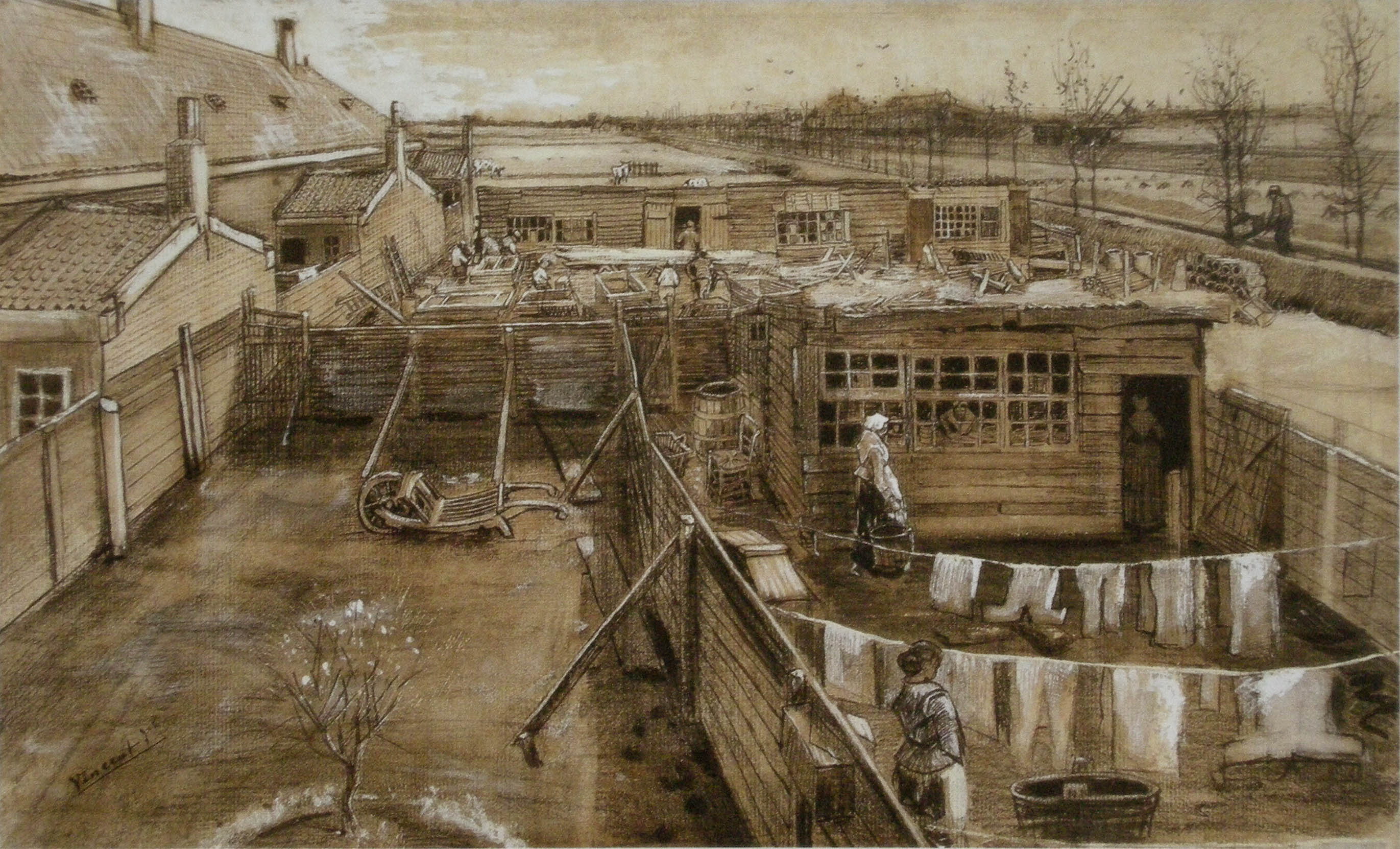
Meadows near Rijswijk and the Schenkweg
Imagine a young man, twenty-eight years old, who has just been thrown out of his father's house on Christmas Day for refusing to attend church. He is in love with his widowed cousin Kee, who has rejected him so plainly that her family will no longer receive him. He has been drawing for years but has only barely begun to paint. He is renting cheap rooms on the dusty outer edge of The Hague, on a road called the Schenkweg, where the medieval polder is being chewed up by a new railway. From the window of his rented studio that January of 1882, Vincent van Gogh looks across a drainage ditch at the rural meadows of Rijswijk and at the half-built Rijnspoor station rising on the horizon, and he makes one of the first proper paintings of his life.
The View from the Studio
The Schenkweg lay less than a mile east of the centre of The Hague. In 1882 it was still mostly open country, polder land reclaimed in medieval times, but speculators were buying it up and throwing up cheap housing for working-class tenants. Across the Schenkweg ditch, the new Rijnspoor station for the Utrecht-Gouda-The Hague railway was rising from the meadows. That same station, now Den Haag Centraal, is still the city's main railway terminus. Van Gogh's window opened on this exact moment of transition. He chose to record it with watercolour and pencil rather than smooth it away. The painting shows the half-rural meadow, the ditch, and the rectangular block of the new station on the horizon, a Dutch landscape interrupted by an industrial age that had not quite finished arriving.
Mauve, and the Decision to Paint
Until the previous December, Van Gogh had been a draftsman. He had drawn obsessively for years and only occasionally added a watercolour wash. In August 1881 he visited his cousin-in-law Anton Mauve, a successful painter of the Hague School, and showed him his work. Mauve encouraged him and suggested he begin painting properly. By late November Van Gogh was back in The Hague taking daily lessons in Mauve's studio. Then came the Christmas quarrel with his father, the pastor in Etten, and the flight back to The Hague. He set up at the Schenkweg, scraped together furniture and a couple of boxes of bulbs and some flowers, and declared himself happy. The room was the first in what his biographer Arnold Pomerans called a long line of plainly furnished rooms, a sequence that would end in the famous bedroom at Arles.
Sien, the Models, the Geest
Almost as soon as he had a studio, Van Gogh filled it with models. He could not afford the steady stream he wanted, but he spent what his brother Theo sent him on soup-kitchen women, almshouse orphan men, day labourers from the Geest, the working-class district on The Hague's west side. He called the Geest the Whitechapel of The Hague in a letter to his friend Anthon van Rappard. Among his models was Sien Hoornik, a pregnant seamstress and sometime prostitute who became his mistress and the subject of Sorrow, the great early figure drawing now scattered between versions. Sien was a real person, not a symbol, and the relationship was difficult. They lived together until September 1883, when Theo's quiet pressure pulled Van Gogh away to Drenthe. It was the only domestic relationship of his life. Modern Hague honours the connection with a commemorative plaque in the Hendrick Hamelstraat, where the second studio stood, opposite a children's playground.
The Little Window
Van Gogh used a perspective frame, a wooden grid threaded with cotton that artists from Leonardo and Durer onward had used to organize a scene. He had a local carpenter build him a sturdier version with legs that could be adjusted on rough ground. He called it his little window. Many of his Hague drawings still show traces of the squaring that came from using it. He took the frame with him to Arles years later and used it for the Langlois Bridge paintings. Naifeh and Smith, his biographers, suggested that windows mattered to Van Gogh as a way of looking out at the world without being seen looking back. The Meadows watercolour is exactly that kind of view: the artist hidden in his upper-floor room, taking in the dust and trains and meadow grass without being asked who he is.
What Remains
The Schenkweg is no longer countryside. The Hague has spread three miles east of where it stood in 1882, swallowing the meadow, the ditch, the Rijnspoor sidings, and the working-class courtyards Sien Hoornik came from. The Bethlehemskerk where Van Gogh painted his Church Pew with Worshippers, the slum hofjes of the Geest, the third-class waiting room at the Rijnspoor station, the iron mill where Lodewijk Enthoven may have supported him - all of it has been redeveloped, demolished, rebuilt. The Haagse Bos just north of the Schenkweg, one of the last patches of ancient forest in the Netherlands, still survives, and Van Gogh painted there in August 1882. The watercolour that began this story remains, dated January 1882, holding open a window onto a Dutch landscape that has otherwise vanished.
From the Air
The historical Schenkweg site is in central The Hague at roughly 52.08N, 4.33E, immediately east of Den Haag Centraal station. The Hague sits about 6 km inland from the North Sea coast. Rotterdam The Hague (EHRD) lies about 15 km southeast; Schiphol (EHAM) is about 40 km northeast. The Haagse Bos, the ancient forest Van Gogh also painted, is still visible just north of the city centre.