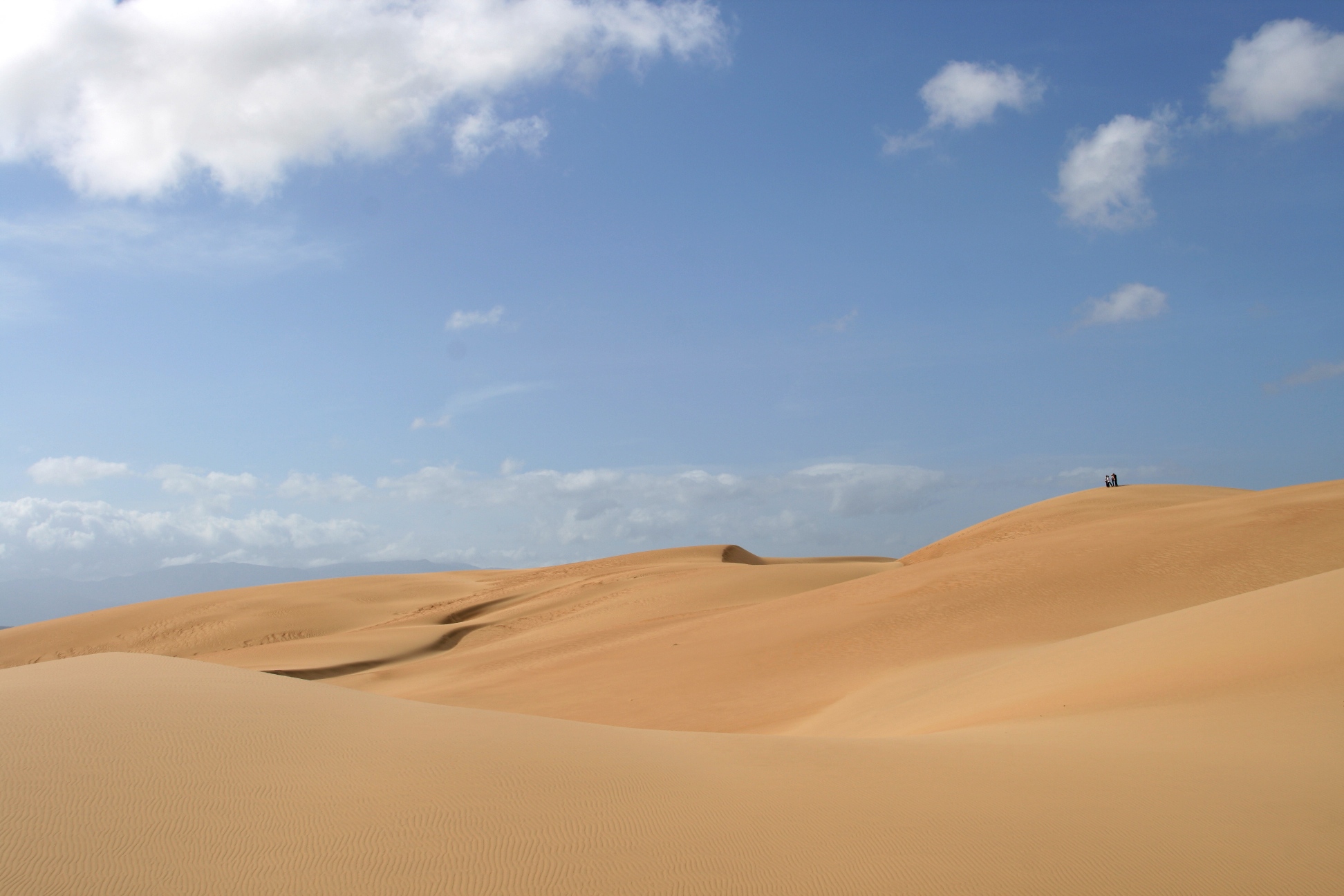
Medanos de Coro National Park
Camels walk across the dunes here. That fact alone should signal that something unusual is happening in Venezuela, a country most people associate with rainforest, not desert. But the Medanos de Coro National Park, established in 1974 on the narrow isthmus connecting the Paraguana Peninsula to the South American mainland, protects 91 square kilometers of sand dunes, salt marshes, and mangrove swamps that look far more like the Sahara than the Amazon. The dunes - called medanos in Spanish - rise as high as 40 meters and shift constantly under a relentless Caribbean wind. The camels, imported years ago as a novelty for tourists, have become part of the scenery, plodding across ridgelines as if they had always belonged here.
Three Landscapes in One
The park divides into three distinct zones, each shaped by different geological forces. An alluvial plain spreads where the Mitare River and smaller streams deposit sediment into a broad delta - flat, silty ground that transitions into the drier terrain beyond. The aeolian plain holds the main attraction: three types of sand dunes arranged in formations that geologists study for their textbook clarity, each shaped by wind direction, sand supply, and the sparse vegetation that sometimes anchors a dune's base long enough for it to grow. Then there is the littoral plain along the coast, where a belt of mangrove swamps meets the Caribbean, creating a brackish transition zone between desert and sea. Salt marshes fill the low ground between these zones. The entire park sits on the Medanos Isthmus, a thin strip of land that connects the Paraguana Peninsula to the mainland, and from altitude it looks like someone dropped a scoop of the Arabian desert onto a Caribbean sandbar.
Where Rain Is a Stranger
The park lies within the Paraguana xeric scrub ecoregion, one of the driest habitats in South America. Rain is so rare that when it does fall, the event qualifies as news. In December 1999, when catastrophic flooding struck Venezuela's coastal states in what became known as the Vargas tragedy, the same deluge reached the Medanos. Park guards, who had spent their careers patrolling a waterless landscape, watched in astonishment as four lagoons formed among the dunes - something none of them had ever witnessed before. The water lingered briefly, then the sun and wind reclaimed the sand. The episode was a reminder that even the driest places on Earth exist at the mercy of larger atmospheric systems, and that a desert is not a permanent condition but a balance of forces that occasionally tips.
Life at the Margins
Flora in the park amounts to little more than thorny scrub - low, tough bushes that cling to whatever moisture the sand retains. The landscape looks barren at first glance, but the park has been designated an Important Bird Area, with 21 recorded species including the Yellow-shouldered amazon, a parrot increasingly rare across its Caribbean range. On the ground, the animal community is sparse but persistent: lizards dart between dune grasses, rabbits shelter in scrub hollows, anteaters probe the harder ground at the park's edges, and foxes hunt the margins where desert meets mangrove. None of these creatures are abundant, but their presence in such an extreme environment speaks to the adaptability of life at the edges. The park's designation in 1974 was an acknowledgment that even a landscape this stark deserves protection - not despite its emptiness but because of it.
Walking the Dunes
Visitors arrive from the nearby city of Coro by bus or taxi and step into a landscape that rewrites expectations about Venezuela. The dunes stretch to the horizon, golden-white under a sun that rarely hides behind clouds. The wind is constant, sculpting the sand into ridges, crescents, and long sinuous lines that change shape between morning and afternoon. Footprints vanish within hours. The camels - a sight incongruous enough to make first-time visitors laugh - offer rides across the higher dunes, their padded feet better suited to the loose sand than human shoes. Walking is the other option, and it is harder than it looks: the sand shifts underfoot, the sun reflects upward as well as downward, and distances deceive when there are no landmarks. But the silence and the scale make the effort worthwhile. Standing on a 40-meter dune crest with the Caribbean visible in one direction and the Paraguana Peninsula in the other, the view captures the full strangeness of this park - a pocket of desert that somehow found its way to the tropics.
From the Air
Located at 11.61N, 69.74W on the Medanos Isthmus connecting the Paraguana Peninsula to the Venezuelan mainland, in Falcon state. From cruising altitude, the park is unmistakable - a bright expanse of sand dunes contrasting sharply with the surrounding scrubland and Caribbean water on both sides of the narrow isthmus. The dune field appears as a pale patch approximately 5 km across. Jose Leonardo Chirino Airport (SVCR) near Coro is approximately 15 km southeast. The isthmus narrows dramatically here, making it one of the most recognizable coastal features in northwestern Venezuela. Best viewed in clear weather when the white-gold dunes create maximum contrast with the turquoise Caribbean waters.