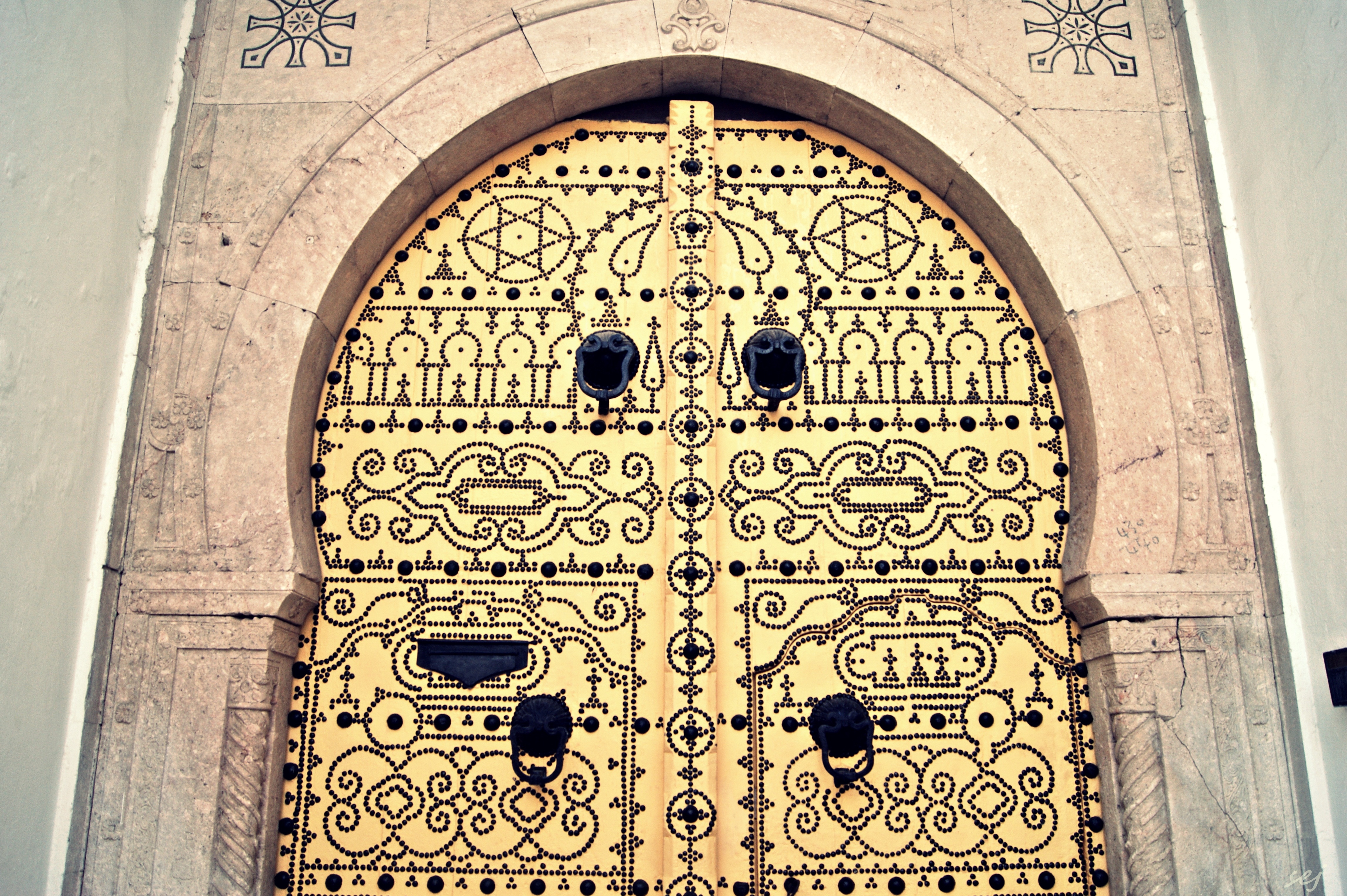
Medina of Tunis
From above, it looks like chaos. Narrow streets branch and dead-end without apparent logic, rooftops press against each other at irregular angles, and the boundary between public thoroughfare and private dwelling dissolves into ambiguity. Colonial-era writers described the Medina of Tunis as dangerous, anarchic, a territory of ambush. They were wrong. Since the 1930s, ethnographers and urban historians have demonstrated that the Medina's layout follows precise sociocultural codes governing the relationship between public and private, sacred and commercial, male and female space. The apparent disorder is, in fact, an order so sophisticated that it took outsiders decades to read it.
Founded Around a Mosque
The Medina grew outward from the Zitouna Mosque beginning in 698, its main axis running between the mosque and the kasbah -- the seat of government -- to the west, then extending east to the Bab el Bhar gate. Expansions north and south created two suburbs: Bab Souika to the north, Bab El Jazira to the south. Before the Almohad Caliphate, other cities had served as capital -- Mahdia, Kairouan -- but under Almohad and then Hafsid rule, Tunis assumed primacy. The Medina took its essential form during the Hafsid period, acquiring buildings that blended Ifriqiyan, Andalusian, and Oriental styles while incorporating columns and capitals salvaged from Roman and Byzantine monuments. Today, the Medina covers 270 hectares with nearly 110,000 inhabitants -- one-tenth of the city's population in a sixth of its urbanized area -- and contains roughly 700 monuments including palaces, mosques, mausoleums, madrasas, and fountains. UNESCO inscribed it as a World Heritage Site in 1979.
Reading the Streets
Despite their apparent irregularity, the Medina's streets follow a logic comparable to the Roman cardo and decumanus. The main north-south and east-west axes intersect at the court of the Zitouna Mosque, creating a hierarchy of thoroughfares: main streets, secondary streets, and cul-de-sacs that sometimes give access to spaces reserved for women. The concept of public space is deliberately ambiguous -- streets function as extensions of houses, and shop displays routinely spill onto roadways from stalls measuring barely three square meters. Privacy intensifies with distance from the commercial zone: the more a building is set back from the shops, the more it is valued. The largest houses and noble residences cluster in the elevated Kasbah quarter. Roof terraces serve as important social spaces, as depicted in Ferid Boughedir's film Halfaouine. Even the football rivalries follow the old geography: the northern suburb supports Esperance Sportive de Tunis, while the south backs the rival Club Africain.
Builders Across Centuries
Each dynasty left its architectural signature. The Muradid rulers of the seventeenth century were prolific builders: Hammouda Pasha constructed numerous souks and palaces, then in 1655 commissioned Ottoman architects to build the Hammouda Pacha Mosque with its elegant octagonal minaret and family mausoleum beneath. His grandson Mohamed Bey El Mouradi built the Sidi Mahrez Mosque, the largest Hanafi mosque in Tunisia, modeled on Istanbul's great domed mosques. The Husainid ruler Ali II ibn Hussein had the Tourbet el Bey constructed in the Medina's south -- the largest funerary monument in Tunis. The Saheb Ettabaa Mosque, built between 1808 and 1814, was the last mosque the Husseinites built before the French occupation. By the 1860s, under Muhammad III as-Sadiq, the Medina's walls had deteriorated so badly that sections were demolished along with historic gates including Bab Cartagena and Bab Bnet.
Living Heritage Under Pressure
The Medina is not a museum. Its 110,000 residents live in a historic fabric that still functions according to patterns established centuries ago, even as those patterns face modern pressures. The Hafsia quarter, once the Jewish hara, has undergone urban renewal. Domestic architecture maintains the traditional inward-looking courtyard house, but the introduction of modern sewage remains incomplete, and waste water still flows through some streets. As a coastal heritage site, the Medina faces a longer-term threat: the IPCC Sixth Assessment Report identified it among African cultural sites vulnerable to sea level rise. Under all warming scenarios, sea levels will continue rising for millennia, meaning that protection of the Medina is not a one-time engineering challenge but a permanent commitment. The question is whether a city that has survived Almohads, Hafsids, Ottomans, and French colonizers can navigate the centuries ahead with its identity intact. Its track record suggests it can.
From the Air
Located at 36.80N, 10.17E in the heart of Tunis. From the air, the Medina is recognizable as the dense, irregular urban fabric west of the broad Avenue Habib Bourguiba, bounded by remnants of old walls and gates. The Zitouna Mosque minaret is the tallest structure in the old city. The Kasbah fortress complex is visible at the western edge. Best viewed at 2,000-4,000 feet. Nearest airport is Tunis-Carthage International (DTTA), approximately 8 km to the northeast.