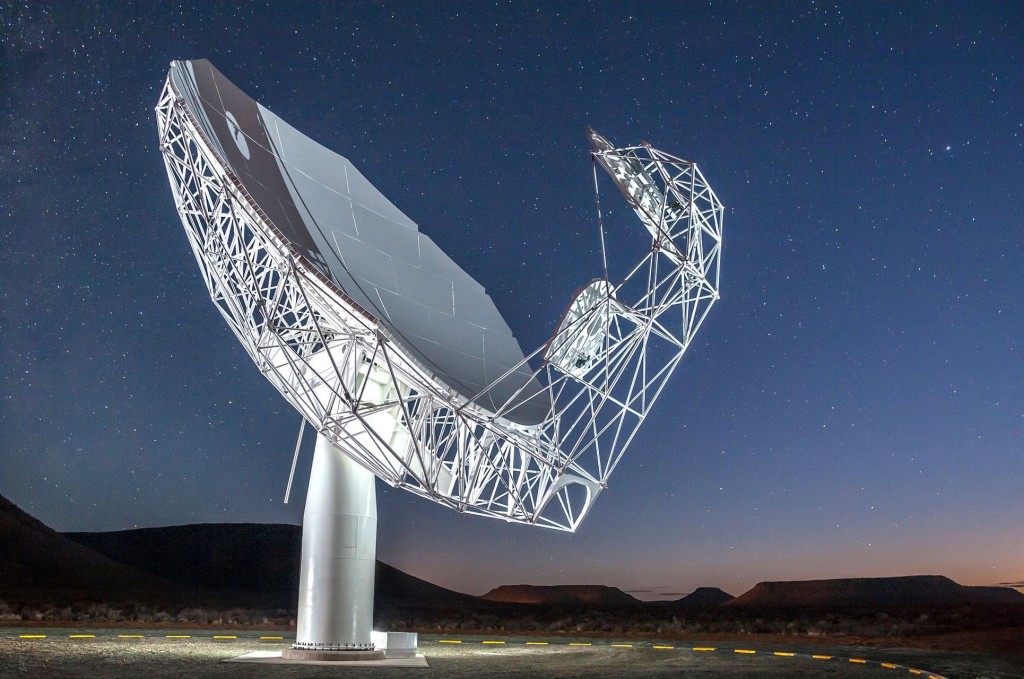
MeerKAT
The name is a pun. MeerKAT started life as the Karoo Array Telescope, but when the South African government quadrupled its budget from 20 dishes to 64, someone realized that "more of KAT" -- MeerKAT -- also happened to be the name of the small desert mammals that pop up from burrows across the Karoo. The telescope, like its namesake, stands alert in the desert, watching for things most instruments cannot see.
Built in South Africa, for the World
MeerKAT was designed and largely built by South African engineers and industries. The South African Radio Astronomy Observatory oversaw a project that used nearly 5,000 cubic meters of concrete and 570 tonnes of steel to anchor 64 antenna foundations into the Karoo bedrock. Construction ran from 2014 to 2018, surviving a budget suspension that halted work between 2010 and 2012 and a period when the national budget projected only 15 antennas would be completed by 2015. On July 13, 2018, Deputy President David Mabuza inaugurated the telescope by unveiling an image that revealed unprecedented detail of the region surrounding Sagittarius A*, the supermassive black hole at the center of the Milky Way. In 2023, the Royal Astronomical Society awarded MeerKAT's team its Group Achievement Award, recognizing breakthrough observations made in just a few years of operation.
The Architecture of Listening
Each of MeerKAT's 64 dishes measures 13.5 meters across and uses an offset Gregorian configuration, a design chosen because its unblocked aperture provides clean sensitivity and rejects interference from satellites and terrestrial transmitters. The dishes carry cryogenically cooled receivers, and their signals are digitized at the antenna and sent via buried fiber optics to the Karoo Array Processor Building. That building is itself a feat of engineering: a partially buried Faraday cage housing massive computing systems, shielded so that the electronics do not contaminate the radio silence the telescope requires. Three diesel rotary UPS units provide uninterrupted power to the entire site. Two hydrogen maser clocks and two rubidium atomic clocks keep time with the precision that interferometry demands.
Giant Bubbles and Neutron Star Collisions
MeerKAT's early science returns have been remarkable. In September 2019, astronomers using the telescope discovered enormous balloon-like radio structures towering hundreds of light-years above and below the galactic center, features that had been invisible to previous instruments. The telescope also captured the radio afterglow of a neutron star merger, the kind of cataclysmic event that forges heavy elements like gold and platinum. These discoveries validated MeerKAT's design philosophy: rather than chasing the largest possible dish, the team built a precisely calibrated array whose combined sensitivity exceeds what brute size alone could achieve. The telescope supports deep continuum imaging, polarization studies, spectral line mapping, pulsar timing, and transient searches, a versatility that keeps its observing schedule packed.
Pathway to the Square Kilometre Array
MeerKAT was always intended as a stepping stone. Its 64 dishes will be folded into Phase 1 of the Square Kilometre Array's mid-frequency component, joining 133 new SKA dishes to create a 197-antenna network on the same Karoo site. All existing MeerKAT infrastructure -- the processor building, the fiber network, the power systems -- will transfer directly to the SKA. South African engineers have participated in 7 of the 11 SKA design consortia and led two of them, contributing roughly 10 percent of the global workforce. The skills development program that grew alongside MeerKAT has awarded more than 1,000 scholarships and fellowships, building radio astronomy expertise across Africa from a standing start.
A Continental Ambition
MeerKAT's influence reaches beyond South Africa. The African Very Long Baseline Interferometry Network is extending radio astronomy capability to Botswana, Ghana, Kenya, Madagascar, Mauritius, Mozambique, Namibia, and Zambia. MeerKAT participates in global VLBI operations, adding its sensitivity to a worldwide network of observatories. From above, the 64 dishes are scattered across the Karoo like seeds thrown by a careful hand -- most clustered within a one-kilometer core, the rest stretching to an eight-kilometer radius. The pattern looks almost organic, but every position was calculated to optimize the telescope's response to the radio sky. It is an instrument born of a young democracy's ambition to contribute something fundamental to humanity's understanding of the universe.
From the Air
Located at 30.71S, 21.44E in the Karoo desert, Northern Cape, South Africa, within the radio quiet zone of Meerkat National Park. The 64 white dishes are visible from altitude, with most clustered within a 1 km diameter core. Nearest major airport is Upington (FAUP), approximately 250 km northeast. Carnarvon is the nearest town. Expect minimal radio navigation aids due to the radio quiet zone restrictions.