Megaliths in the Netherlands
In 1547 a Bruges canon named Anthonius Schonhovius read his Tacitus, looked at a stone tomb near Rolde, and concluded that demons had built it. A hundred and thirteen years later a Drenthe pastor decided the builders had been giants who walked north from the Holy Land via Scandinavia. Both men were wrong, but their guesses survived in popular imagination for centuries because the truth was almost as strange: ordinary farmers, working with stones the ice had dropped on them, raised these tombs around 3400 BC and kept burying their dead inside them for more than six hundred years. Fifty-four of them are still standing in the Dutch north, most along a single ridge.
Stones the Glaciers Left
The hunebedden, as the Dutch call them, exist because of the Saalian ice sheet. Roughly 150,000 years ago, glaciers dragged enormous granite boulders south from Scandinavia and dumped them across what is now Drenthe and northern Germany when the ice retreated. Five thousand years ago, Funnelbeaker farmers found them lying on the land - free building material, scattered like coarse gravel in a giant's path. They wedged smaller boulders upright as wall stones, dragged the largest blocks on top as capstones, and packed the gaps between with dry-stone masonry of split slabs. Then they covered the whole structure with an earthen mound. The chambers ran from 2.5 metres long in the smallest dolmens to 20 metres in the great Borger passage grave - D27, the largest in the country, with a width of 4.1 metres and capstones the weight of small cars.
A Hondsrug Necropolis
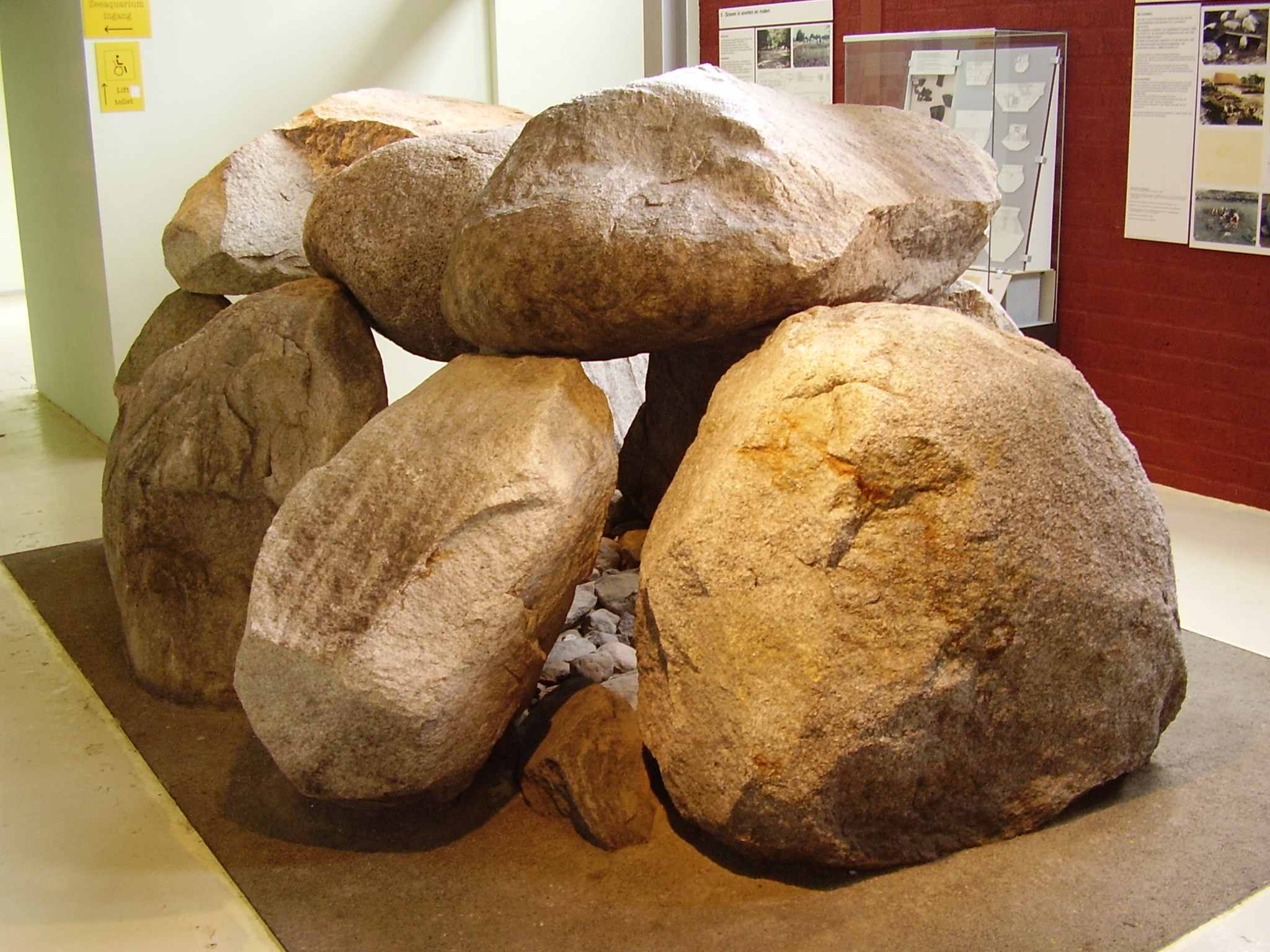
The surviving tombs concentrate on the Hondsrug, a low ridge running northwest to southeast between Groningen and Emmen. Fifty-two of the fifty-four are in the province of Drenthe. Two more sit in Groningen, one of which - the Heveskesklooster dolmen, the only one of its kind in the country - was discovered in 1983 beneath a wierde mound and is now reassembled inside the Muzeeaquarium in Delfzijl. The Hondsrug graves cluster within reach of the N34 highway today, and you can drive their length in an afternoon. Builders favoured an east-west orientation with the entrance facing south, the ends of most chambers aligning with the extreme rising and setting points of the sun and moon. A few outliers stand to the west near Diever and Havelte, and one questionable stone near Lage Vuursche in Utrucht province, if genuinely megalithic, would be the westernmost in the entire Funnelbeaker world.
The Pottery in the Dirt
Bones rarely survived in the acidic Drenthe soil - just under 8 kilograms of cremated remains across all the Dutch tombs combined, from 48 identifiable individuals. But the pottery survived in extraordinary quantities. The Havelte 1 tomb (D53) alone yielded sherds that archaeologists reconstructed into 649 vessels. The destroyed Glimmen 1 grave (G2) gave up about 360. The Drouwenerveld tomb (D26) produced 157. The dead were sent off with funnel cups, shoulder cups, fruit bowls, collared bottles, amber beads, flint axes, and crossed arrowheads. Some of these objects were laid inside the chamber. Others were carefully deposited in pits just outside the entrance, suggesting rituals performed at the threshold long after the body had gone in. The vessel styles change in seven distinct phases between roughly 3400 and 2800 BC, evidence that families came back to the same tomb across thirty generations.
From Devils' Altars to State Property
Modern study of the tombs began with the poet Titia Brongersma of Dokkum, who in 1685 led the first known excavation - at Borger, D27, the largest of all. The state began protecting the graves surprisingly early. A 1734 resolution by the government of Drenthe was the third antiquities-protection law in European history, after Denmark in 1620 and Sweden in 1630. By the 1870s, after a string of illicit excavations damaged the great De Papeloze Kerk tomb (D49), most of the graves had been acquired by the province or the Crown. The amateur Lucas Oldenhuis Gratama then restored several of them - badly - by removing their earth mounds, having mistakenly accepted that they had never existed. The careful work began in 1912 with Jan Hendrik Holwerda's excavations at Drouwen, and continued for decades under Albert Egges van Giffen, who measured every site, restored almost all of them, and devised the lettered-and-numbered catalogue (D for Drenthe, G for Groningen) that researchers still use. A dedicated hunebed museum opened in Borger in 1967, with D27 itself as its centerpiece exhibit.
Reading a Five-Thousand-Year-Old Skyline
From the air the hunebedden are almost invisible - low mounds among ploughed fields and pine plantations. From the ground they are unmistakable: rough granite forms that look nothing like quarry-cut stone, with weathered surfaces still showing the grooves the glaciers carved. The largest are immediately legible as architecture. D27 at Borger, 22.6 metres of outer length, sits inside a fenced enclosure off the N34 with a museum next door. Walk the chamber and you stand in a space designed by people who had no written language, no metal tools, no wheeled vehicles, and yet possessed the engineering imagination to lift stones weighing several tonnes onto upright supports without crushing themselves or their work. The Funnelbeaker farmers vanished into other cultures by 2800 BC. Their architecture is still here.
From the Air
The main hunebed cluster runs along the Hondsrug ridge between Groningen (53.22 N, 6.57 E) and Emmen (52.78 N, 6.90 E), roughly parallel to the N34 highway. The article coordinate (53.23 N, 6.47 E) marks the northern end. Groningen Airport Eelde (EHGG) is the nearest major field, about 10 km south of that point. From low altitude, look for small rectangular enclosures along the ridge - most surrounded by a few trees and a path - in otherwise flat farmland and pine forest. The Borger D27 site, the largest, has a museum building beside it. The Heveskesklooster dolmen is no longer at its original location; it is reassembled inside the Muzeeaquarium in Delfzijl on the Groningen coast.