Meigetsu-in: Kamakura's Temple of Hydrangeas
Every June, a narrow side street in Kita-Kamakura floods with visitors who have come for a single color: the deep, almost impossible blue of 2,500 hydrangea bushes blooming along the temple walkways of Meigetsu-in. The flowers are a relatively recent addition, chosen for the practical reason that they grow easily on the temple's hillside soil. But the effect is anything but practical. Walking through the entrance path feels like stepping into an aquarium of blue petals, and the name stuck -- Meigetsu-in is known throughout Japan as Ajisai-dera, the Temple of Hydrangeas. The temple itself, however, is far older than its flowers, rooted in the power struggles and Zen Buddhism of medieval Kamakura.
A Name Written in Death
Meigetsu-in takes its name from the posthumous Buddhist name of Uesugi Norikata, the nobleman who built it. Norikata belonged to the powerful Uesugi clan, a family that shaped the politics of the Kamakura period and beyond. The temple was originally a subsidiary of a larger temple called Zenko-ji, which held considerable prestige as one of the Rinzai Zen temples ranked just below Kamakura's famous Five Mountains in the official temple hierarchy. Zenko-ji did not survive the upheaval of the Meiji Restoration, when the government's anti-Buddhist policies -- known as Haibutsu kishaku -- forced the closure or destruction of temples across Japan. But its smaller dependent, Meigetsu-in, endured. The temple belongs to the Kenchō-ji school of Rinzai Zen Buddhism, and its principal object of worship is the bodhisattva Sho Kannon, the embodiment of compassion.
Stone Warrior in Kamakura Robes
Among the temple's most significant possessions is a 13th-century statue of Uesugi Shigefusa, founder of the Uesugi clan. Carved in the realistic style of the Kamakura period, the figure wears the ornate robes of a high-ranking dignitary, his posture conveying the authority of a man who helped establish one of medieval Japan's most influential warrior families. The statue is designated an Important Cultural Property of Japan. Nearby, a yagura -- a cave tomb carved into the hillside -- stands as the largest of its kind in all of Kamakura. A small tower at the center of the cave is believed to be Norikata's own tomb. The carved figures of the Sixteen Arhats, Buddhist saints who achieved nirvana, line the walls of the yagura in silent vigil. The grave of Hojo Tokiyori, the fifth regent of the Kamakura shogunate, also rests within the temple grounds.
The Window of Enlightenment
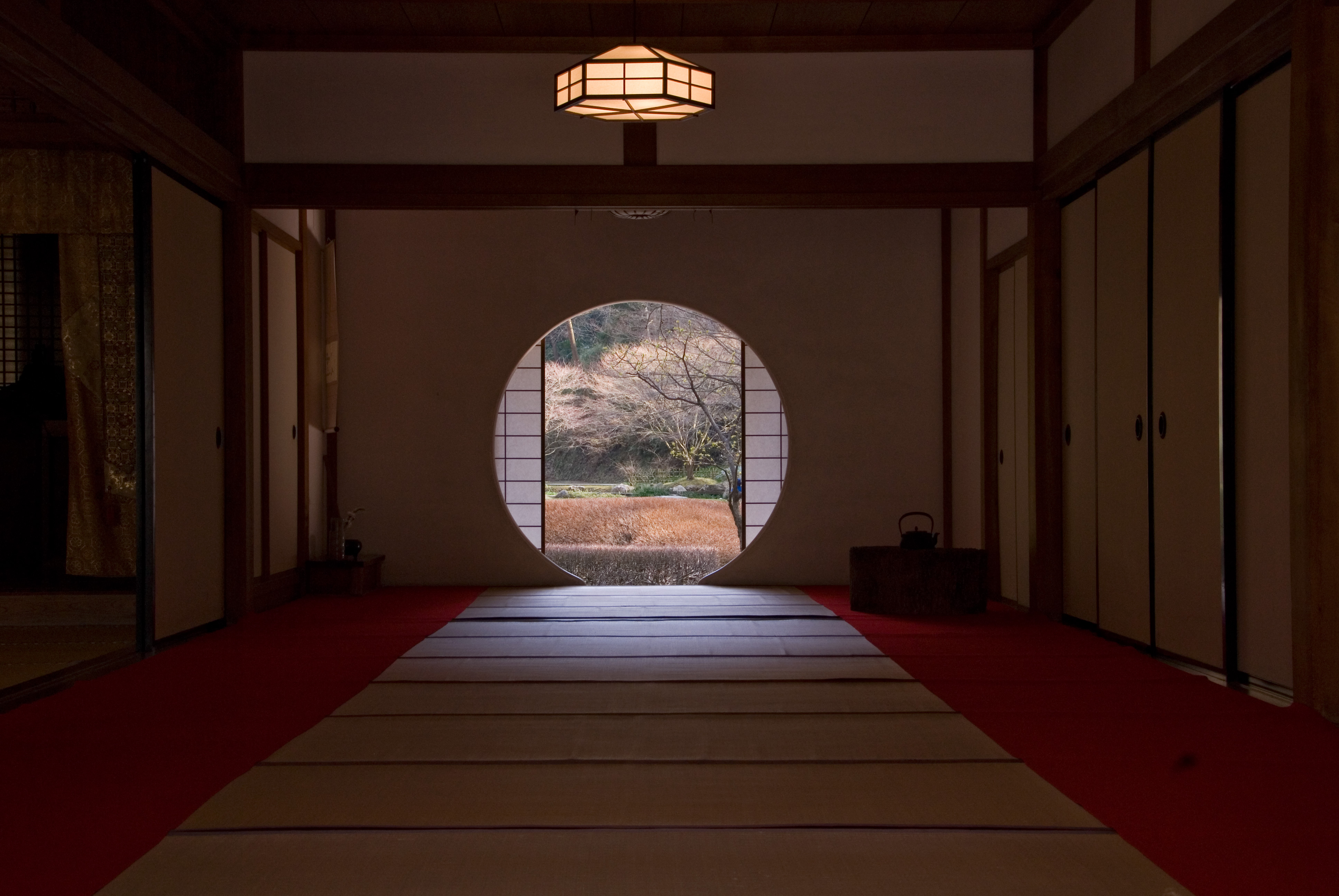
Meigetsu-in's most photographed feature, after the hydrangeas, is the Satori no Mado -- the Window of Enlightenment. A perfectly circular opening in the rear wall of the main hall frames the garden beyond like a living painting. In spring, the circle fills with fresh green; in autumn, it blazes with red and gold maple leaves; in winter, it frames bare branches against pale sky. The circle is a Zen symbol of wholeness and the void, and visitors line up for the chance to sit before it in stillness. Behind the window, the temple garden unfolds with the restrained beauty of Zen landscape design. A karesansui -- a dry garden of raked sand, carefully placed rocks, and sparse plantings -- represents the legendary Buddhist Mount Shumi, the sacred mountain at the center of the cosmos. The interplay of framed views and open spaces embodies the Zen teaching that enlightenment lies not in what you add to your perception, but in what you remove.
Blue Season
The hydrangeas were not part of any medieval monk's vision. They were planted in more recent decades, reportedly because hydrangeas thrive on the acidic hillside soil of Kita-Kamakura with minimal tending. What began as a low-maintenance landscaping choice became the temple's defining attraction. Each June, the bushes erupt in shades of blue, purple, and violet, lining the walkway from the entrance gate to the main hall. The temple limits visitors during peak bloom to manage the crowds, and the approach from Kita-Kamakura Station -- a ten-minute walk along the train tracks of the JR Yokosuka Line -- becomes a procession of umbrellas and cameras. But the temple rewards visits in every season. Snow settles on stone Jizo statues in winter. Autumn turns the maples into fire. And on quiet weekdays outside hydrangea season, the temple returns to its original purpose: a place of Zen stillness, tucked into the green hills of Kamakura, where the only sound is wind through bamboo.
From the Air
Located at 35.335N, 139.551E in the wooded hills of Kita-Kamakura, Kanagawa Prefecture. The temple is tucked into a narrow valley northwest of central Kamakura, identifiable from the air by the dense tree canopy of the surrounding hills and the nearby rail corridor of the JR Yokosuka Line. Best viewed at 1,500-2,500 feet AGL for the relationship between temple grounds and hillside. Haneda Airport (RJTT) is approximately 20 nautical miles to the northeast. Kamakura's coastal setting along Sagami Bay is visible to the south.