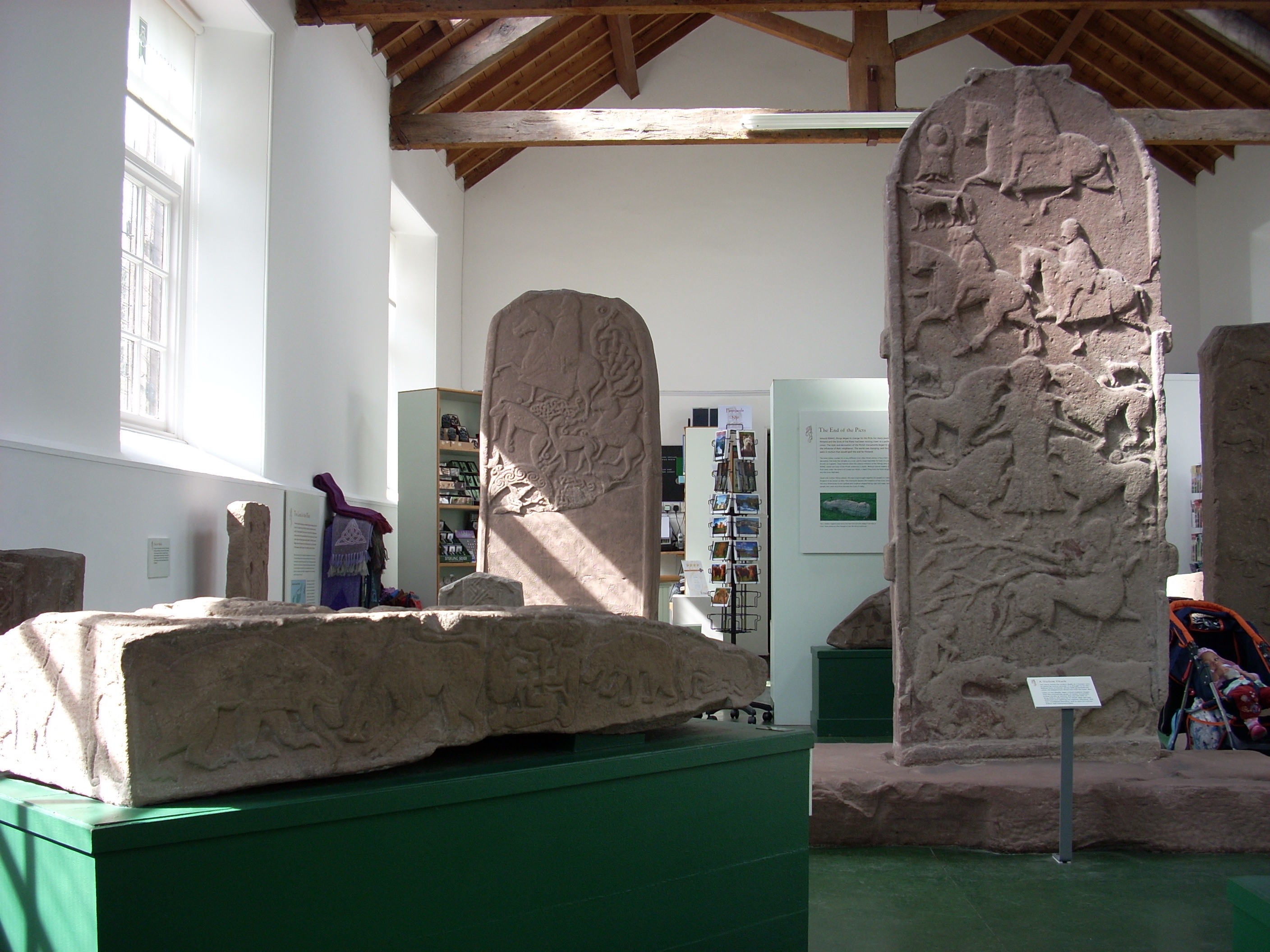
Meigle Sculptured Stone Museum
Somewhere in the rolling farmland between Coupar Angus and Forfar, a vanished civilization left its tombstones. Twenty-seven of them now stand inside a former parish school in the village of Meigle, where they have been gathered like displaced witnesses called to testify about a culture that left no written records but carved its stories in stone with extraordinary skill. The Meigle Sculptured Stone Museum holds one of the most important collections of Pictish sculpture in existence -- monuments raised by a warrior aristocracy whose symbols scholars have been trying to decode for centuries.
Warriors in Stone
The Picts controlled much of what is now eastern and northern Scotland from roughly the 3rd century AD until their kingdom merged with that of the Scots in the 9th century. They left behind no literature, no chronicles, no explanations. What they left were stones -- hundreds of them scattered across the landscape, carved with mysterious symbols, Christian crosses, hunting scenes, and figures that seem to hover between the real and the mythological. Most of the stones at Meigle are Class II monuments, carved in relief and typically bearing a Christian cross on one face. They date primarily to the 9th and 10th centuries and were intended as tombstones for the Pictish elite. The warriors depicted on them carry weapons and ride horses. They hunt deer with hounds. They exist in a world of interlaced knotwork, fantastic beasts, and symbols whose meaning died with the people who carved them.
The Masterpieces
Meigle 2 is the showpiece of the collection, standing nearly 2.5 metres high. One face bears a cross whose form may be modeled on a jewelled metal cross, with a central boss surrounded by eight smaller bosses that likely symbolise the eight days of Passion Week from Palm Sunday to Easter Sunday. The reverse depicts Daniel in the lions' den. Meigle 2 once stood at the northern entrance to the churchyard, opposite Meigle 1, in front of a mound that local folklore identifies as Vanora's Grave -- linking the site to Arthurian legend. Meigle 26, an exceptionally fine recumbent gravestone, shows the sculptors' range: its borders end in birds' heads at one end, and at the other, animal jaws open to frame a hollow slot. Carved at the end of the stone is a manticore alongside a human figure, an image that travels from Persian mythology through classical art to this quiet corner of Perthshire.
Traces of a Lost Monastery
The concentration of so many carved monuments in one village is itself a clue. The collection implies that an important ecclesiastical site -- perhaps a monastery -- once stood here, possibly founded as early as the 8th century. The museum occupies a former parish school built in 1844, a modest building that belies the significance of what it contains. The present church nearby dates to about 1870, but the carved stones speak of a much older sacred landscape. These monuments were worked with iron chisels, punches, hammers, and wooden mallets by craftsmen whose technical skill matched their artistic ambition. The diagonal key patterns, the interlaced designs, the naturalistic animal carvings -- all testify to a sculptural tradition that stood comparison with anything being produced in contemporary Europe.
Reading the Unreadable
The great frustration and the great fascination of Pictish stones is that their symbol system remains undeciphered. The double disc and Z-rod on the Dunnichen Stone, the mirror and comb motifs, the Pictish beast that appears across scores of monuments -- these are a visual language whose grammar is lost. At Meigle, you can stand before these stones and see clearly that they meant something precise to the people who commissioned them. The carvings are too consistent, too widely distributed, too carefully executed to be merely decorative. They communicated identity, status, perhaps clan affiliation or territorial claims. The Eassie Stone and the Aberlemno stones, both within a few kilometres of Meigle, belong to the same sculptural tradition. Together with Meigle, they form a constellation of Pictish art in the Angus and Perthshire landscape that is unmatched anywhere else in Britain.
From the Air
Located at 56.59N, 3.16W in the village of Meigle, on the A94 between Coupar Angus and Forfar. The village is visible as a small settlement amid agricultural fields in Strathmore. Nearest airports: Dundee (EGPN) 15nm east, Perth/Scone (EGPT) 15nm southwest. Glamis Castle is a visual landmark 4km to the east.