Meiji Maru: The Ship That Launched a National Holiday
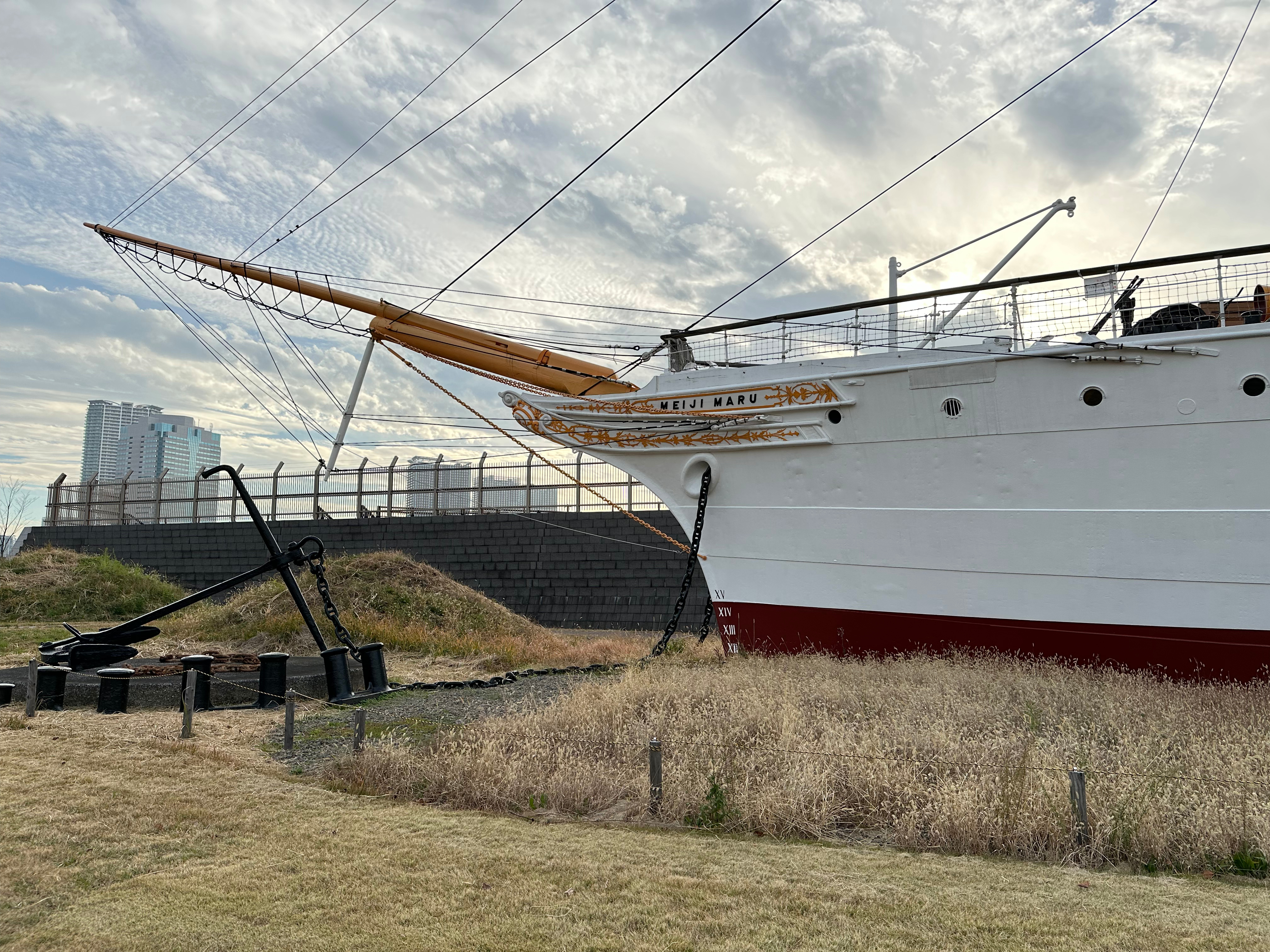
Every third Monday in July, Japan celebrates Marine Day. Beaches fill, harbors hang bunting, and the nation pauses to honor its relationship with the sea. The holiday traces back to a single voyage in 1876, when Emperor Meiji stepped off an iron-hulled ship in Yokohama Harbor after sailing from the northern reaches of his empire. That ship -- the Meiji Maru -- still exists. She sits on dry land at the Etchujima Campus of the Tokyo University of Marine Science and Technology, her masts rigged, her hull painted black, the oldest surviving iron ship in Japan and the only vessel ever designated an Important Cultural Property.
Iron from the Clyde
The Meiji Maru was built in 1873 at the shipyard of Robert Napier and Sons in Govan, on the banks of the River Clyde in what is now part of Glasgow, Scotland. Napier's yard was legendary -- it had built some of the first iron-hulled steamships and supplied engines to the Royal Navy. The Japanese government commissioned the vessel as a lighthouse tender, a specialized ship designed to service and supply the network of lighthouses being constructed along Japan's coastline as part of the Meiji era modernization. She was launched as a two-masted vessel with both sail and steam propulsion, a practical hybrid suited to the long coastlines and unpredictable weather of the Japanese archipelago. The ship sailed from Scotland to Japan, arriving in a country that was rapidly transforming itself from a feudal society into a modern industrial state.
The Emperor's Cabin
In 1876, Emperor Meiji chose the Meiji Maru for an inspection tour of northern Japan. The ship carried him from Aomori, on the northern tip of Honshu, across the Tsugaru Strait to Hakodate in Hokkaido, and then south along the Pacific coast to Yokohama. A specially decorated cabin was fitted for the emperor's exclusive use during the voyage. When the ship arrived in Yokohama on July 20, the event was significant enough that the date was later enshrined as a national holiday. Marine Day -- Umi no Hi -- originally fell on July 20 each year before being moved to the third Monday in July as part of Japan's Happy Monday system in 2003. The holiday celebrates Japan's identity as a maritime nation, and its origin lies in this single imperial voyage aboard a Scottish-built lighthouse tender.
From Service to Schoolship
After her years in the lighthouse service, the Meiji Maru was transferred in 1897 to the Tokyo Nautical School for use as a moored training ship. The following year, in 1898, she was re-rigged as a full-rigged ship by the Shomei Shipbuilding Company in Shinagawa, her original two-masted configuration replaced with a taller, more complex rig befitting a vessel used to teach cadets the art of seamanship. The Tokyo Nautical School eventually became part of the Tokyo University of Marine Science and Technology, and the ship remained on campus through each institutional transformation. Generations of Japanese merchant marine officers trained aboard her decks, learning the ropes -- literally -- on a ship that had once carried their emperor.
Preserved in Place
In 1964, the Meiji Maru was moved to permanent display at the university campus and preserved as a memorial. The decision recognized what time had quietly confirmed: this was no ordinary ship. An eight-year restoration beginning in 1980 was completed in 1988, returning the vessel to something close to her original appearance. In 1978, the Meiji Maru received designation as an Important Cultural Property, the only ship in Japan to hold the distinction. Today she sits on the Etchujima Campus in Koto Ward, her black hull and rigged masts rising above the campus grounds near the waterfront. The emperor's cabin remains aboard, preserved exactly as it was when Meiji himself sat inside. The ship is open to visitors, admission is free, and the campus integrates the vessel into the surrounding waterfront landscape. A ship built to tend lighthouses ended up becoming one herself -- a fixed beacon marking the point where Japan's maritime past meets its present.
From the Air
Located at 35.67°N, 139.79°E on the Etchujima Campus in Koto Ward, eastern Tokyo, near the waterfront along the Sumida River's mouth into Tokyo Bay. The ship is displayed on dry land but its masts may be faintly visible from low altitude among the campus buildings. The surrounding area is dense urban waterfront with canals, bridges, and port infrastructure. Tokyo Haneda International Airport (RJTT) lies approximately 8 nautical miles to the south-southwest. The campus sits near the junction of the Sumida River and Tokyo Bay, with Tsukishima and Tsukuda islands immediately to the west.