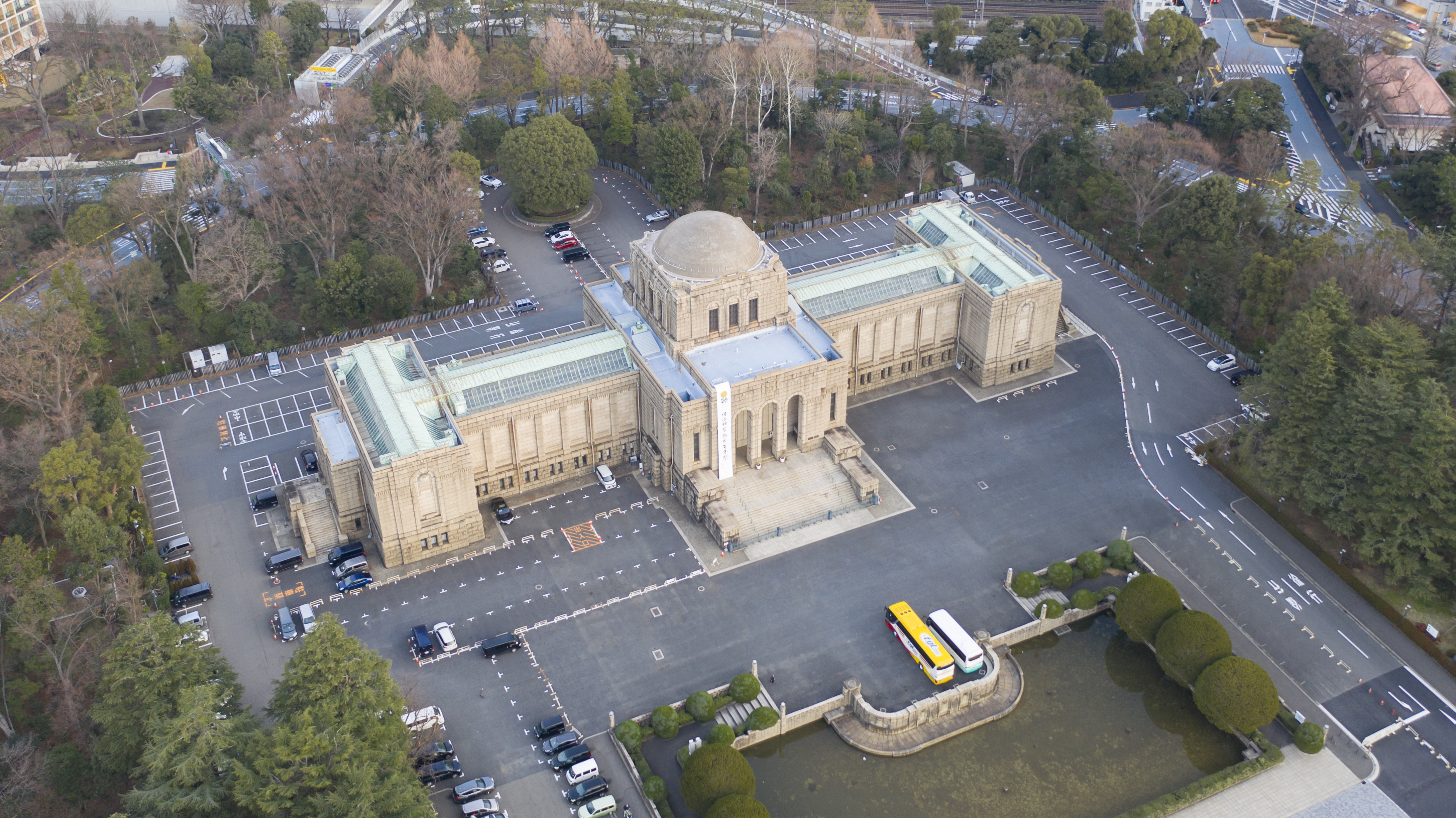
Meiji Memorial Picture Gallery
Eighty paintings hang in strict chronological order inside a marble-clad hall, and together they tell the story of a nation remaking itself. Half are rendered in the Japanese Nihonga tradition, half in Western Yoga technique, and the pairing is no accident. The Meiji Memorial Picture Gallery, completed in 1926 in Tokyo's Meiji Shrine outer garden, was designed as a monument not just to Emperor Meiji but to the very idea that Japan could hold two artistic worlds in equal regard. The building itself makes the same argument: a neoclassical facade of rusticated stone and engaged pilasters, designed by Kobayashi Masatsugu, who won a public competition against 156 other entries in 1918, housing paintings by some of Japan's most distinguished artists of the early twentieth century.
A Competition of 156 Designs
After Emperor Meiji's death in 1912, the Japanese government set about creating a permanent memorial on the site where his funeral was held, in the Gaien or outer precinct of Meiji Shrine. The gallery was conceived as something unprecedented: a building that would use painting to narrate the entire arc of the Meiji era, from the emperor's birth in 1852 through the Meiji Restoration and into the industrial transformation of Japan. In 1918, a public design competition drew 156 entries. Kobayashi Masatsugu's winning design called for a neoclassical structure measuring approximately 112 by 34 meters, crowned by a dome and flanked by two wings. Construction by Okura Doboku began in 1919, and the gallery opened on October 22, 1926, though the final paintings would not be completed and installed for another ten years.
Marble, Mosaic, and Natural Light
Step through the bronze doors and the scale shifts. The central hall rises beneath a shell dome, its walls clad in domestically sourced marble -- fifty-six percent from Mino-Akasaka in Gifu Prefecture, the rest drawn from quarries across Ehime, Fukushima, Gunma, Okayama, and Yamaguchi. A mosaic-tiled floor stretches underfoot. Stained glass windows filter light near the entrance. The painting galleries themselves are naturally lit from above, a design solution that the gallery's planners studied carefully, comparing their approach to the Galerie des Batailles at Versailles and the Galerie des Rubens at the Louvre. The architects chose restraint over ornament, letting the paintings command attention. In June 2011, the building was designated an Important Cultural Property for its excellence of design and superior construction techniques, particularly the engineering of the shell dome and the overhead lighting system.
Two Traditions, One Chronicle
The eighty paintings divide evenly: forty in Nihonga, the Japanese painting tradition that uses mineral pigments and silk or paper, and forty in Yoga, the Western oil-painting style that Japanese artists had only begun to master in the late nineteenth century. Each painting depicts a specific moment from Emperor Meiji's life and reign, arranged chronologically so that walking through the gallery is walking through Japan's most transformative decades. The selection and historical research behind each scene was overseen by Kaneko Kentaro, a statesman who also led the editorial boards of two monumental publishing projects: the Dai-Nihon Ishin Shiryo, documenting the Meiji Restoration across 4,215 volumes, and a companion work on the Meiji Emperor spanning 260 volumes. The dual-style approach was deliberate -- the gallery's planners wanted to demonstrate that Japan's artistic heritage and its embrace of Western techniques could coexist without one diminishing the other.
Before the Camera's Eye
The gallery exists partly because of a gap in the visual record. As scholar Donald Keene noted, pre-Meiji imperial portraiture stretching back to the Kamakura period reveals very little individuality, eschewing realism in favor of courtly elegance or Buddhist consecration. The earliest surviving photograph of Emperor Meiji was not taken until late 1871, at the Yokosuka Naval Yard. By that point, the emperor had already presided over the abolition of the feudal system and the opening of Japan to the world. The paintings in the gallery fill that visual silence, reconstructing scenes that no camera captured -- the young emperor's childhood, the dramatic political upheavals of the 1860s, the ceremonies and conferences that reshaped a nation. They are history paintings in the fullest sense, commissioned not merely to decorate but to document.
The Ginkgo Avenue and the View from Above
The gallery sits at the end of one of Tokyo's most photographed streetscapes: the Icho Namiki, a ginkgo-lined avenue that turns brilliant gold every November, drawing photographers and crowds from across the city. From the air, the gallery's symmetrical neoclassical form stands out clearly against the surrounding greenery of Meiji Jingu Gaien -- the sports fields, the baseball stadium, and the landscaped grounds that make up the outer shrine precinct. The building's long axis, its dome, and the formal approach along the ginkgo avenue create a geometric clarity that reads well even from altitude, a European-inspired composition dropped into the dense fabric of central Tokyo.
From the Air
Located at 35.679N, 139.718E in Shinjuku, central Tokyo. The gallery sits at the southern end of the famous ginkgo avenue in Meiji Jingu Gaien (outer garden), adjacent to the National Stadium and Meiji Jingu Baseball Stadium. The neoclassical building with its dome is visible from low altitude against the green expanse of the outer garden. Tokyo Haneda International Airport (RJTT) lies approximately 10 nautical miles to the south. Chofu Airport (RJTF) is roughly 12 nautical miles to the west. Best viewed at 2,000-3,000 feet AGL where the formal ginkgo avenue alignment leading to the gallery facade becomes apparent.