Meiji-mura: The Village That Rescued an Era
The idea struck on a commuter train. Architect Yoshiro Taniguchi was riding the Yamanote Line in Tokyo when he saw the Rokumeikan being torn down. The Rokumeikan -- the "Deer Cry Pavilion" -- had been one of the defining symbols of Meiji-era Japan, a Western-style social hall where the newly modernizing nation hosted foreign dignitaries in the 1880s. Watching it disappear into rubble, Taniguchi turned to his college classmate Motoo Tsuchikawa, then vice president of the Nagoya Railroad company, and the two men hatched a plan that would take the rest of their lives to realize. They would save Meiji-era buildings from the wrecking ball -- buy them, disassemble them, ship them, and rebuild them in a single place where they could survive. On July 16, 1962, they formed a foundation. On March 18, 1965, Meiji-mura opened on the rolling hills above Lake Iruka in Inuyama, Aichi Prefecture, with fifteen rescued buildings. Today there are sixty-seven.
Wright's Lobby Finds a Second Home
The crown jewel of Meiji-mura is not Japanese at all. Frank Lloyd Wright's Imperial Hotel opened in central Tokyo in 1923, just in time to survive the Great Kanto Earthquake that devastated the city that same year -- a fact that cemented its legend as an architectural marvel. But by 1967, the hotel's owners decided the building was too small for modern needs and demolished the main structure. The entrance hall and lobby were saved, disassembled into thousands of pieces, and shipped to Inuyama. The reconstruction began in 1970 and was not fully completed, interior details and all, until 1985. Walking through the reassembled lobby today, with its interlocking geometric patterns in Oya stone and brick, its low ceilings opening into dramatic vertical spaces, feels like entering a building that belongs nowhere and everywhere at once. It is the largest structure in the museum and its emotional centerpiece.
Sixty-Seven Buildings, Three Continents
Meiji-mura's collection spans far beyond Tokyo landmarks. The sixty-seven structures represent Japan's transformation from feudal isolation to industrial modernity during the Meiji (1868-1912), Taisho (1912-1926), and early Showa (1926-1945) periods. Eleven are designated Important Cultural Properties. There is a Japanese immigrants' assembly hall from Hilo, Hawaii, built in 1889. A Nikkei evangelical church from Seattle, Washington, dating to 1908. A residence from Registro, Brazil, built in 1919. These overseas buildings document the Japanese diaspora during the same era, adding a global dimension to the domestic architectural story. Back on Japanese soil, the collection includes the Shinagawa Lighthouse from Tokyo (1870), the Mie Prefectural Office from Tsu (1879), St. Francis Xavier Cathedral from Kyoto (1890), and the Cabinet Library of the Tokyo Imperial Palace (1911). An operational Meiji-era post office sits among them, still handling mail.
Steam and Steel on the Hillside
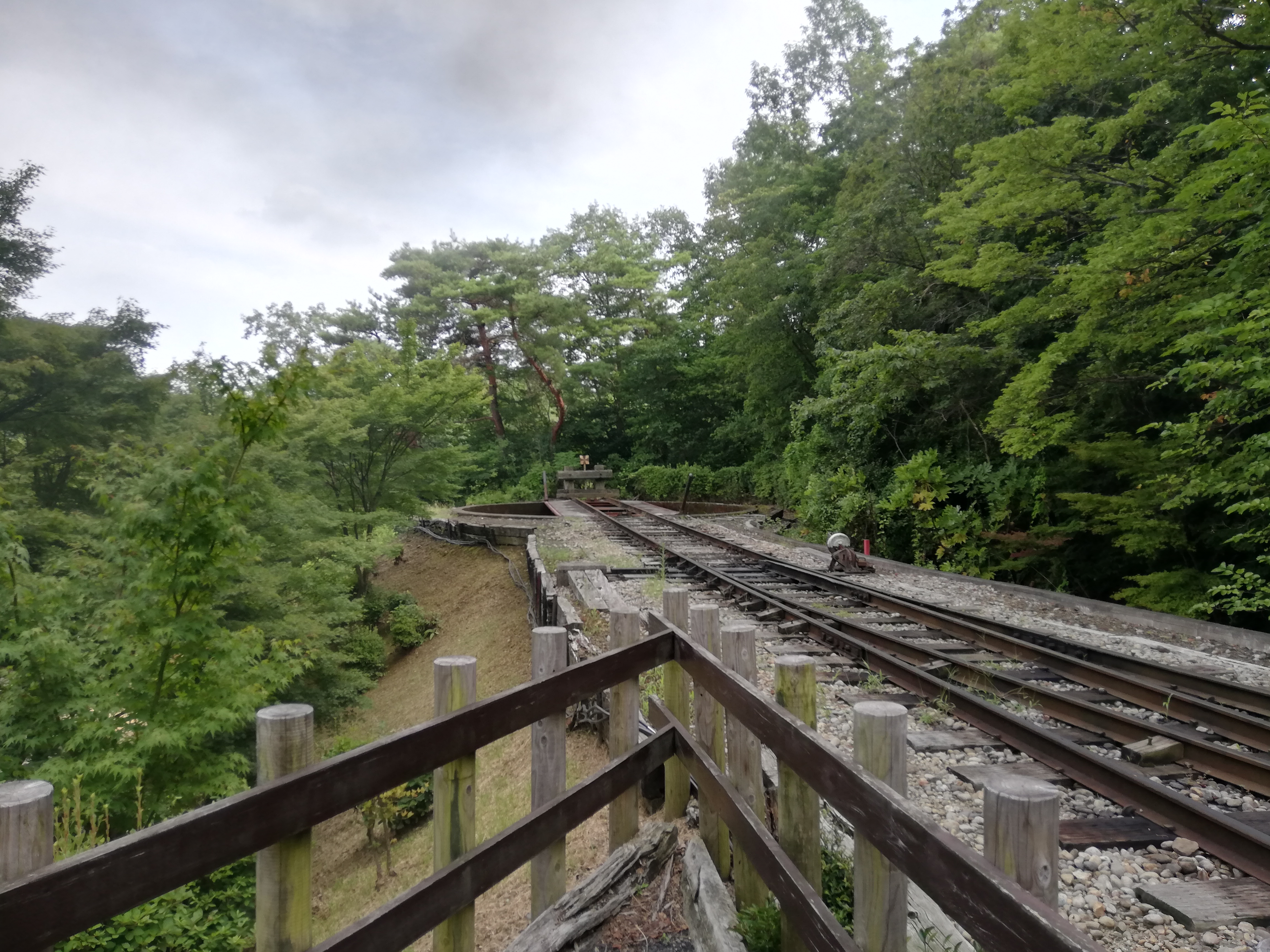
Two steam locomotives haul visitors along tracks winding through the museum grounds, pulling three Meiji-built carriages. Locomotive No. 12 is a JGR Class 160 imported from England in 1874, making it one of the oldest operational steam engines in Japan. Locomotive No. 9 arrived from the United States in 1913 and once ran on the Minobu Line. A vintage Kyoto streetcar adds to the period transportation, and horse-drawn carriages complete the picture. The museum sprawls across the hilly terrain along the shore of Lake Iruka, a reservoir created by damming the Iruka River. Shuttle buses supplement the historic vehicles, but the topography itself is part of the experience -- the buildings are scattered across different elevations, each appearing in its own clearing or along a wooded path, so that rounding a corner might reveal a Victorian-era barracks or a Meiji merchant house.
Preservation Against the Current
Meiji-mura's founders understood that Japan's impulse toward modernization -- the very impulse that created the buildings they were saving -- would also destroy them. Many structures in the collection were rescued from demolition during the post-World War II building boom, when Japan was again tearing down the old to build the new. The Tomatsu House, a traditional Nagoya merchant home built in 1901, survived the wartime bombing of Nagoya only to face postwar redevelopment; it was relocated to the museum in the 1970s. The Shibakawa Mataemon Residence, built in 1911 and severely damaged in the 1995 Kobe earthquake, was moved from Nishinomiya to Meiji-mura between 2005 and 2007. The museum is operated by a subsidiary of Nagoya Railroad, the same company whose co-founder helped dream it into existence. Famous Japanese actors have served as honorary village chiefs, beginning with Musei Tokugawa in 1965. The buildings keep arriving. The rescue continues.
From the Air
Located at 35.34N, 136.99E on the wooded hillsides along the southern shore of Lake Iruka reservoir in Inuyama, Aichi Prefecture. From altitude, the museum appears as a large expanse of parkland with scattered structures visible among trees along the lakeshore -- distinctly different from the surrounding agricultural and suburban land use. The lake itself is a prominent visual reference. Best viewed at 3,000-5,000 feet AGL for the overall layout. Nearest airport is Nagoya Airfield / Komaki (RJNA), approximately 8 nautical miles south. Chubu Centrair International Airport (RJGG) lies roughly 40 nautical miles to the south.