Meiji University Museum
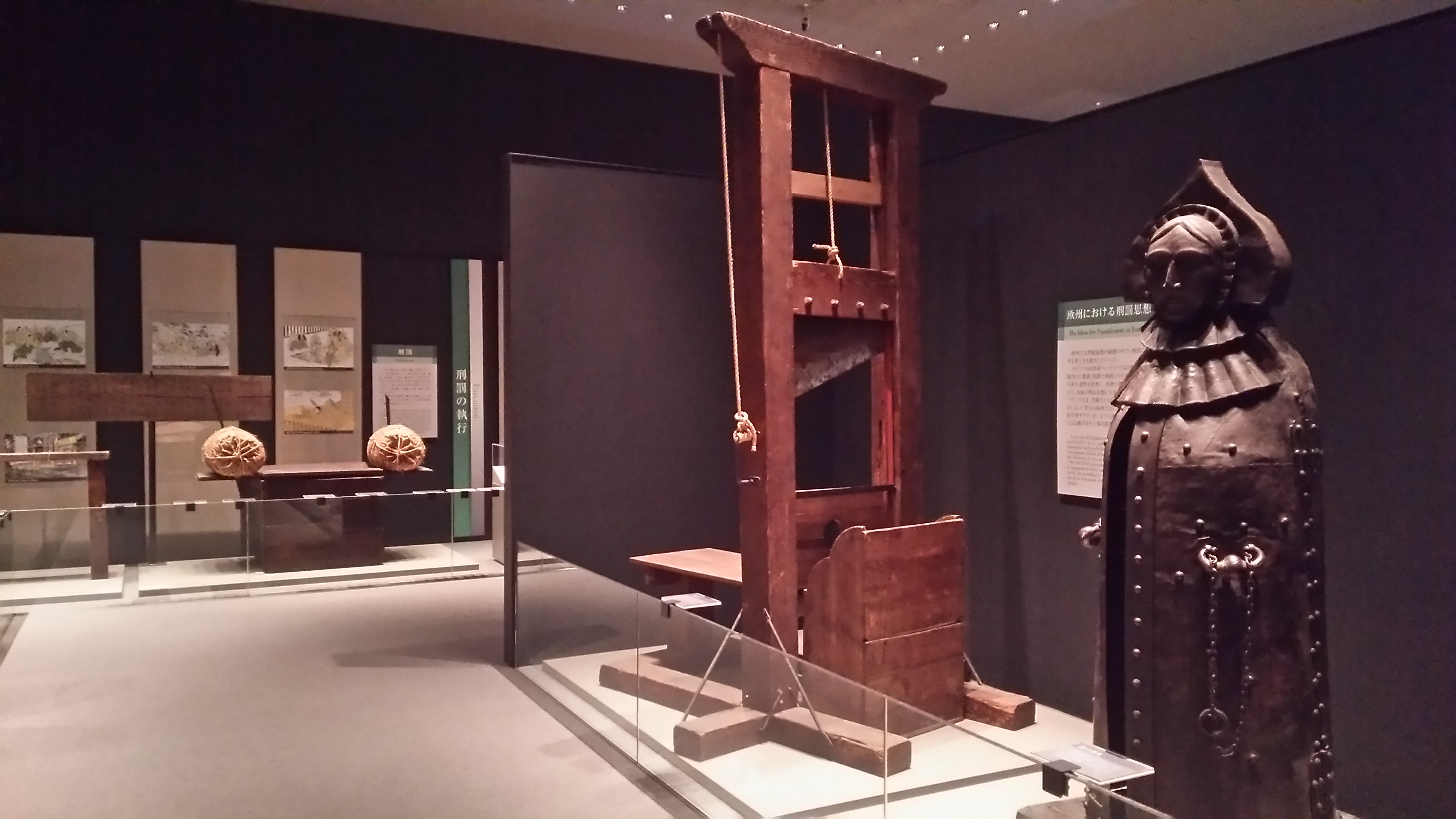
A guillotine blade hangs behind glass on the third floor of an unremarkable university building in Kanda-Surugadai, one of Tokyo's busiest student neighborhoods. Beside it sits an iron maiden, its spiked interior open for inspection. These are not replicas. The Meiji University Museum houses what may be the only iron maiden in Japan, displayed alongside Edo-period crucifixion posts and stone-pressing torture devices, in a collection that has been quietly unsettling visitors since 1929. That a university founded by three young lawyers in 1881 would build Japan's most disturbing museum of criminal justice feels less like irony and more like a statement about where the study of law begins: with the consequences of its absence.
The Cabinet of Punishments
The Crime Museum, known formally as the Criminal Materials Department, is the collection that draws the curious and the morbid alike. Established in 1929 in Meiji University's old Memorial Hall, the original exhibition was assembled by the School of Law as an educational resource about crime, punishment, and judicial process. It closed during the chaos of World War II but reopened in 1952 for the university's 70th anniversary, and was designated a museum-equivalent facility under Japan's Museum Act in 1954. The displays walk visitors through centuries of criminal justice, from Edo-period instruments used to apprehend suspects to the formalized cruelty of official punishment: haritsuke, the Japanese form of crucifixion; gokumon, the public display of severed heads; and ishidaki, in which heavy stones were placed on the knees of a kneeling prisoner. The French guillotine and the Iron Maiden of Nuremberg anchor the international section, drawing a stark line between Eastern and Western approaches to the same dark impulse.
Ten Thousand Years in the Basement
Below the instruments of punishment, the Archaeology Museum tells an entirely different story. Artifacts from the Sunagawa Site, the Natsushima Shell Mound, and the Izuruhara Site span the deep prehistory of the Japanese archipelago, from Jomon-period pottery to stone tools that predate written history by millennia. The collection grew out of Meiji University's archaeological fieldwork and was formally established in 1985, having evolved from an earlier gallery that opened in 1951. These quiet display cases, filled with chipped obsidian and fragments of ancient ceramics, offer a jarring contrast to the floor above. Where the Crime Museum shows what humans do to each other, the Archaeology Museum shows what humans built before the systems of law and punishment even existed.
The Merchant's Eye
The third pillar of the museum is the Commercial Goods Museum, operated by the School of Commerce. Originating as a Commercial Goods Gallery in 1951, it served as a teaching collection for students studying trade and manufacture. The displays catalog the material culture of Japanese commerce: textiles, ceramics, packaging, and the everyday objects that defined economic life across different eras. Renamed the Commercial Goods Museum in 2002, it was merged with the other two collections when Meiji University Museum opened in its current form in April 2004 at the Academy Common building. A University History Room completed the picture, adding a permanent exhibition on the institution's own journey from a small Meiji-era law school near Sukiyabashi Bridge to one of Tokyo's largest private universities.
Where Law Meets Memory
What makes the Meiji University Museum unusual is not any single artifact but the deliberate collision of its parts. Crime, commerce, and ancient civilization share a single building, and visitors move between them freely, admission free. The museum houses the office of the Museological Society of Japan and in 2009 hosted the first University Museum Meeting, drawing representatives from 37 university museums nationwide. Its permanent exhibition was renewed in March 2016. For a museum that began as a teaching tool for law students, it has become something broader: a place where the mechanisms of punishment sit alongside the products of trade and the relics of deep time, inviting visitors to consider how societies organize themselves, for better and for worse.
From the Air
Located at 35.699N, 139.762E in the Surugadai area of Chiyoda Ward, central Tokyo. The museum is inside the Meiji University Academy Common building near Ochanomizu Station. From the air, the campus sits between the Kanda River and the dense Jimbocho book district. Nearest airports: Tokyo Haneda (RJTT, 15 km south) and Tokyo Narita (RJAA, 60 km east). The area is densely built university and commercial terrain. No nearby general aviation fields; best appreciated as part of a broader flyover of central Tokyo's educational quarter.