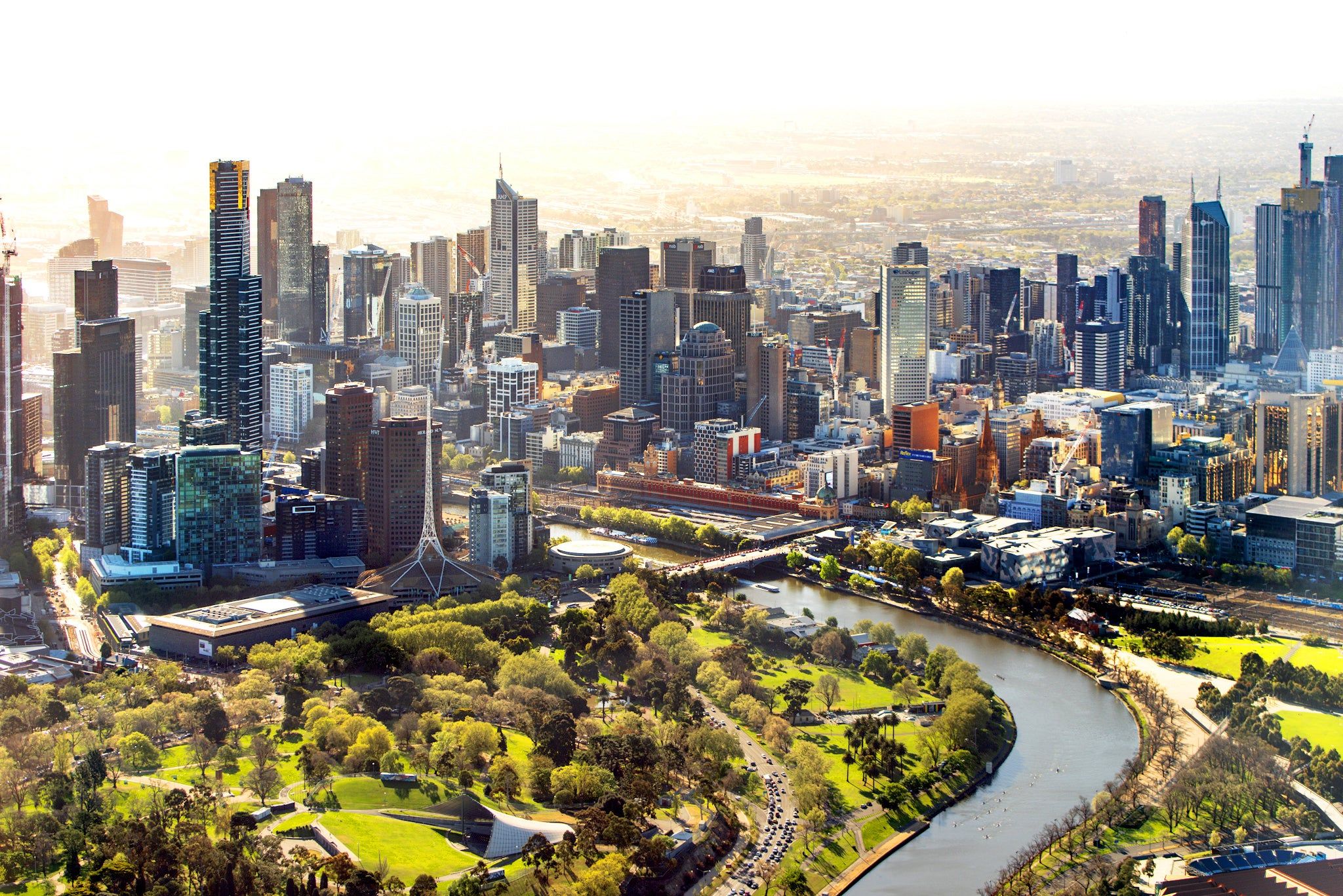
Melbourne
At its peak in the 1850s, some two tonnes of gold per week flowed into Melbourne's Treasury Building. The wealth extracted from the Victorian goldfields was so immense it paid off all of Britain's foreign debts and helped fund the empire's commercial expansion. Melbourne went from a muddy frontier settlement of 4,000 people in 1837 to a metropolis of 300,000 by 1854 - growth so explosive the city earned the nickname 'Marvellous Melbourne.' That gold-rush audacity never quite faded. Today's Melbourne, a city of 5.2 million, has transformed its narrow nineteenth-century service laneways into open-air galleries, turned coffee preparation into a competitive art form, and maintained its position as Australia's cultural capital through sheer force of personality. The Woiwurrung people called this place Naarm. What they'd make of its current obsession with single-origin beans and commissioned street murals is anyone's guess.
The City Gold Built
The architecture tells the story. Walk Collins Street and you're walking through money - not the glass towers of contemporary wealth but the stone palaces of Victorian confidence. Parliament House, the State Library, the Old Treasury, the Town Hall: each built to announce that Melbourne was no colonial outpost but a serious city demanding serious buildings. The architects - JJ Clark, Joseph Reed, Leonard Terry - brought Italian classicism to the antipodes, and locally quarried bluestone gave their visions a distinctly Melbourne character: stern, heavy, foreboding in the best possible way.
The Old Treasury Building, completed in 1862, once held gold bullion in its basement vaults. It's now a museum, but the Renaissance Revival facade still projects the same message it did 160 years ago: this place has substance. The gold rush may have lasted only decades, but the city it built was designed to last centuries. Between 1850 and 1900, Bendigo alone produced more gold than anywhere else in the world. The evidence stands in every elaborate cornice and cast-iron balcony.
The Laneway Labyrinth
In the nineteenth century, Melbourne's laneways were for deliveries - horse-drawn carts accessing the rear of buildings on the grand boulevards. They were utilitarian, invisible, ignored. Then something changed. Artists began painting the walls. Cafes claimed the narrow passages. What was hidden became the destination.
Hosier Lane is the famous one, every inch of brick covered in murals, stencils, and graffiti that changes faster than any guidebook can document. But the real Melbourne laneway experience is getting lost in Centre Place, Degraves Street, Union Lane - places where you might turn a corner and find an artist at work on a wall or stumble into a speakeasy bar whose entrance is disguised as a cabinet. The city council eventually stopped fighting the street art and started designating approved areas, essentially turning vandalism into policy. It's a very Melbourne solution: if you can't beat the chaos, curate it.
The Coffee Obsession
Melbourne doesn't drink coffee; Melbourne performs coffee. The flat white may have gone global, but here it's still art - espresso with steamed milk and microfoam prepared by baristas who compete for recognition the way athletes chase medals. The 'magic' is a local invention: double ristretto with steamed milk in a smaller cup than a flat white, a coffee for people who found the flat white insufficiently concentrated.
Patricia Coffee Brewers has no seating but lines out the door. Brother Baba Budan hangs chairs from the ceiling and serves single-origin beans to devotees who debate extraction times. The cafe culture isn't transplanted from Vienna or Paris; it grew from Melbourne's post-war Italian migration and evolved into something distinct - less formal, more obsessive, convinced that the difference between a good coffee and a great one matters. Whether this is admirable dedication or collective mania depends on your tolerance for conversations about grind size.
The Sporting Obsession
Melburnians - and yes, that's what they call themselves, pronounced as if the city's name has two syllables not three - are sports-mad in ways that perplex outsiders. Australian Rules Football is a religion here, invented in Melbourne in 1858 and still played at the Melbourne Cricket Ground before crowds of 100,000. The MCG has hosted two Olympics, countless cricket Tests, and the annual AFL Grand Final that effectively shuts down the city.
But it's not just football. The Australian Open brings tennis to Melbourne Park every January. The Melbourne Cup horse race, held the first Tuesday in November, stops the nation - literally, as Victoria gets a public holiday while the rest of Australia finds excuses to watch. The Spring Racing Carnival turns fashion into sport and sport into spectacle. There's something almost Victorian about this dedication to organized competition, as if the gold rush energy needed somewhere to go once the gold ran out. It went into watching people chase balls.
The Rivalry That Defines
No understanding of Melbourne is complete without understanding its relationship with Sydney - a sibling rivalry that shapes both cities' identities. Sydney has the harbour and the Opera House; Melbourne has culture and coffee. Sydney is flash and beaches; Melbourne is substance and laneways. Sydneysiders think Melburnians are pretentious; Melburnians think Sydney lacks depth. Both cities spend more time thinking about each other than they'd ever admit.
Melbourne was briefly Australia's capital, from Federation in 1901 until Canberra was purpose-built to end the argument in 1927. The sense of stolen birthright never quite faded. Melbourne consoles itself with arts festivals, literary prizes, independent music scenes, and restaurants that chase innovation rather than views. Whether Melbourne is actually Australia's cultural capital or just says so more often is a question best asked outside earshot of either city. What's undeniable is that the rivalry has pushed both to be better - Melbourne's laneways, its coffee scene, its obsessive self-improvement all responses to Sydney's effortless good looks.
From the Air
Melbourne (37.81°S, 144.96°E) sits at the head of Port Phillip Bay in southeastern Australia, approximately 900km southwest of Sydney. The city's grid layout is clearly visible from above, with the Yarra River winding through the center and the distinctive rectangular pattern of the CBD surrounded by expansive parkland. Melbourne Airport (YMML/MEL) lies 23km northwest of the CBD with four runways (the main 34/16 at 3,657m). Avalon Airport (YMAV) 55km southwest serves budget carriers. From altitude, identify the MCG's oval shape east of the city, the Royal Botanic Gardens' green expanse, and the geometric precision of Victorian-era street planning. Port Phillip Bay extends 1,930 sq km to the south - one of the world's largest landlocked bays. The Dandenong Ranges rise to the east, visible on clear days. Weather can be famously changeable - 'four seasons in one day' is a local cliche with meteorological truth. Sea breezes develop afternoon in summer; fog can affect winter mornings. The Great Ocean Road begins 100km southwest - visible from altitude as the coastline curves westward past dramatic cliff formations.