Melle, Germany
In 1972, German bureaucrats did something quietly remarkable to a quiet corner of Lower Saxony: they merged fifty-six separate municipalities into a single city and called the result Melle. Today, that act of cartographic ambition still ranks Melle as the third largest city in Lower Saxony by surface area, even though most of that surface is field, forest, and farmland rather than streetscape. The result is a place that feels less like a city and more like a federation of villages held together by the long green valley between two hill ranges.
The Valley Between Two Forests
Geography wrote Melle's story before politics did. The Wiehen Hills rise to the north, the Teutoburg Forest to the south, and the town settled in the low corridor between them - the same corridor that has funneled traders, armies, and railways across northern Germany for centuries. Osnabrück lies about thirty kilometers west, Bielefeld about thirty kilometers east, and Melle sits in the middle like a comma in a long sentence. The eight constituent municipalities - Melle-Mitte, Buer, Bruchmühlen, Gesmold, Neuenkirchen, Oldendorf, Riemsloh and Wellingholzhausen - each kept their old half-timbered cores when the merger came through, so the city today is read in plural rather than singular.
From Wigbold to Prussia
Melle's documented history begins in 1169, but the moment that mattered came in 1443, when Heinrich von Moers, the Bishop of Osnabrück, granted Melle the privilege of a Wigbold - a kind of half-town status that gave the settlement market rights without quite making it a city. Through the Westphalian arm of the Hanseatic League, Osnabrück looked after Melle's commercial interests abroad, the way a larger sibling might shepherd a younger one through a crowd. Then came the dynastic shuffles that defined northern Germany. Melle belonged to the Kingdom of Hanover until 1866, when the Austro-Prussian War redrew the map and the town found itself, almost overnight, a Prussian possession.
The Girl Who Wrote in Portuguese
Of all the names on Melle's roster of notable residents, the most unexpected belongs to Ilse Losa. Born in 1913 in Buer, one of the villages now stitched into Melle, she came of age as a German-Jewish girl in a country preparing to murder people like her. She fled. She landed in Portugal, learned the language as an adult, and went on to become one of the most beloved writers in twentieth-century Portuguese literature - a children's author, a translator, a voice that brought German writers like Bertolt Brecht into Portuguese homes. She died in 2006, having written most of her life in a language she had not been born to. A village in the Lower Saxon countryside produced a Lusophone literary treasure, and almost no one outside Portugal knows where she started.
Furniture, Clocks, and Carillons
Throughout the nineteenth and twentieth centuries, Melle made its living from wood. The Meller Möbelfabrik anchored the local economy from 1870, and a clock factory called Turmuhrfabrik Ed. Korfhage & Söhne in the Melle/Buer district supplied tower clocks across Germany - including the carillon that still rings from the Melle town hall. When the furniture industry collapsed in the 1970s and 1980s, the city diversified into machine-building and food processing, but the old industrial bones remained. Walk past the listed brick factory on Oldendorfer Straße today and the Neo-Renaissance facade from 1904 looks essentially as it did when it was built - a Wilhelmine confidence frozen in clinker brick.
Twelve Twins and a Friendly American
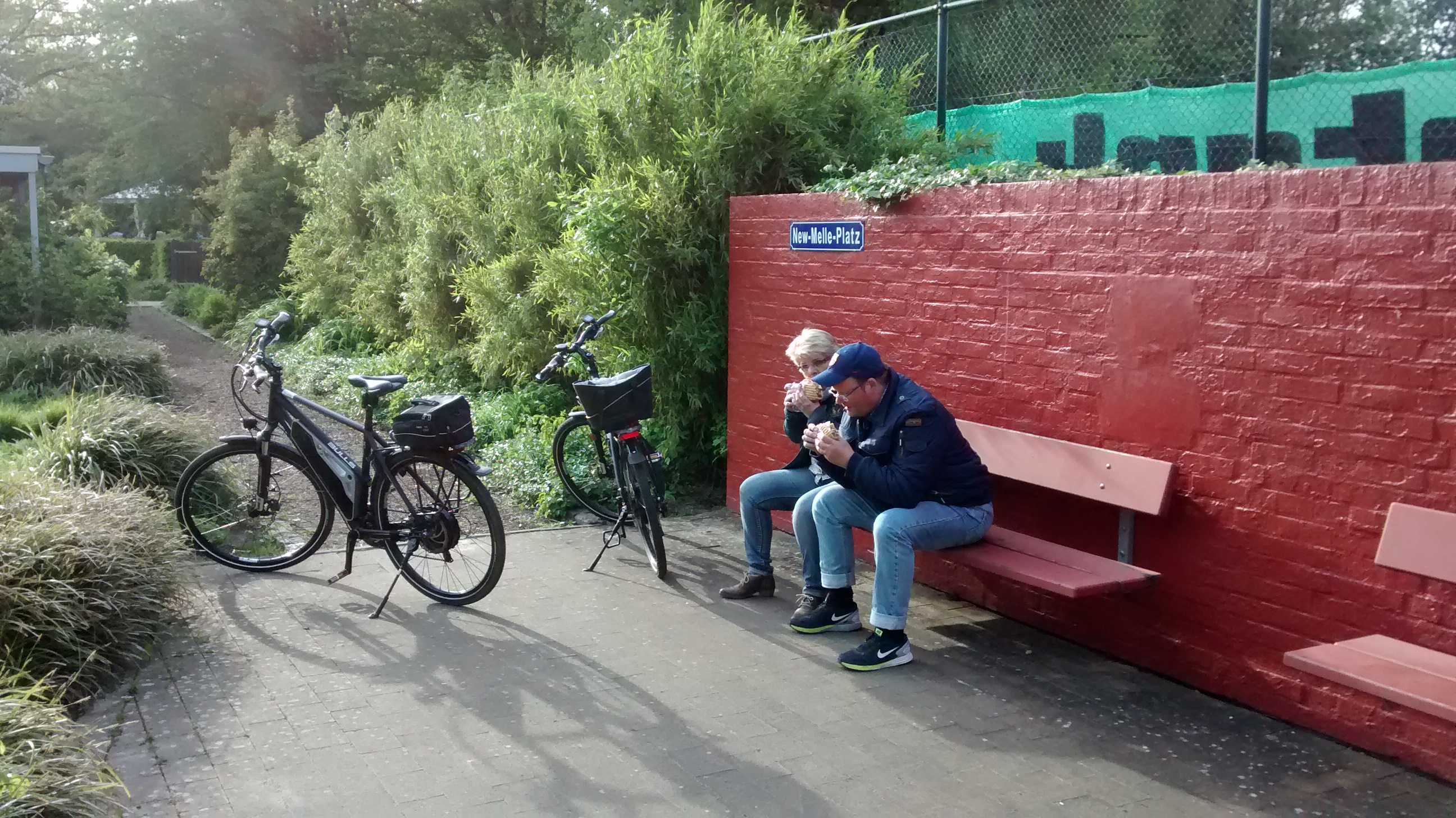
Few German cities of Melle's size carry as long a sister-city list. Twelve formal partnerships stretch from Niğde in Turkey to Torzhok in Russia, from Ghent and Eke in Belgium to Cires-lès-Mello in France, with Latvia, Switzerland, and Berlin thrown in. There is even a Melle in Belgium and a Melle in France, each a twin of the original. Across the Atlantic, the connection turns sentimental: New Melle, Missouri, founded by emigrants in the 1840s, keeps a friendly informal relationship with the mother town. The valley empties, the valley fills, and somewhere in the American Midwest a small town named for this stretch of Lower Saxony still answers when called.
From the Air
Located at 52.20°N, 8.34°E, in the long valley between the Wiehen Hills (north) and the Teutoburg Forest (south). The nearest major airport is Münster Osnabrück (ICAO: EDDG) roughly 60 km southwest. Hannover Airport (EDDV) lies about 100 km east, and Bremen (EDDW) 110 km north. Best viewed at 4,000-6,000 ft on clear days, when the parallel hill ridges and the Mittellandkanal to the north stand out clearly. The A30 motorway threads east-west across the city.