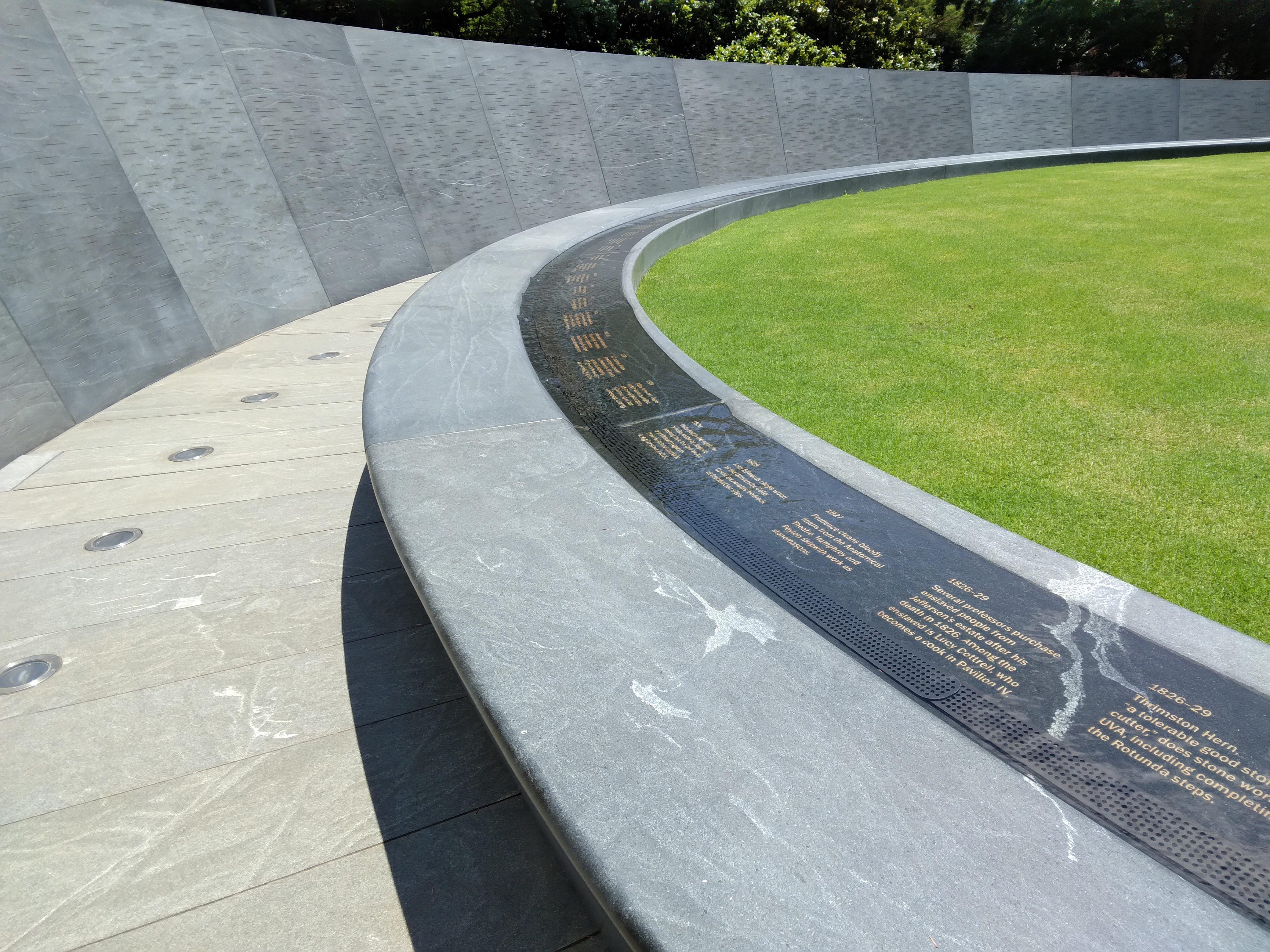
Memorial to Enslaved Laborers
The ring is broken on purpose. Carved from local Virginia Mist granite on the grounds of the University of Virginia, the Memorial to Enslaved Laborers takes the shape of shattered shackles -- a circle deliberately left incomplete, roughly the same diameter as Jefferson's Rotunda just uphill. One structure celebrated the Enlightenment ideals of its founder. The other, dedicated nearly two centuries later, forces a reckoning with the human cost of those ideals. Inside the broken ring, the names of more than 4,000 enslaved individuals are inscribed in stone, many recovered through years of painstaking archival research. Some entries carry only a first name. Some carry only a skill -- bricklayer, cook, carpenter. Some carry nothing but the word "unknown."
Eyes That Watch From Stone
On the exterior of the outer wall, a subtle pair of engraved eyes gazes outward. They belong to Isabella Gibbons, an enslaved woman owned by university professors before emancipation. After the Civil War, Gibbons became an educator of freed African Americans in Charlottesville, turning the tools of learning that had been denied to her into instruments of liberation for others. Her words are inscribed on the memorial itself, a voice finally given permanence on the campus where she once labored in silence. The eyes were created by artist Eto Otitigbe, derived from a historical image of Gibbons, and they lend the monument an unsettling presence -- as though the enslaved dead are watching to see what the university does with the truth it has finally acknowledged.
Aligned With Freedom
The memorial's designers embedded meaning into its very orientation. One path extending from the ring points toward the North Star, the celestial beacon that guided enslaved people fleeing north toward freedom. A second path aligns with the sunset on March 3, the date in 1865 when Union troops arrived in Charlottesville and emancipated the local enslaved community. That date is now observed as Liberation and Freedom Day, with an annual march through the city and across university grounds. A grove of ginkgo trees surrounds the memorial, a deliberate echo of the productive landscape of fruits and vegetables that enslaved laborers once tended on this same soil. The architecture firm Howeler+Yoon, landscape architect Gregg Bleam, mediator Frank Dukes, and artist Eto Otitigbe collaborated on the design, which the University's Board of Visitors approved in 2019.
From Student Activism to Stone
The memorial did not emerge from administrative goodwill alone. Student-led initiatives beginning as early as 2010 pushed the university to confront its entanglement with slavery. The President's Commission on Slavery and the University provided guidance as the project evolved through an ideas competition and years of design refinement. Construction began in January 2019, and the granite slabs were set in place by October. The formal dedication was planned for April 11, 2020, but the coronavirus pandemic shuttered the campus before the ceremony could take place. Funding came from private donations -- $2.5 million matched by the university according to one account, with another source estimating total costs around $6 million covered entirely by donors. The memorial stands today not as a finished gesture but as an ongoing commitment: if more names are discovered through research, they will be added to the stone.
Charlottesville's Unfinished Reckoning
The Memorial to Enslaved Laborers sits within a broader landscape of contested memory in Charlottesville. The city has grappled publicly with its relationship to Confederate iconography and racial history, a struggle that intensified after the Unite the Right rally in 2017. The memorial represents a different approach to that reckoning -- not removing symbols but adding them, insisting that the full story be told on the grounds where it unfolded. The University of Virginia, founded by Thomas Jefferson in 1819, was built and maintained by enslaved laborers who quarried stone, fired bricks, and constructed the very buildings now revered as architectural masterpieces. The broken ring does not let visitors forget this. It stands east of Brooks Hall and the Rotunda, a permanent counterpoint to the neoclassical beauty above -- beautiful itself, but in a way that aches.
From the Air
Located at 38.035N, 78.502W on the University of Virginia campus in Charlottesville, Virginia. The memorial sits east of the Rotunda, Jefferson's iconic domed building visible from altitude. Nearest airports: Charlottesville-Albemarle Airport (KCHO), approximately 8nm north. Shenandoah Valley Regional (KSHD) is about 25nm west across the Blue Ridge. The UVA grounds and surrounding Charlottesville are nestled in the foothills east of the Blue Ridge Mountains. Best viewed at 2,000-3,000 ft AGL; look for the distinctive serpentine walls and Lawn area of UVA's campus.